US Media Fails to Educate The Public About Links Between Greater Natural Gas Use and Climate Change

methaneleakageThe New York Times and the Wall Street Journal  today reported on a new study by the University of Texas that found leakage rates of methane from natural gas fracking operations are lower than previously stated by US EPA. This report found that direct measurements of methane emissions from  190 onshore natural gas sites in the United States indicate that methane emissions from completed wells are are  lower than commonly thought although the report also acknowledged that emissions from pneumatic controllers and other equipment associated with natural gas production facilities were higher than previously estimated.

The report also concluded that taking into account the lower emissions from completed wells and the higher emissions from other equipment, actual methane emissions are most likely 20% lower than previously estimated.

This report has created a large buzz on the internet because at issue is whether natural gas is a bridge fuel to lower the threat of climate change. If the methane leakage rate is less than 3.6%, then it is widely assumed that natural gas is better than coal.  That is, if leakage levels are below this level it is generally assumed that switching to natural gas lowers the US carbon footprint and therefore greater natural gas production should be supported by citizens concerned about climate change. As a result the methane leakage rate issue has gathered enormous interest in climate change policy discussions.. Studies of methane leakage rates have reached widely different conclusions about actual leakage rates in part because different studies have used different: measurement methodologies, types of wells measured, portions of the the entire natural gas production process, and assumptions about leakage in the gas distribution process. The recent University of Texas study acknowledges that there are elements of the natural gas production to consumption cycle that were not fully considered.  And so, it is likely that scientific conclusions about methane leakage rates will continue to change from study to study in the next few years.

Because natural gas may produce less CO2 equivalent per unit of energy produced, natural gas companies are pushing natural gas as at least a short- to medium-term solution to climate change

Yet, as we have written about before, there is one extraordinary important issue about the link between natural gas production and climate change that is rarely being reported on in the US press nor is it usually part of the US debate about natural gas fracking and its impact on climate change.

The methane leakage debate usually assumes if the methane leakage rate is low enough, switching from coal to natural gas as fuel should be welcomed by proponents of action on climate change. Yet what is notably missing in the media discussion of this issue is the urgency of moving to non-fossil fuels or energy technologies that produce very, very low carbon emissions to give the world any hope of prevent catastrophic climate change.

We explained the  urgency of moving quickly to non-fossil energy in considerable detail in the recent entry on this website in  Ethical Issues with Relying on Natural Gas as a Solution  to Climate Change

Even if natural gas combustion creates approaching 50 percent less CO2 equivalent per unit of energy produced, an amount which is well beyond best case on ghg emission reductions,  it will not create the much greater emissions reductions necessary in the next 30 years to give any hope of  limiting warming from exceeding levels that will cause catastrophic impacts.  In short, natural gas combustion can’t produce the the emissions reductions that are needed just a few decades to put the world on a safe ghg emissions pathway.  Also investment in natural gas facilities may delay the needed rapid switch to non-fossil fuels. Although natural gas switching might help reduce the threat of climate change threat if  methane leakage rates are at the lower end of the range discussed  in the scientific literature in the very short term, the world needs massive investment in non-fossil technology as soon as possible.

In addition if coal combustion were to be replaced now by non-fossil fuel energy, it would help immediately much more than conversion of coal to natural gas combustion does in putting the world on an urgently needed ghg emissions reduction pathway needed to prevent catastrophic warming.

nw book advIn addition, large investments in natural gas combustion facilities will likely make it harder to switch to non-fossil energy because these investors will likely demand a return on their investment in the natural gas plants before they are shut down.

Large investment in cheaper natural gas may also increase energy demand to levels that result in greater total releases of ghgs even assuming that natural gas produces less CO2 equivalent on a BTU basis than coal.

It is simply irresponsible for the US media to report on the methane leakage issue without explaining the urgency of moving to non-fossil energy.

Of great concern, some natural gas companies are on the one hand claiming that natural gas is better for the climate change while they fight legislation to increase the US share of renewable energy.  A strong ethical case can be made that any political support for natural gas as a short-term bridge fuel  should be conditioned on the natural gas industry promising to stop lobbying against rapid scale up of renewable energy programs.

By:

Donald A. Brown

Scholar In Residence, Sustainability Ethics and Law,
Widener University School of Law
Visiting Professor, Nogoya University, Nogoya. Japan

dabrown57@gmail.com


New York Times Article Misleads On The Moral Acceptability of Climate Change Policies.

cost-bene

money burrning

Many observers of the state of global response to climate change have concluded that there is no hope in preventing devastating climate change harms unless nations and individuals understand that they have ethical and moral responsibilities that are not captured by framing climate change as a matter of economic interest or welfare maximization alone not to mention that framing climate change policies as matters of economic interest distorts and ignores ethical responsibilities. For this reason, there is a growing consensus among serious observers of national commitments on climate change, that the only hope to increase national ghg emissions emissions reductions targets to levels that will avoid dangerous climate change impacts is to find ways to assure that national ghg targets are based upon “equity” and justice.


A New York Times article on September 11, 2013 makes a greatly misleading claim about the moral basis for action on climate change.  The article, Counting the Cost of Fixing the Future, by Edwardo Porter,  erroneously claims that a moralist would respond to climate change by demanding that the price on carbon be significantly higher than what the business world would recommend the price should be ($65.00/ ton versus  $13.50 /ton).  Although the article doesn’t say explicitly that that if the social cost of carbon is high enough there are no moral objections to using welfare maximization considerations as the basis for determining the acceptability of climate change policies, this is implied by the article because the use of the social  cost of capital  calculations  by policy-makers is almost always used in cost-benefit analyses. The problem with this claim is that there is an unexamined premise in this article that is deeply ethically flawed. The article assumes that whether a government should act to prevent climate change depends upon whether a proposed government climate change policy will increase welfare after the social cost of carbon is calculated and compared to the costs entailed by reducing greenhouse gas (ghg) emissions.  There are strong strong moral and ethical reasons against using the social cost of carbon in this way.

new book description for website-1_01Whether a nation or individual should act to prevent climate change is a matter of justice, not simply a matter of economic efficiency or welfare maximization. Although some utilitarians might agree that government policy should maximize welfare or utility, there are  strong ethical objections to a nation basing its climate policy on the basis of welfare maximization alone.  Moral problems with the use of the social cost of carbon calculations in cost-benefit determinations used to determine whether a government should act to reduce the threat of climate change include the following:

  • Some governments and individuals more than others are more responsible for climate change because they have much higher emissions of ghg in total tons, per capita levels, and historical contributions to elevated atmospheric concentrations.  Justice requires that these considerations be taken into account in determining emissions reductions targets. 
  • Some of the poorest people in the world who have done almost nothing to cause climate change are the most vulnerable to climate change. These people will suffer the most if  governments and individuals refuse to reduce their emissions based upon “efficiency” or “welfare maximization” considerations. These people have not consented to be harmed because costs to polluters of reducing their emissions are high. “Efficiency” and “welfare maximization” justifications unjustly sacrifice vulnerable people to the economic prosperity of the entire community.
  • The harms to vulnerable people from climate change are not mere reductions in economic welfare, they include catastrophic loses to life and damages to ecological systems on which life depends.
  • Damage estimates on which the social cost of carbon are based are not evenly distributed. Some places more than others face catastrophic risk. People in these places have not consented to be harmed. Theories of procedural and distributive justice prevent these people from being harmed without their consent.
  • Climate change will interfere with the enjoyment of human rights. Those who violate the human rights of others may not use “efficiency” or “welfare maximization” justifications for violating the human rights of others.
  • Nations and individuals have ethical and moral duties to reduce the threat of climate change, not simply economic interests.

These are only a few of the ethical and moral problems with the use of social cost of carbon calculations in cost-benefit analysis as justification for non-action on climate change.  For additional ethical problems with economic arguments made about the acceptability of climate change policies see articles on this website under the category Economics and Climate Change Ethics in the Index. 

The New York Times article makes a claim about what moralists would do which is very misleading because it implies that as long as the calculation of the social cost of carbon is high enough, there are no moral objections with  the use of  welfare maximization calculations as the basis of climate change policy.

The New York Times article should have acknowledged that there are ethical objections to a nation basing its climate policies on cost-benefit analyses.  One of the reasons why there has been a widespread  failure of citizens to understand their ethical responsibilities to reduce the threat of climate change is because free-market fundamentalist ideologies have successfully framed the climate change debate as a matter of economic interest rather then global responsibility. The New York Times article implicitly continues to encourage people to look at climate change policies as a matter of economic self-interest rather than ethical obligation. This both distorts and hides obvious ethical problems with national and individual responses to climate change.


By: 

Donald A. Brown

Scholar In Residence

Widener University School of Law

dabrown57@gmail.com


IPCC’s New Report: Does It Make any Ethical Difference that Confidence Levels About Human Causation Have Increased?

ipcc_altlogo_full_rgb


The New York Times reported on August 19 that the Intergovernmental Panel on Climate Change (IPCC) will soon issue its 5th assessment report that will  state that the scientific consensus that humans are causing climate change has increased from a 90% probability in 2007 to a 95% probability in the new report.  This new report, according to the New York Times, will assert that expected warming in this century will lead to wide-spread melting of land ice, extreme heat waves, difficulty growing food and massive changes in plant and animal life, probably including a wave of extinctions.  Yet such predictions about climate change’s impacts have been made for well over thirty years.

One might ask whether the change in confidence levels from 90% to 95% makes a difference as a matter of ethics.  We believe it does not because those causing climate change have had clear ethical duties to reduce the threat of climate change once they were put on notice that their actions were likely putting others at great risk. This is information that was widely available three decades ago. Ethical duties to not create harm begin once someone is put on notice that their behavior is likely to cause great harm particularly in regard to actions about which:

  • Waiting to take action will make the problem worse;
  • Delays will make it much harder to prevent catastrophic impacts;
  • Those who are most at risk have not consented to be placed at further risk;
  • The harms from the dangerous behavior are not mere inconveniences but potentially catastrophic destruction of life and ecological system on which life depends;
  •  Much of the science on which the projections of catastrophic harms is based is not controversial and has been well established for many decades;
  •  The vast majority of the scientists that do peer-reviewed science on climate change support the conclusion that humans are likely changing the Earth’s climate in ways that will create great harms for the most vulnerable people on the planet.

new book description for website-1_01Under these circumstances, one does not need complete certainty before ethical obligations to do no harm are triggered. Once someone is put on notice that his or her behavior is greatly dangerous, they have a duty to stop the dangerous behavior. This duty is particularly strong when the harms are potentially great as they are in the case of climate change. This ethical duty to cease dangerous behavior is widely recognized in criminal codes around  the world that make many kinds of dangerous behavior criminal. In the United States, for instance, reckless driving and reckless endangerment are criminal violations. (For more on ethics and uncertainty see, On Confusing Two Roles of Science and Their Relation to Ethics.)

Some economists will argue that a change from 90% to 95% confidence levels is ethically relevant when calculating expected utility from climate change policies when cost-benefit analyses of policies are applied to climate change policies. Yet, as we have explained in many articles on this subject, cost-benefit analysis is a deeply ethically problematic policy tool for climate change. Its use seeks to find polices which maximizes utility while ignoring questions of distributive justice, ethical obligations based upon duties to prevent harm, human rights violations, procedural justice considerations that would give victims of harms rights to participate in decisions that impose risks,  and many other ethical issues. (See, Ethical Issues Entailed By Economic Arguments Against Climate Change Policies.)

We do not deny that higher levels of confidence that activities are harming others strengthen the ethical duty to take action, however the duty to reduce ghg emissions has existed since the scientific community has been describing the threats of climate change three decades ago.

Insistence on absolute certainty before governments intervene in markets on climate change has been a tactic of the climate change disinformation campaign on climate change for several decades. As a matter of ethics high-emitting nations and individuals have had clear ethical duties to reduce ghg emissions to their fair share of safe global emissions for over thirty years.


By:

Donald A. Brown

Scholar In Residence, Sustainability Ethics and Law

Professor

Widener University School of Law

Visting Professor, Nagoya University, Nogoya, Japan

dabrown57@gmail.com


“What Is Wrong Climate Politics And How to Fix It” A Review of a New Book By Paul Harris


9922_whats_wrong_with_climate_politics_paul_g_harris

Given the strength of the scientific evidence that the world is rapidly heading to a climate catastrophe, it is vitally important to ask what has gone so terribly wrong with the world’s political response to climate change.  Understanding the cause of the utterly irresponsible and tragic political inaction on climate change provides some hope for changing course.

A a new well-written book by Paul Harris, What is Wrong with Climate Politics and How to Fix It, examines the failure of the global community to reduce the civilization challenging threat of human-induced warming. This book is an excellent, easily understood review of the sorry status of international cooperation to find a global solution to climate change. The book is valuable for its contribution to the growing literature on climate change policy particularly in regard to its clear description of the sorry history of international climate negotiations.

The main thesis of the book is that the  international focus in these negotiations on the obligations of nation states, rather than on individual responsibility, is a major cause of  what has gone wrong.

The book makes a compelling case that the almost exclusive national focus of climate change negotiations is problematic for two reasons.

First, nations have historically always engaged in international problems from the standpoint of national interest rather than global obligations.

Second, from the initiation of the climate negotiations, the international community has assumed that national responsibility will be apportioned largely according to two broad categories, namely developed and developing countries.  This categorization is problematic because this classification into these two categories arguably made some limited sense when the United Nations Framework Convention on Climate Change was opened for ratification in 1992, but it doesn’t now given that some of the countries that were initially classified as developing countries, including India and China, are quickly emerging as the among the largest emitters of greenhouse gases (ghg).

In addition, in almost all developing countries there is a growing middle and affluent class of high consumers. If developing nations understand that they have no responsibility to curb high consumption of their affluent citizens in regard to ghg, there is absolutely no hope for reducing global emissions  to levels necessary to prevent catastrophic warming.

In addition, if high emitting consumers in developing nations assume that the duty to reduce ghg emissions is solely a national obligation, not a personal one, they will more likely continue to emit ghgs at high levels without being haunted by ethical or moral failure.

And so, Harris compellingly explains why a reliance on national responsibility alone in the global search for an adequate response to climate change will likely guarantee continuing international failure to reduce the enormous threat of climate change.

The book also reviews in some detail the mostly dysfunctional role that the United States and China have played in international negotiations for over two decades while at the same time describing the centrality of these two countries in maintaining hope for a global climate change solution.

Harris also provides strategies for changing the world’s response to climate change so that citizens around the world understand that they have individual responsibility.

The first recommendation is to expand the use of a “human-rights” approach to policies on climate change. Implicit in this strategy is the idea that if individuals understand that they are responsible for human rights violations, they may take their obligations to reduce their gig emissions more seriously.

There is little doubt that climate change is already preventing many people around the world from enjoying a host of human rights, a phenomenon that is sure to grow in the years ahead.  Furthermore there are several practical reasons why an increased emphasis on human rights has considerable potential utility for improving the international response to  climate change.

One is that a greater understanding of climate change as  a human rights problem should lead to more widespread rejection of many justifications for non-action on climate change. For instance, some of the excuses often used to justify non-action on climate change by nations and others, such as it is not in their economic interest to adopt climate policies, are widely understood to be irrelevant to affecting human rights obligations.

However, although turning up the volume on the human rights significance of climate change is something that should undoutably be encouraged, it is not clear why an increased focus on human rights is likely to achieve a greater acceptance of individual responsibility. In fact, human-rights obligations are currently understood to be the responsibility of nations, not individuals, under existing international law. Thus non-state actors, including businesses,  currently have no or very limited obligations under human rights regimes.

And so, although it is unquestionably true that a greater emphasis on human rights in climate change policy disputes has practical value, it is not clear how this will lead to the shift to a focus on individual responsibility appropriately called for by Harris.

Harris’s second strategy to achieve the needed shift to individual responsibility is a public movement to get individuals to understand that current unsustainable consumption patterns are disastrous.  According to Harris, it is the unquestioned assumed benefits of the economic growth model that dominates the world that is a major cause of  irresponsible consumption generating more and more ghg emissions.

On this issue, Harris is undoubtably correct that an economic growth model that is oblivious to the environmental destruction that it is causing is dominating international relations. What is not clear, however, is why a call for change in the growth model by itself will likely undermine the dominant discourse. A deeper understanding of the sociological forces that enable  the current dominant capitalist development model to dominate international affairs is likely necessary to develop an effective  strategy to dislodge this discourse.

In addition some explanation is necessary for why some developed nations (most of whom are in Northern Europe) have taken climate change more seriously than others if the problem is the international dominance of the economic growth model.

In this regard, Harris’s analysis leaves something of great importance off the table. Harris almost completely ignores the role that economically interested corporations and free-market fundamentalists foundations have had in undermining climate change policies in the United States for over two decades.

As we have written about many times, there has been a huge, well-organized, well-funded climate change disinformation campaign that is largely responsiblse for the failure of the United States to take climate change seriously. See, for instance: The Climate Change Disinformation Campaign: What Kind Of Crime Against Humanity, Tort, Human Rights Violation, Malfeasance, Transgression, Villainy, Or Wrongdoing Is It? Part Two: Is The Disinformation Campaign a Human Rights Violation Or A Special Kind of Malfeasance, Transgression, Villainy, Or Wrongdoing ? and The Climate Change Disinformation Campaign: What Kind Of Crime Against Humanity, Tort, Human Rights Violation, Malfeasance, Transgression, Villainy, Or Wrongdoing Is It? Part One: Is The Disinformation Campaign a Crime Against Humanity or A Civil Tort?

This campaign, through the use of sophisticated public-relations honed tactics, has successfully prevented political action on climate change in the United States for over two decades. It also has had some effect on the the United Kingdom and Australia but much less so in some  other developed countries.

Therefore, the two strategies recommended by Harris to shift  global understanding about who has duties to reduce ghg toward individual responsibility will likely not be successful without a direct, dramatic, and vigorous confrontation with the climate change disinformation campaign. In fact, as we have argued before in considerable detail, this climate change disinformation campaign should be understood as  some new kind of crime against humanity.

The other failure not discussed by  Harris worthy of considerable attention is the failure of the media in many parts of the world to report on several aspects of climate change that need to be understood to fully understand personal and national responsibility. They include, the nature of the scientific consensus position, the civilization challenge entailed by the quantity of emissions reduction necessary to stabilize ghg in the atmosphere at levels that will avoid dangerous climate change, the fact that one can not think about national or individual responsibility clearly without considering equity and justice  questions, and the utter ethical bankruptcy of the scientific and economic justifications for non-action on climate change that have been the dominant excuses for non-action on climate change for 35 years.  At least in the United States, the media has dramatically failed to help citizens understand these crucial features of climate change.

new book description for website-1_01There is no doubt that Harris’s call for a shift to individual responsibility and away from national obligations alone is worthy of serious and expanded  reflection.  Therefore the book is recommended for anyone engaged seriously in climate change policy issues. However, to think strategically about how to generate a greater awareness of individual ethical responsibility, Harris’s book  should be supplemented by additional strategic considerations.  We have attempted to explain some of these considerations  in the recent book: Climate Change Ethics: Navigating the Perfect Moral Storm.  


By:

Donald A. Brown

Scholar In Residence,

Sustainability Ethics and Law.

Widener University School of Law


An Ethical Analysis of Obama’s Climate Speech, the Adverse Political Reaction to It, and the Media Response.


aboma under water climate and obama

mcconnell_thumb Joe Manchin


On June 25th, President Obama gave a major speech on climate change in which he announced what his administration would do to reduce greenhouse gas (ghg) emissions in the United States. Although the US Congress has continued to fail to act on climate change since climate negotiations began in 1990, President Obama identified administrative actions that he would take that did not depend upon US congressional action. As we shall see, the speech was significant for some of the ethical issues touched upon in the speech.

As expected some US politicians vigorously attacked the speech on the basis that the announced actions would destroy jobs and the US coal industry. We now look at this speech, the political response to it, and the US media reaction through an ethical lens.

In light of the US’s strong moral duty to take action to reduce the threat of climate change that has been virtually ignored by most previous US leaders. many parts of this important speech are worthy of praise.

President Obama promised to use this authority under the federal Clean Air Act to reduce greenhouse gases from electric power plants. He also dismissed climate change skeptics as Flat Earthers and urged US citizens at all levels to take steps to reduce climate change causing emissions and push back against those who would work to undermine US policy to reduce the threat of climate change. He further announced  plans to double wind and solar power while increasing the use of renewable energy in federal facilities to 20 % in 7 years.  He also identified a number of policy responses to reduce energy demand with the goal of significantly reducing the waste of energy.

In response to climate skeptics he said:

So the question is not whether we need to act. The overwhelming judgment of science — of chemistry and physics and millions of measurements — has put all that to rest. Ninety-seven percent of scientists, including, by the way, some who originally disputed the data, have now put that to rest. They’ve acknowledged the planet is warming and human activity is contributing to it.

He also acknowledged some US responsibility to help developing nations transition to clean energy and announced a number of policy initiatives in support of this goal.

In regard to the the ethical responsibility of the United States to reduce the threat of climate change, President Obama said:

[A]s the world’s largest economy and second-largest carbon emitter, as a country with unsurpassed ability to drive innovation and scientific breakthroughs, as the country that people around the world continue to look to in times of crisis, we’ve got a vital role to play. We can’t stand on the sidelines. We’ve got a unique responsibility.

This statement is very significant for its ethical implications.  In fact, this is the strongest statement of any US President in regard to acknowledging that US policy on climate change can not solely be based upon US interests alone. That is, it is notable for its recognition of US responsibility to act on climate change. Thus, in addition to US interests in climate change policies, President Obama acknowledged that the United States has obligations, responsibilities, and duties to act. This fact has profound significance for US climate change policy.  It means, that the US must consider its obligations to others not to harm them through our ghg emissions. Yet, as we have seen over and over again, US climate change policies are usually debated in the United States as if only US interests count.

This speech also acknowledged that it is probably too late to avoid the need of nations to adapt to climate change’s adverse impacts.This is so because even if aggressive action it taken on climate change around the world, some adverse climate change impacts are inevitable. Notable in this regard was the speech’s acknowledgement that:

We’re going to need to give special care to people and communities that are unsettled by this transition — not just here in the United States but around the world.

And so, President Obama seems thus to acknowledge US obligations to help developing nations to adapt to climate change.

Another part of the speech with ethical significance is remarks about a new climate change treaty that was agreed to in Durban, South Africa that is to be completed in 2015 and come into effect in 2020. In this regard, President Obama said:

Two years ago, we decided to forge a new agreement beyond 2020 that would apply to all countries, not just developed countries. What we need is an agreement that’s ambitious — because that’s what the scale of the challenge demands. We need an inclusive agreement -– because every country has to play its part. And we need an agreement that’s flexible — because different nations have different needs.

This statement is of considerable ethical significance because it acknowledges that different nations have different responsibilities and needs in regard to climate change policies. This idea was agreed to by the United States but has largely been ignored. In ratifying the United Nations Framework Convention on Climate Change in 1992 under then president George H. W. Bush, the United States promised to reduce its ghg emissions based upon “equity” and “common but differentiated responsibilities” to prevent dangerous climate change. This  idea, which entails looking at the US response to climate change through the lens of distributive justice, has been almost completely ignored by the US Congress and former US presidents. It is also an idea that entails that the United States must reduce its emissions more aggressively than developing nations that have done significantly less to cause increasing atmospheric ghg concentrations.

This statement also implicitly acknowledges that all nations. including the United States, have an ethical duty to increase the ambitiousness of its ghg emissions reductions commitments in climate negotiations that are under discussion until 2015.

President Obama also acknowledged our ethical responsibility to future generations to reduce the threat of climate change when he said:

Our founders believed that those of us in positions of power are elected not just to serve as custodians of the present, but as caretakers of the future.  And they charged us to make decisions with an eye on a longer horizon than the arc of our own political careers. That’s what the American people expect. That’s what they deserve.

And so as a matter of ethics, President Obama acknowledged that the US has a special responsibility to act on climate change in response to our ethical obligations, not our national interests alone , in proportion to our responsibility as a matter of distributive  justice and our obligations to future generations  while at the same time assisting vulnerable developing nations to adapt to the inevitable adverse climate impacts that now can not be avoided.

earrh

President Obama also ended his speech with a call to recognize the sacred importance of protecting Earth by recalling the astonishment of the astronauts when they saw the Earth from outer space as they came around the moon for the first time.

For while we may not live to see the full realization of our ambition, we will have the satisfaction of knowing that the world we leave to our children will be better off for what we did.

“It makes you realize,” that astronaut said all those years ago, “just what you have back there on Earth.” And that image in the photograph, that bright blue ball rising over the moon’s surface, containing everything we hold dear — the laughter of children, a quiet sunset, all the hopes and dreams of posterity — that’s what’s at stake. That’s what we’re fighting for. And if we remember that, I’m absolutely sure we’ll succeed.

 And so as, a matter of ethics, Obama’s speech was laudable and historically significant in many respects. That is not to say, however, that the Obama speech cannot be criticized for some omissions in regard to the US’s ethical obligations for climate change. These omissions included: (a)  the lack of recognition that dependence on natural gas as a bridge fuel for reducing the US carbon footprint raises several ethical questions, a matter reviewed here in detail, (b) acknowledgment of the US special responsibility for climate change for its unwillingness to take action on climate change for over 20 years since it ratified the United Nations Framework Convention on Climate Change in 1992, see, The World Waits In Vain For US Ethical Climate Change Leadership As the World Warms, and, (c) failing to communicate the extreme urgency of quickly and significantly reducing ghg emissions in the next few years to give the world any hope of avoiding dangerous climate change, see, On the Extraordinary Urgency of Nations Responding To Climate Change on the Basis of Equity.  In this regard, Obama’s speech utterly failed to acknowledge the magnitude of the ghg emissions reductions that are  ethically required of the United States in the next decade.

And so, all in all, the Obama speech can be praised for its express recognition of many of the ethical ethical obligations entailed by climate change despite some quibbles about a few ethical issues not covered well.

As was expected, the political opposition in the US to the speech was rapid and intense. For instance Senate Minority Leader Mitch McConnell, R-Ky., said that Obama’s plan on climate change was was a “war on coal” and on jobs.

Senator Joe Manchin, D-WV, went further saying that the Obama climate plan was not just a “war on jobs” and a “war on West Virginia,” but also, a “war on America.”

imhoff

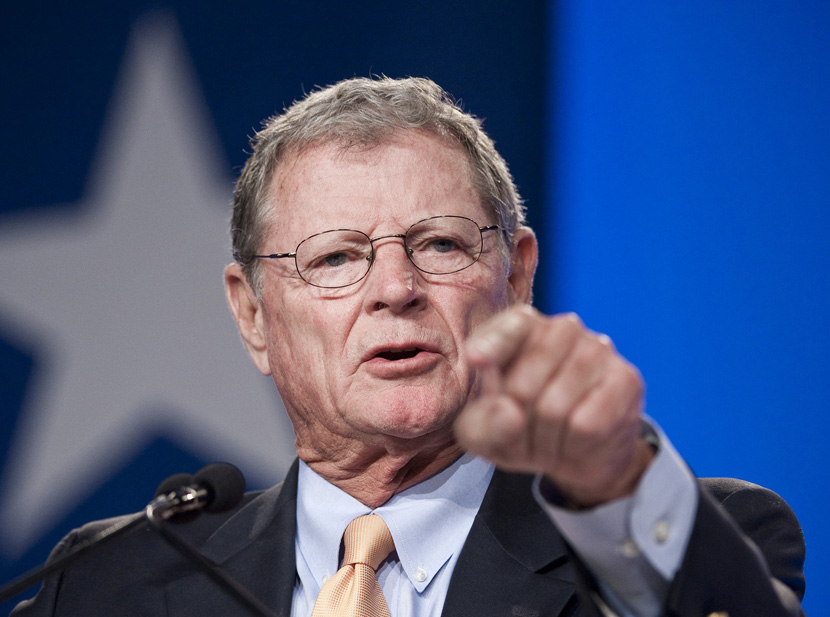
Senator James Inhofe, R-Ok, who has consistently claimed that the  mainstream scientific view on climate is a “hoax,” said the Obama plan will cost the US economy $400 billion a year while ranting about other aspects of the Obama climate plan.

The most frequent justifications for the strong opposition to the Obama climate plan have been the claimed severe economic harms to the US economy, lack of scientific certainty on adverse climate impacts, and the inability of the United States acting alone to prevent climate change.

As we have explained in considerable detail before, these excuses utterly fail to withstand minimum ethical scrutiny.

Economic harm arguments made in opposition to Obama’s climate plan, for instance, even if true, both fail to recognize the ethical obligations that the United States has to not harm others through our ghg emissions and to acknowledge the costs of not acting. US climate policy cannot be based upon US interests alone. The United States has obligations to others. In addition, economic arguments for not acting on climate change ignore obligations that nations have if they are creating human rights violations and duties entailed  by distributive justice. These are only a few of the ethical problems with economic arguments made in opposition to US climate change policies.  For a detailed ethical analyses of economic arguments made  in opposition to US climate change policies, see Ethicsandclimate.org index under Economics and Climate Ethics. 

Scientific certainty arguments made in opposition to climate change fail as a matter of ethics for a  host of reasons including the fact that almost all of the most prestigious scientific organizations in the world and the vast majority of scientists that do peer-reviewed science support the consensus view that has concluded that climate change is  a growing civilization challenging threat to people and ecological systems on which life depends around the world, uncertainty in these situations raises ethical questions about burdens and quantity of proof, those most vulnerable to climate change have not consented to be put at risk from climate change, and the longer the world waits to reduce the threat of  climate change the worse the  problem becomes. For detailed ethical analysis of scientific uncertainty arguments made in opposition to climate change, see Ethicsandclimate.org index under Scientific Uncertainty and Climate Ethics.

Arguments in opposition to action on climate change based upon the claim that the  United States  acting alone will not significantly reduce the threat of climate change fails any ethical test because all nations  have a duty to act to reduce their emissions to their fair share without regard to what other nations do. For detailed ethical analysis of this issue, see, Ethical Issues Raised By US Blue Dog Democratic Senators’ Opposition to Climate Legislation – When May a Nation Make Domestic GHG Reduction Commitments Contingent on Other Nations’ Actions

And so, the arguments made in opposition to the Obama speech fail to withstand  ethical scrutiny.

The US media response to the Obama speech and the political response thereto has once again completely ignored the ethical problems with the strong political opposition to the speech. As we have noted over and over again in regard to the US media coverage of the US response to climate change, the US press is utterly failing to cover ethical issues entailed by opposition to climate change policies in the United States. This is particularly true of economic and scientific uncertainty arguments made in opposition to proposed US climate change policies. Nor is the US press covering ethical issues entailed by the urgency and  magnitude of the need to reduce ghg emissions  given that the world is likely  running out of time to prevent warming of 2 degrees C, a warming amount which is widely believed could create rapid, non-linear climate change. For a discussion of this issue, see: On the Extraordinary Urgency of Nations Responding To What Equity Requires of Them In Their Responses to Climate Change.

One might ask why the US media is failing to cover the obvious ethical questions raised by climate change issues given that the ethical issues have profound consequences for climate change policy and climate change raises obvious civilization challenging ethical issues. We  might ask why the US press is failing to cover the ethical and justice issues entailed by climate change given that vulnerable countries around the world have been screaming for developed nations including the United States to respond in accordance with their ethical obligations. Is the US  press so connected to the economic interests of the United States, that it is blind to the US ethical obligations for climate change? If the US press has not been corrupted by the economic interests of the United States, the only plausible explanation for the US media’s failure to cover the  ethical issues raised by climate change is that the reporter’s covering climate  change don’t understand the civilization challenging ethical issues raised by climate change. If this is the explanation, there is a huge practical need to demand that the US press turn up the volume on the ethical dimensions of climate change.

By:

Donald  A. Brown

Scholar In Residence,

Widener University School of Law.

dabrown57@gmail.com


Property Rights and Sustainability


property rights and sustainability


This article will examine potential conflicts between sustainable development and property rights in light of: (a)  the recent rise of the anti-Agenda 21 campaign that has rapidly gained traction in the United States, (b)  a new book on the subject, and (c) a recent US Supreme Court decision of June 23, 2013.

As we have seen in several recent articles on this website, there is a new, surprisingly successful attack on sustainability in the United States that claims that local and regional planning that includes environmental, energy, transportation, traffic minimization, and land use provisions is the manifestation of a surreptitious United Nations plot to undermine United States sovereignty to impose a Marxist/socialist new world order. See the last in a three part series, Responding To the Anti-Agenda 21 Disinformation Campaign: A Rigorous Look At The Campaign’s Untruthful Claims.

Although the claims that have been made by activists in the Anti-Agenda 21 campaign are so looney, absurd, and woefully ignorant of international law that some who have been aware of this recent development have chosen to ignore it on the basis that it could never achieve traction in a modern democracy in the 21rst Century,  this right wing attack on sustainability has emerged all across the United States. As we have explained in considerable detail in past articles in this series, the anti-Agenda 21 campaign has been remarkably successful in the last two years in preventing local communities from implementing plans necessary to achieve their democratically derived community aspirations to implement local sustainability programs.

The anti-Agenda 21 Campaign has been successful, at least in part, by claiming that sustainable development and Agenda 21 undermines property rights.  They make this claim despite the fact that, as we have shown in previous papers in this series, Section 8.18 of Agenda 21 provides that governments and legislators should establish judicial and administrative procedures for legal redress and remedy of actions affecting environment and development that may affect rights. Agenda 21, section 10.5 also expressly says that property rights should be taken into account in land use decisions. And so, not only is there no support for the claim that Agenda 21 encourages the reduction of property rights, as we have seen, Agenda 21 says the exact opposite.

It would appear that activists in the anti-Agenda 21 campaign believe that property ownership conveys the right to use property without limit and with no or few responsibilities to protect the environment or ecological systems.

Although Agenda 21 does not undermine property rights are there potential conflicts between sustainability and property rights? A new book has been published that looks at potential conflicts between property rights and sustainability. The book is Property Rights and Sustainability: the Evolution of Property Rights to Meet Ecological Challenges which is edited by David Grinlinton and Prue Taylor. This book seeks to determine  how to reconcile the exercise of freedom to use one’s property as one pleases with the responsibility to protect ecological resources.  The book contains 15 chapters that examine potential conflicts between property rights and the responsibilities of property owners not to harm the environment. The book further identifies ways of reforming property law to establish clearer obligations to protect the environment.  Although all authors in this volume acknowledge the importance of retaining property rights they also examine the need of property law to more clearly establish responsibilities that owners have to protect the environment.

All of the chapters in this book acknowledge social benefits from secure property rights, however most of the chapters in the book assume that the property law must also be clearer about the obligations of property owners to avoid harming the natural resource base on which life depends.

In the opening chapter, Grinlinton and Taylor argue that property rights law prioritizes economic interests over ecological obligations.

In chapter two, Klause Bosselmann argues that current property laws inappropriately give priority to individual entitlements over collective responsibilities. Bosselmann further claims that the property law’s unfinished business is to reconcile private rights with public duties.

Eric Freyfogle argues that is not right to pay land owners to forgo actions that are harmful to others.

J. Ronald Engel argues that property law needs to reflect an understanding of moral obligations property owners have that are understood through reflection on covenants that ground the social contract.

Peter Horsley criticizes current property law by claiming that it is based upon assumptions that humans own nature rather than an understanding of the relationship between humans and nature, namely that humans are part of nature. Property law according to Horsely fails to prevent many small cumulative impacts on nature, ignores the carrying capacity of ecosystems, and fails  to protect ecosystem integrity. Thus, according to Horsely the current focus on “rights” is causing growing harm to the natural world on which we depend.

Samuel Alexander claims that the overriding objective of property laws is to facilitate economic growth as efficiently as possible.

Nicole Graham claims that the meaning of property rights has always evolved over time and that recent steps to solve environmental problems by use of economic markets has been built on six myths about markets. These myths are: (1) rights and profits are not accompanied by responsibilities and costs; (2) the fragmentation of property into multiple and concurrent interests is a good thing; (3) market players make rational choices with perfect information; (4) environmental products can be accurately valued; (5) the demand for environmental products is responsive to price signals; and (6) environmental markets can solve environmental problems.

Craig Anthony (Toni) Arnold agues that the dominant idea about property is that it is a “bundle of rights” that leads to property owners becoming abstracted from ecological systems. He thus argues that property should be understood as a web of interests rather than as a “bundle of rights.”

Successive chapters by Veronica Strong, Nin Thomas, and Lee Golden examine differing cultural approaches to property.

Concluding chapters by David Grinlinton, Ann Brower and John Page, Elmarie van der Schyff, and Amokura Kawharu look at changing conceptions of property and the challenge of accommodating principles of sustainability to the ownership of and use of natural resources.

This new book claims that there may be a need to modify property rights to protect ecological systems although none of the chapters call for private interests in property to be completely replaced by public interests.

This book is an excellent summary of issues that arise when property rights conflict with the protection of the environment.

Yet there are open questions about how frequently environmental protection objectives contained in land us plans, regulations that constrain land uses to achieve environmental protection goals, or permit conditions actually conflict with property rights.

As we have explained in considerable detail in prior entries on this subject, Agenda 21 does not call for changes in property rights. In fact, Agenda 21 urges that property rights be protected. We now, however, look at whether many of the issues that have arisen in some of the local and regional controversies violate the property rights protection under the US Constitution.

To determine the magnitude of any conflict between sustainability and property rights, it is first necessary to look at how courts have articulated when government regulation violates property rights. A comprehensive article on whether there is a conflict between sustainability policies has been published recently. This article is: Does Sustainability Require a New Theory of Property Rights? (Circo. 2009) In this article, Circo concludes that under US constitutional law:

When the contested government action merely regulates land use without physically interfering with possession, the adversely affected landowner will have no right to compensation (a takings claim) absent a showing that the restriction denies the owner “all economically viable use of the land” or that it imposes burdens that bear no relationship to the regulation’s public benefits. In other words, unless the regulation virtually prohibits any valuable use of the land, courts will use a deferential balancing test to determine how far government regulation may go.

 Circo’s summary of takings law goes on to conclude:

The leading land use cases reflect the traditional theory that government may impose significant, even highly intrusive, restrictions on property rights for police power purposes. The usual test is that a police power imposition on property rights is valid unless it is “clearly arbitrary and unreasonable, having no substantial relation to the public health, safety, morals, or general welfare.” Notice the two elements involved: the limitation on property rights must be for a valid police power function (health, safety, morals, or general welfare) and the limitation imposed must bear at least some relationship to that police power purpose (must not be arbitrary or unreasonable).

 Thus it is clear that it is not a violation of property rights for government to impose reasonable restrictions on land use necessary to protect the environment unless the restrictions completely eliminate the use of the property by the owner.

20130529_NoUseofPrivateProperty

Yet the anti-Agenda 21 campaign has asserted that land-use restrictions such as those that require land owners to install stream buffers when necessary to protect water quality, zoning ordinances that attempt to assure that development does not exceed the carrying capacity limits of ecological systems such as the maximum sustainable yield of groundwater, or regulations that require the protection of wetlands are an infringement of property rights. But as Circo’s analysis makes clear, property rights are not unlimited, and the US courts have almost always upheld reasonable regulation of land needed to protect the environment.

However, if government restricts any reasonable use of land to achieve sustainability goals, this would likely be seen by US courts as a violation of property rights. Yet courts do not see property rights as giving land owners the right to use the land in such a way that it adversely affects the environment.

Does this mean that any proposed government restriction on land use  in the name of sustainable development would not conflict with property rights as currently understood under US constitutional law? Here Circo sees at least one kind of government regulation urged by the idea of sustainability that could create conflicts between property rights and sustainability. That is in cases where governments limit the use of natural resources for the sole benefit of future generations. In such a case, Circo sees a potential conflict between sustainability and land use. It is in such cases where the issues of concern in the book discussed above arise. Yet, most environmental restrictions on the use of land that don’t prevent the land owner from using his or her land are not prohibited by property rights in the United States. And so, the anti-Agenda 21 campaign’s claims that sustainability undermines property rights is also not true for two reasons. As we have seen Agenda 21 calls for the protection of property rights. Also most of the land-use provisions under attack by the anti-Agenda 21 campaign do not violate property rights under. The general rule that environmental restrictions on land use do not entail an unlawful taking of property under the US constitutional law was set out in the Village of Euclid v. Ambler Realty Co., 272 U. S. 365 (1926).  This case held that insisting that landowners internalize the negative externalities of their conduct is a hallmark of responsible land-use policy and limitations on land use do not create and unconstitutional taking.

However a recent case by the US Supreme Court,  identifies a  potential  infringement on property rights when government imposes unreasonable conditions on land-use permits or approvals.  In Koontz v. St. Johns River Water Management District, No. 11-1447, 570 U.S. __ (2013), the court   concluded that there could be an unconstitutional taking of property if governments condition the issuance of permit to mitigate adverse environmental protection goals when the condition lacks an essential nexus and rough proportionality to those impacts. Otherwise there is no taking.

For the limited number of issues raised by sustainability that actually conflict with property rights, the book Property Rights and Sustainability: the Evolution of Property Rights to meet Ecological Challenges is good introduction to the issues that should be considered on matters where there is a conflict between protecting the environment and property rights.

 By:

Donald A. Brown

Scholar In Residence, Sustainbility Ethics and Law

Widener University School of Law

dabrown57@gmail.com


Equity Remains At The Center of Bonn Climate Change Talks


equity and climate change


In a recent article in Ethicsandclimate.org, we explained why there is an urgent need of nations to respond to climate change be reducing their greenhouse gas emissions to levels required of them by “equity” to give the world any hope of  limiting warming to tolerable amounts. On the Extraordinary Urgency of Nations Responding To Climate Change on the Basis of Equity

This article was written to explain in simple terms why national responses on the basis of equity are an indispensable ingredient in any global solution to climate change.  This article was also written because the media in the United States and other parts of the world are utterly failing to explain the importance of equity in national responses to climate change. This failure makes it easier for economic interests who perceive that they will be harmed if a nation reduces  its carbon emissions to manipulate the public with such arguments as the United States should not reduce its emissions because China is the largest polluter in the world. Citizens around the world need to understand that all nations have a duty to reduce their emissions to levels required of them by equity regardless of what other nations do to retain any reasonable hope of finding a global solution to climate change.

Since posting this article, nations have met under the United Nations Framework Convention on Climate Change (UNFCCC) in Bonn in early May, 2013 and in the first two weeks of June. In these meetings, equity continued to be a major focus of concern because of increasing scientific awareness of the urgent need of nations to increase their ambition in their greenhouse gas (ghg) emissions reduction commitments to have any hope of preventing dangerous climate change.

Equity was not the only important issue under consideration at the Bonn  new book description for website-1_01meetings. Other significant issues under discussion were loss and damages, REDD (reducing emissions from deforestation and forest degradation), market mechanisms under the UNFCCC, NAMAs (nationally appropriate mitigation actions for developing countries), and technology transfer, and completion of the architecture for the second commitment period under the Kyoto Protocol.

However, perhaps the most important issues in discussion in Bonn were those relating to structuring a new global climate change treaty that the world has agreed to complete by 2015 in Paris under the Ad Hoc Working Group on the Durban Platform referred to by acronym ADP. These discussions focused on finding agreement on pre-2020 ambition national emissions reductions commitments and a framework for post-2020 agreement, carried out in two different work streams.

Parities working under the ADP are working to get a comprehensive deal by the 2015 deadline. The Bonn meeting marked the beginning of that “road to Paris” where 2015 COP-21 that is expected to finalize a new climate change agreement with legal significance that will come into force in 2020 .

equity and ambitionParties at the May Bonn meeting stressed the need for nations to align their commitments on the basis of  equity as required by the UNFCCC.  During the May Bonn meeting some developing countries argued in behalf of a proposal by Brazil that developed countries must take the lead on emissions reductions that took into account historical responsibility.

Other equitable frameworks were also discussed in May including frameworks known as “contraction and convergence,” “greenhouse development rights,” the “Indian Proposal,” and others.

There was also discussion on a new framework that is based upon the idea that all people everywhere should have the same right to use global atmospheric space.

A number of Parties spoke of the urgent need to close the ambition gap, as well as the quantification of the amount of adaptation that will be required in the light of the current scientific assessment of adaptation needs should current commitments not be met.

At the just concluded Bonn meeting in June, there was very little progress made in getting nations to increase their ambition based upon equity or on agreement about what equity requires. Although the June Bonn meeting saw some modest  progress on a few issues including REDD, little progress was made on the substantive content of future national commitments under the new treaty to be negotiated by 2015.  These issues will be taken up again in Warsaw at the next conference of the parties under the UNFCCC in mid-November.

By:

Donald A. Brown

Scholar in Residence

Sustainability Ethics and Law

Widener University School of Law

dabrown57@gmail.com


An Opportunity to Learn About Links Between Global Governance and Environmental Ethics


sustain 2


earthethics


Those who desire to achieve greater traction for ethical principles in guiding solutions to global sustainability problems including but not limited to climate change need to understand the barriers and opportunities presented by current global governance regimes. Although many, if not most sustainability problems, can be adequately dealt with at the national, regional, or local government level, some sustainability problems can not be solved without global cooperation that is mindful of the strengths and weaknesses of global institutions and the role of international law.

Professionals in law, environmental planning and science, policy makers, researchers and students of international law and governance with respect to sustainability and the natural environment require an understanding of the ethical questions at the center of international environmental and sustainability controversies in order to achieve greater traction for ethical principles in government decision-making.  Also a  comprehension of the strength and weaknesses of global governance systems is essential for those who seek to work on ethically based global solutions to the world challenging global sustainability issues.

Anyone interested in these issues has an opportunity to attend a program on International Law, Global Governance, And The Earth Charter Principles. The Earth Charter Center for Education for Sustainable Development’s program aims to empower participants who attend to become competent leaders for sustainability and help them enhance their knowledge at the intersection of international law, global governance, and the Earth Charter. This course will help deepen understanding of global governance systems, international environmental law instruments, and other legal  options to make global governance more responsive to ethical principles. The program will be held from July 3-7 in Costa Rica and applications are open. Please, find all the relevant information here: http://www.earthcharter.org/lawprogramme

By: 

Donald A. Brown

Scholar In Residence,

Sustainability Ethics and Law

Widener University School of Law

dabrown57@gmail.com

Responding To the Anti-Agenda 21 Disinformation Campaign: A Rigorous Look At The Campaign’s Untruthful Claims.

lies.abolish the un


Agenda_21_Cover


Two new documents are available to help those interested in responding to  the anti-Agenda 21 campaign that has been the subject of the last two papers on Ethicsandclimate.org  that is undermining local and regional land use and sustainable development planning in the United States.

As we have explained in the last two articles, an anti-Agenda 21 campaign has been surprisingly successful in the United States in undermining land-use, transportation, and energy planning at the local and regional level. The Tea Party in the United States appears to have a new focus: they are fighting local and regional government land-use and sustainable development planning on the basis that it is part of a United Nations plot to undermine national sovereignty and impose a Marxist/socialist new world order.

The first article in this series on Ethicsandclimate.org described the rapid success of this phenomenon and critically looked at four claims frequently made by this campaign. The second article continued the critical examination of nine additional claims frequently made by anti-Agenda 21 activists. The second paper also reviewed the anti-Agenda campaign’s claims as a matter of ethics.

Although the claims that have been made by activists in the Anti-Agenda 21 campaign are so looney, absurd, and woefully ignorant of international law that some who have been aware of this recent development in US history have chosen to ignore it on the basis that it could never achieve traction in a modern democracy in the 21rst Century. Yet as we have explained in considerable detail in past articles in this series, the anti-Agenda 21 campaign has been remarkably successful in the last two years in preventing local communities from implementing plans necessary to achieve their democratically derived community aspirations concerning. among other things, protection of air and water quality, reducing traffic congestion, creating bike lanes, improving public transportation, reducing carbon emissions that are contributing to climate change, and land-use and energy planning.

As we have demonstrated in the past two articles, the claims made by the anti-Agenda 21 campaign are directly contradicted by the text of Agenda 21. They are also deeply misleading about what Agenda 21 is, its legal affect on the the United States, and staggeringly inconsistent with international law.

A new paper is now available that combines the previous two entries in Ethicsandclimate.org while expanding on them. This paper is designed to be a rigorous reference for those who want to respond to the claims of the anti-Agenda 21 campaign in detail.

This first paper is:

TheAnti-Agenda21 Disinformation Campaign in the United States: An Ethical Critique of an Attack on Sustainability

http://papers.ssrn.com/sol3/papers.cfm?abstract_id=2277882

Also available  is a one page paper that can be used more easily by those interested in responding to this campaign. This one page paper is a summary of the longer paper above. The paper is:

Responses to Claims Made By The Anti-Agenda 21 Campaign

http://papers.ssrn.com/sol3/papers.cfm?abstract_id=2279098

By:

Donald A. Brown

Scholar In Residence, Sustainability Ethics and Law

Widener University School of Law

dabrown57@gmail.com


The Anti-Agenda 21 Disinformation Campaign, Part 2

 disinformationnew world order


I. Introduction to Part 2

This article continues the analysis of the anti-Agenda 21 disinformation campaign begun in our last article.  In that article we looked at the four claims about Agenda 21 that appeared in a resolution passed by West Cornwall Township in Pennsylvania which are also very frequently being made by activists in the anti-Agenda 21 campaign across the United States.  We now continue our examination of specific claims made by the anti-Agenda 21 campaign by looking at claims made by John Anthony, a conservative businessman who frequently speaks on Agenda 21 issues around the United States and who has produced a You Tube in which he makes the specific claims considered here.  The claims that Mr. Anthony makes are also often being made by other anti-Agenda 21 activists.  We end with a claim made by the Republican National Platform.

After looking at eight additional claims in this article we examine the ethical issues raised by the anti-Agenda 21 campaign.

The last entry in this series will examine the organizations who are most responsible for the anti-Agenda 21 campaign.

II. Continuing Analysis of Claims of the anti-Agenda 21 Campaign

Claim 5. Agenda 21 attempts to erode the local control found in our communities across the nation and turns home and regional rule over to a global agenda set by  organizations authorized by the United Nations. (West Cornwall Township Resolution)

The fact that this claim is a complete and utter canard can be determined by looking at the actual language of Agenda 21.  Paragraph 3.5 (a) of Agenda 21, for instance,  calls for the empowerment of local and community groups under the principal of delegating authority, accountability, and resources to the most appropriate level to ensure that the program will be geographically and ecologically specific.

In addition paragraph 10.6 (e) of Agenda21,  as we’ve seen above, calls for delegating policy making to the lowest level of public authority consistent with effective action and a locally driven approach.

Absolutely nothing in Agenda 21 calls for the  divestment of local power and the substitution of the United Nations authority expressly provides that

Agenda 21 does acknowledge that some environmental and economic development problems cannot be solved by one community alone because some problems do not fit the boundaries of a single local community’s  jurisdiction. In these cases, governments need to cooperate to have any hope of solving the problem. For instance, upstream communities and nations can degrade the water supply of downstream nations and communities.  Three or more communities may degrade a common water supply. In such cases a regional solution is required to solve the problem and Agenda 21 implicitly calls for regional government cooperation in such cases.  In solving these regional problems, the United Nations is not called upon to play any role in the regional decision making. In these situations, the governments are encouraged, but not required, by Agenda 21 to consider the environmental and economic impacts in an integrated in decision-making.

Some environmental problems are global in scope such as ocean acidification, ozone layer depletion, and climate change. For these problems global cooperation is necessary and the United Nations has often played a convening role in bringing national governments together to solve these problems. However, even for global problems the United Nations has no power nor attempts to dictate the elements of global solutions. The United Nation’s role in global problems has been to call nations together in negotiations to arrive at treaties which have to be ratified by national governments.  In the United States treaty ratification requires a 2/3 vote of the US Senate. In global treaty negotiations, the United Nations plays no negotiating role except to facilitate negotiations among nations and sometimes to act in an administrative role in regard to the implementation of treaties. Yet even when it plays this role it reports to the nations who are parties to the treaties.

Thus Agenda 21 endorses a principle which is known legally as the “subsidarity” principle. The subsidiarity principle is an organizing principle of decentralization, stating that a matter ought to be handled by the smallest, lowest, or least centralized authority capable of addressing that matter effectively.

Not only is there no basis for the claim that Agenda 21 undermines regional control by replacing it with a global control, as we have seen, Agenda 21 by incorporating principle 2 of the Rio declaration acknowledges the sovereign right of nations to exploit their own resources pursuant to their own environmental and development policies.

one world gov

Claim 6. Agenda 21 calls for decisions affecting local property to be made in accordance with the Charter of the United Nations rather than local property law. (John Anthony tape)

This claim is simply a lie or reckless disregard for the truth. As we have seen, Agenda 21 calls for decisions to be made at the lowest practical level in accordance with the laws and policies of that level.

Furthermore, the Charter of the United Nations expressly provides in Article 2, Paragraph seven that:

Nothing contained in the present Charter shall authorize the United Nations to intervene in matters which are essentially within the domestic jurisdiction of any state.

Since the planning issues under attack by the anti-Agenda 21 are matters within the jurisdiction of local, regional, state or national governments, the Charter of the United Nations actually prohibits the United Nations from usurping local or regional authority.

Thus, the claim that Agenda 21 calls for local decisions to be determined under the authority of the United Nations Charter is so loony and inconsistent with international law that it has obviously been made by someone who does not understand international law, yet who has been convinced by conspiracy theories that the United Nations is rapidly usurping national sovereignty.

Claim 7. Agenda 21 means that individual rights must take second place to the rights of the collective. (John Anthony tape) 

Not only does Agenda 21 nowhere say that individual rights must take second place to the rights of the collective as we have seen above, Agenda 21 is clear that governments at the appropriate scale should make decisions according to their own laws and policies, expressly reaffirms property rights, calls for judicial processes to protect rights, and is comprised of a set of recommendations for consideration by the appropriate government, not rules that must be adopted.  This claim, along with many others discussed in this series, must be understood as a lie or reckless disregard for the truth.

end of wall srt paint

Claim 8. Agenda 21 calls for free enterprise to be replaced with public/ private partnership. (John Anthony tape)

Nothing in Agenda 21 remotely comes close to saying that free enterprise should be replaced. As we have seen several times there is an entire chapter of Agenda 21, chapter 30, that calls for the strengthening of free enterprise in decision-making and Agenda 21 actually recommends greater use of market mechanisms.

Many businesses and business organizations have enthusiastically supported the ideas of Agenda 21. For instance the World Council of Sustainable Buisinness is an organization comprised of over 200 international corporations that have actively participated in UN meetings on sustainability. Thousands of businesses around the world have made commitments to sustainable development. As we saw above the United State government consistently met with US business interests before taking positions on sustainability issues at the UN. The claim that Agenda 21 calls for replacement of the private sector is not only inaccurate it is preposterous.

Claim 9. In decision-making at the local level, the job of the facilitator is to guide the local stakeholder groups to accept predetermined objectives consistent with Agenda 21.(John Anthony tape)

This claim apparently is made about multi-stakeholder meetings that are encouraged by Agenda 21 at the appropriate government level.  Multi-stakeholder meetings are usually organized by the government unit that is considering action relating to planning. The local governments usually select which facilitators will run meetings. It is very, very unlikely that facilitators of these meeting know anything about Agenda 21 or looked to it to find rules to apply to local solutions. There is no evidence at all that all or the majority of facilitators that have participated in local declension-making relevant to sustainability issues have forced the stakeholders to come up with recommendations consistent with Agenda 21.

Claim 10. Agenda 21 implementation will mean that people will only be able to live in the black areas in the following maps, living in rural areas will no longer be possible in the United States. (John Anthony tape)

AGENDA-21-BMP-1 where people live


This claim is obviously ludicrous and utterly disingenuous. There have been no proposals that have come close to limiting future domestic dwellings to the black spaces on the map nor to prohibiting people from locating their homes in rural areas. In the United States, land use decisions are made by state and local governments in accordance with state and local law. The United Nations has zero authority over the decisions of State and local governments on these issues. Agenda 21 makes no recommendations to prohibit living in rural communities.

From time to time in the past state and local governments have made land use decisions that restrict land uses to protect wild life and natural resources but they have not done this in response to Agenda 21. Some governments may also choose to restrict certain land uses for ecological preservation reasons in the future. Property owners of lands that might be identified to  be preserved for ecological reasons have strong property rights in the United States that prevent the government from taking their property without just compensation and due process of law. Agenda 21 not only does not undermine the rights of property owners, it reaffirms them as we have seen.

Claim 11. Agenda 21 requires that the same solutions be applied the same everywhere in the world. (John Anthony tape)

Once again, this claim is directly contradicted by the text of Agenda 21. Paragraph 8.2 of Agenda 21 says in relevant part:

National plans, goals and objectives, national rules, regulations and law, and the specific situations in which different countries are placed are the overall framework in which integration takes place. In this context, it must be borne in mind that environmental standards may pose severe economic and social costs if they are uniformly applied in developing countries.

As we have also explained above , Agenda 21 expressly recognizes the sovereignty and right of nations to exploit their own resources according to their own needs. Agenda 21 is simply a menu of options for consideration, not a set of rules to be applied.

Claim 12. Agenda 21 Erodes National Sovereignty. (Republican National Platform)

Agenda 21 not only does not erode American sovereignty in any way, as we have seen throughout this analysis it reaffirms national sovereignty.

First, we have seen from the quote above that Section 8.2 expressly provides that the law of nations is the basis for integrating environmental and economic issues in implementing Agenda 21.

Second, we have seen that Agenda 21 is simply a menu of options not a set of rules to be applied in nations.

Third, we have seen that the Charter of the United Nations says that the Charter does not give the United Nations the authority to interfere with matters rightly within the jurisdictions of nations.

Fourth, we saw that paragraph 10.6 (e) of Agenda 21 calls for delegating policy making to the lowest level of public authority consistent with effective action and a locally driven approach.

Fifth, we have seen that Agenda 21 expressly incorporates Principle two of the Rio Declaration which says that “Nations have in accordance with the Charter of the United Nations and the principles of international law the sovereign right to exploit their own resources pursuant to their own environmental and development policies.” (Rio Declaration, Principle 2)

Sixth, it is a well establish principle of international law that nations are not bound by international agreements unless they are treaties that have been ratifies or adopted according to national law.  In the United States, the US Senate must ratify a treaty by 2/3 vote of the United States Senate. The United States never ratified Agenda 21 nor even considered so doing because it was universally understood to be a non-binding document from its conception.

In summary, the United States retains full, undiluted sovereignty over matters discussed in Agenda 21.  Nothing in Agenda 21 remotely undermines the sovereignty of the United States.


envirrnmental ethics


III. Ethical Analysis of Anti-Agenda 21

We now look at the anti-Agenda 21 campaign phenomenon through an ethical lens.  We  end this ethical analysis with a reflection on the ethics of sustainable development.

1. Tactics of anti-Agenda 21 Campaign

We have seen in this series of articles that the assumptions and claims of the anti-Agenda 21 campaign are very frequently based upon either lies or reckless disregard for the truth. Over and over again, claims of this campaign are made about the meaning or effect of Agenda 21 which are directly contradicted by the text of this document or are based upon a completely delusional understanding of the potential power of the United Nations over local or regional governments in the United States as a legal matter.

As we noted at the beginning of this series, citizens have clear rights to protect their interests by participating in and attempting to influence local and regional planning efforts. There is no doubt, some land-use decisions have occasionally    infringed upon property rights. In these cases existing US law provides legal protection for redress. Nothing in Agenda 21 can be construed to change this.

However those seeking to influence government processes have no rights to tell utter untruths about issues in contention. For this reason, the tactics of the anti-Agenda 21 campaign are ethically problematic particularly in light of the magnitude and scope of the misinformation the anti-Agenda 21 campaign has been inserting into discussions about local planning issues.

The tactics of the anti-Agenda 21 campaign include not only include large doses of misinformation about Agenda 21, they also appear to be designed to scare uninformed citizens that their rights are being taken over by the United Nations which is in the process of undermining national sovereignty in pursuit of imposing a Marxist/socialist one world government.

And so, the tactics of the anti-Agenda 21 campaign include the spreading a huge number of false claims that are being used to scare uninformed citizens. These tactics are clearly morally reprehensible.

2. The Ethics of Sustainability

As we explained, Agenda 21 is a document that encourages but does not require governments around the world to pursue integrated decision-making about environmental, economic, and social issues at the global, national, regional, and local scales. The idea is premised on the notion that if economic, environmental, or social policies are pursued by themselves they may prevent the achievement of legitimate environmental, economic, and social goals that may be achieved in integrated decision-making.

The idea of sustainable development does not give strong guidance on how to reconcile conflicts between environmental and economic goals.  As we noted in the first part of this series, the definition that is usually used to define the term is notoriously vague. Namely, sustainable development is development which meets the needs of present generations without  compromising the ability of future generations to meet their own needs. This definition could be understood to allow destruction of all natural resources if technology finds substitutes, makes human needs the measure of value for natural resources, fails to recognize duties to sentient animals, makes no distinctions on what human needs are, etc. As a result, many environmental ethicists have criticized the term the idea of sustainable development for its failure to be clearer about the value of nature and animals.

Similarly many environmental activists have criticized the concept of sustainable development on the basis that its implicit valorization of development will lead to environmental destruction.   

Yet it can be argued, that the idea of sustainable development is worthwhile pursuing practically and ethically despite its ethical vagueness because it calls for decisions relating to economic development to take into consideration potential adverse environmental impacts. It also encourages governments considering environmental protection policies to consider unwanted impacts on legitimate economic development objectives.  Because environmental and economic goals can have ethical significance, sustainable development is ethically supportable despite the lack of clarity about how to resolve conflicts between environmental and economic goals. For this reason, sustainable development is what philosophers call an “orienting” concept. It helps orient decision-making to consider the right thing to do, even if it is ethically incomplete in giving guidance on how to resolve environmental protection and economic development conflicts. Many other “orienting” concepts which contain no ethical rule but are helpful are frequently used in public life.  For instance, the very word “justice” is such an orienting concept.

The word “justice” in the abstract does not tell one what should be done when distributing societal benefits but it is useful in orienting thinking about what is a fair distribution of societal goods in human affairs 0r when procedures should be created to provide rights of participation in decisions for those who could be affected by government decisions.  For the same reason, a call for integrated decision-making is ethically positive even if it does not resolve all conflicts about environmental and economic issues.

This is so because many governments have pursued economic development objectives or environment protection goals without consideration of how policies in each of these areas might affect the legitimate aspirations of the other policy goals.  For instance, very frequently economic development projects that affected water quality have been approved before the project’s impacts on water quality were considered. Because people have a right to not have the water on which they depend degraded by others, it is ethically required that adverse impacts on water quality be considered in economic policy decisions that could affect water quality. There are also many examples particularly in developing countries where projects which proposed to restrict the use of natural resources have been approved without consideration of the adverse impacts that would follow by restricting natural resource on local indigenous people who depended on the resources for subsistence.  Ethics requires that environmental decisions consider how people’s subsistence needs may be affected by environmental policies.

And so the idea of sustainable development is ethically supportable despite its lack of clarity about how to resolve conflicts between environmental and economic goals. In cases of conflict between environmental and economic goals, governments need to look to other ethical principles contained in law or ethical theory to resolve conflicts. And so, sustainable development is an ethically supportable goal despite the fact that its it gives incomplete ethical guidance on how to resolve conflicts between environmental, economic, and other policy goals.

It would appear that the anti-Agenda 21 disinformation campaign is always  opposed to the idea of sustainable development that encourages integrated decision-making on environmental, economic, and social policies.

Such a position is itself ethically problematic precisely because people and governments have ethical duties to avoid certain kinds of adverse environmental, economic, and social impacts on others.

Therefore, we conclude that the anti-Agenda 21 campaign can be criticized on ethical grounds for many reasons including the fact that it appears to be opposed to integrated decision-making on projects that can have adverse environmental, economic, and social impacts.

IV. Conclusion

We have demonstrated that the claims of the anti-Agenda 21 campaign are built upon misleading and inaccurate claims about Agenda 21. We have also shown that the tactics of this campaign are ethically problematic.

The last entry in this series will look at the organizations that have been propagating the claims that we have examined in this series.

By:

Donald A. Brown

Scholar In Residence,

Sustainability Ethics and Law

Widener University School of Law