Why Politicians May Not Ethically Rely on Their Own Uninformed Opinion About Climate Science and 10 Questions That The Press Should Ask Politicians About Climate Science In Light of This Responsibility.

Marco Rubio, a US Senator from Florida, recently said that he was not sure the climate change was human caused. This is one of the reasons why he’s unwilling to support US government action to reduce the threat of climate change.  Many other US politicians have also recently said they will not support legislation to reduce US greenhouse gas emissions because they are not convinced that climate change happening or is human-caused. In fact, 7 out of 8 Republican candidates for the US presidency proclaimed they didn’t believe that climate change was a problem. (Skeptical Science) When these politicians are asked about the basis for their positions on climate change, they almost always respond by saying such things as they “have heard that there is a disagreement among scientists” or similar responses that strongly suggest they have informed an opinion on climate change science without any understanding of the depth of the scientific evidence on which the scientific consensus view 0f climate change has been based. For instance, US politicians frequently assert that it is an open question whether humans are causing the undeniable warming that the Earth is experiencing, thus exposing ignorance of dozens of lines of independent robust evidence of human causation including attribution studies, finger print analyses,  strong evidence that correlates fossil fuel use to rising atmospheric concentrations of greenhouse gases, and other physical and chemical evidence.

Although ordinary individuals may have no duty to go beyond their own personal opinion about the science of climate change, government officials who have the power to enact policies that could present catastrophic harm to millions of people around the world may not as a matter of ethics justify their refusal to support policies to reduce the threat of climate change on the basis of their uninformed opinions on climate science. This is so because government officials, unlike ordinary citizens, have the power to prevent or minimize great harms to millions of people around the world that mainstream scientists have concluded that their constituents or governments that they represent are causing or contributing to. That is, a government officials have more responsibility than the average citizen to understand the state of climate change science because the government official can uniquely prevent harm that their constituents or governments are causing. And so, when government officials with the power to enact climate change policies are on notice that respectable scientific evidence supports the conclusion that their constituents or governments are likely causing great harm, they may not appeal to their uninformed opinion on climate science as justification for not taking action.
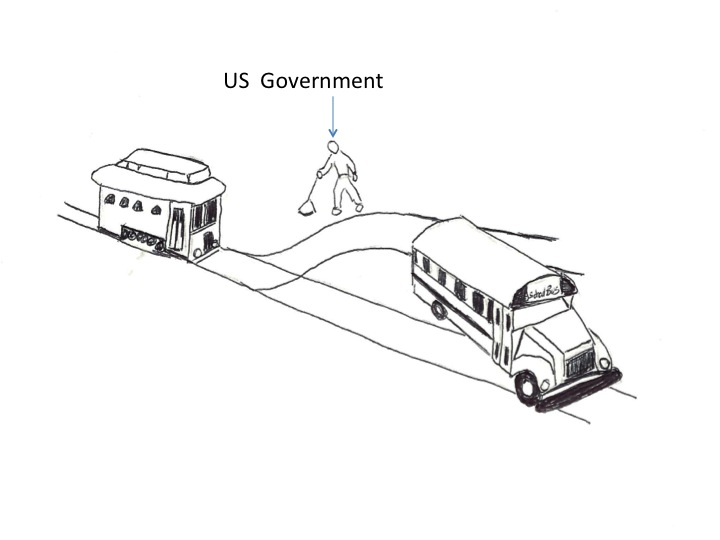

The government official is like the railroad official who has been told by employees who are in a position to know the location of the company’s trains that there is a runaway train hurtling toward a bus full of children that is stuck on the track, when the official has the ability to divert the train onto a track on which no humans will be harmed.

In the case of climate change, government officials should know that 97 of every 100 scientists that actually do peer-reviewed climate science research and in the  United States by the most prestigious scientific organizations including the US National Academy of Sciences that greenhouse gases coming from his constituents threaten catastrophic harm not only to his constituents but to millions of people around the world, most of whom have done little to cause climate change.

In the case of climate change, the US politician not only has the power, working with colleagues, to prevent great harm caused by his or her constituents, he or she has the responsibility to prevent his or her constituents from harming others outside United States. This responsibility was expressly agreed to by the United States when it ratified the United Nations Convention on Climate Change which contains the following acknowledgment of the US governments responsibility to prevent harm to those outside the United States in the convention’s Preamble:

Recalling also that States have, in accordance with the Charter of the United Nations and the principles of international law, the sovereign right to exploit their own resources pursuant to their own environmental and developmental policies, and the responsibility to ensure that activities within their jurisdiction or control do not cause damage to the environment of other States or of areas beyond the limits of national jurisdiction. (UNFCCC Preamble)

In the case of climate change, the people that will be harmed (those in our metaphorical bus) are not only the constituents of the politician but hundreds of millions of people around the world that have done little or nothing to cause climate change.
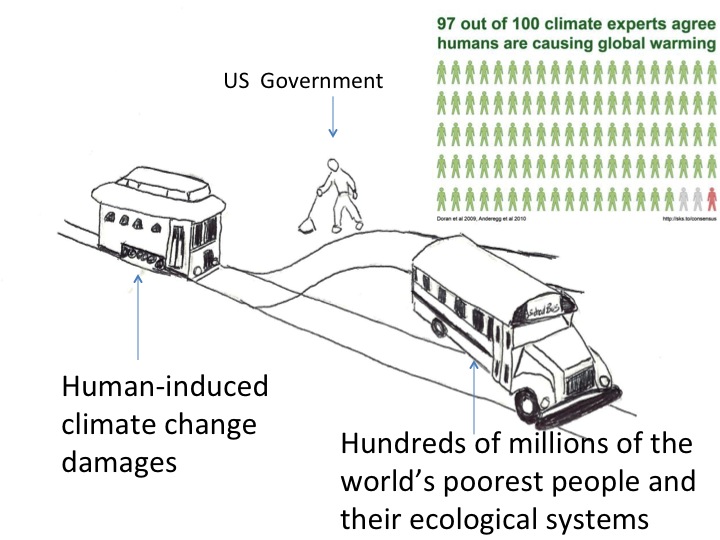
 

The vast majority of climate scientists and over 100 scientific organizations whose members have climate science expertise have concluded that humans are causing climate change and human-induced climate change creates catastrophic threats for the human race and particularly for hundreds of millions of poor people around the world who are most vulnerable to climate change impacts.  Although there are some differences among some mainstream scientists about some of the details of the consensus view, an open letter from the American Association for the Advancement of Science’s which was endorsed by 18 of the most prestigious scientific organizations in the United States summed up the nature of the scientific consensus as follows:

As you consider climate change legislation, we, as leaders of scientific organizations, write to state the consensus scientific view. Observations throughout the world make it clear that climate change is occurring, and rigorous scientific research demonstrates that the greenhouse gases emitted by human activities are the primary driver. These conclusions are based on multiple independent lines of evidence, and contrary assertions are inconsistent with an objective assessment of the vast body of peer- reviewed science. (AAAS 2009)

Though scientific consensus must always be open to responsible skepticism given: (a) the strength of the consensus on this topic, (b) the enormity of the harms predicted by the consensus view, (c) an approximately 30 year delay in taking action that has transpired since a serious climate change debate began in the United States in the early 1980s, (d)  a delay that has made the problem worse while making it more difficult to achieve ghg emissions reductions necessary to prevent dangerous climate change because of the steepness of reductions now needed, no politician can ethically justify his or her refusal to support action on climate change based upon a personal opinion that is not supported by strong scientific evidence that has been reviewed by scientific organizations with a wide breadth of interdisciplinary scientific expertise.  Because any further delay will make the climate change threat worse, US politicians have a duty to support policies that will reduce the threat of climate unless they can produce strong scientific evidence that has been fully vetted by respectable scientific institutions that climate change is not the threat entailed by the scientific consensus view.

In this situation the government official has a strong duty to go beyond his or her own uninformed opinion about whether humans are causing dangerous climate change. They must justify their refusal to act on strong, peer-reviewed scientific evidence that is accepted by mainstream scientific institutions that have the breadth of expertise to consider one study in the context of thousands of other studies in climate change science. And so, government officials may not justify their refusal to act simply on the basis of  their personal opinion.

Because politicians have an affirmative duty to initially rely upon mainstream scientific views in regard to human activities that could cause great harm, the press has a journalistic duty to help citizens understand any politician’s views that oppose action on climate change policies on scientific grounds. The US press has almost always failed to probe the justifications of those opposing action on climate change on scientific grounds. For this reason, journalists should ask politicians that claim there is not sufficient scientific support for government action climate change the following questions:

1. What specific scientific references and sources do you rely upon to conclude that there is a reasonable scientific dispute about whether human actions are causing dangerous climate change?

2. Are you aware that the United States Academy of Sciences and almost all respected scientific organizations whose membership includes scientists  with expertise relevant to climate change science support the scientific consensus view that holds has that the planet is warming, that the warming is mostly human caused, and that harsh impacts from warming are very likely under business-as-usual?

3.  On what basis do you disregard the conclusions that humans are causing dangerous climate change held by the United States Academy of Sciences, over a hundred scientific organizations whose membership includes experts with expertise relevant to the science of climate change, and 97 percent of scientists who actually do peer-reviewed research on climate change?

4. When you claim that the United States need not adopt climate change policies because adverse climate change impacts have not yet been proven, are you claiming that climate change skeptics have proven that human-induced climate change will not create adverse impacts on human health and the ecological systems of others on which their life often depends and if so what is that proof?

5. When you claim that the United States should not adopt climate change policies because there is scientific uncertainty about adverse climate change impacts, are you arguing that no action of climate change should be taken until all scientific uncertainties are resolved given that waiting to resolve all scientific uncertainties before action is taken will very likely make it too late to prevent dangerous human-induced climate change harms according to the consensus view?

6. Do you deny that those who argue that they should be allowed to continue to emit greenhouse gases at levels that may be dangerous should assume the burden of proof that their actions are safe given the strength of the consensus view on climate change science?

7. Do you deny that those who are most vulnerable to climate change’s harshest potential impacts have a right to participate in a decision about whether to act to reduce the threat of climate change in the face of scientific uncertainty?

8. Given that in ratifying the United Nations Framework Convention on Climate Change (UNFCCC) the Untied States in 1992 agreed to the following under Article 3, do you believe the United States is now free to ignore this promise by refusing to take action on climate change on the basis of scientific uncertainty?

The Parties should take precautionary measures to anticipate, prevent or minimize the causes of climate change and mitigate its adverse effects. Where there are threats of serious or irreversible damage, lack of full scientific certainty should not be used as a reason for postponing such measures, taking into account that policies and measures to deal with climate change should be cost-effective so as to ensure global benefits at the lowest possible cost.

(UNFCCC, Art 3)

 9. If you claim that the climate change impacts predicted by the Intergovernmental Panel on Climate Change (IPCC) have not reached a level of scientific certainty that warrants action, do you agree that climate change impacts predicted by IPCC could be wrong in both directions, potentially leading to even harsher adverse impacts than those predicted?

10. Given that for over 20 years since international climate change negotiations began, the United States has refused to commit to reduce its greenhouse gas emissions based upon the justification that there is too much scientific uncertainty to warrant action, if it turns out that human-induced climate change actually greatly harms the health and ecological systems on which life depends of others, should the United States be responsible for the harms that could have been avoided if preventative action had been taken earlier?

By:

dabrown57@gmail.com

Donald A. Brown

Scholar In Residence,

Sustainability Ethics and Law

Widener University School of Law


A short video : Can The United States Justify Its Unwillingness to Reduce Its GHG Emissions on the Basis of US Economic Interest Alone?

Some US politicians claim that the US need not reduce its GHG emissions because it is not in the US economic interest to do so. This short vide explains why the US has ethical duties to the rest of the world to reduce US ghg emissions, not only economic interests.

By:

Donald A Brown
Scholar in Residence, Sustainability Ethics and Law

Widener University School of Law

dabrown57@gmail.com


The Climate Change Disinformation Campaign: What Kind Of Crime Against Humanity, Tort, Human Rights Violation, Malfeasance, Transgression, Villainy, Or Wrongdoing Is It? Part Two: Is The Disinformation Campaign a Human Rights Violation Or A Special Kind of Malfeasance, Transgression, Villainy, Or Wrongdoing ?

This is the second in a series looking at how to classify the climate change disinformation campaign given that it is some new kind of assault on humanity,  yet not easily classifiable into existing categories of behaviors that cause great harm.  Part One of this series identified four prior articles and three videos that Ethicsandclimate.org has previously produced on this subject as well as looking at whether this effort to undermine the mainstream scientific view about climate change can be classified as a crime against humanity or a tort under common law.  These previous articles distinguished the tactics of the disinformation campaign from responsible skepticism and the acceptable exercise of free speech after explaining what is meant by the “climate change disinformation campaign” and how it operated.

I. Is The Climate Change Disinformation Campaign A Human Rights Violation?

A. Introduction

A very strong case can be made that human-induced climate change triggers human rights violations because of the destructive nature of climate change damages. If human rights are to be understood to be recognition of those norms that are necessary to protect human dignity, inadequate climate change policies must be understood to trigger human rights violations because climate change will not only make human dignity impossible for millions of people around the world, including countless members of future generations but also directly threaten life itself and resources necessary to sustain life. And so, as we shall see,  climate change causing activities create human rights violations because of the enormity of harm to life, health, food, property, and inviolability of the right of all people to enjoy the places where they live.

Yet finding legal remedies under human rights legal theories for the the destructive role that the disinformation campaign has played in preventing or delaying solutions to climate change will require finding at a minimum: (a) a specific human right under and an existing human rights regime that has been violated by climate change, (b)  a human rights regime that has the jurisdiction and legal authority  to grant the requested remedy in the specific human rights controversy before it, (c)  a legal theory supporting the claim that non-state actors, not just governments, responsible for the violations of human rights have duties to prevent human rights, and (d) a legal justification to link the duties of non-state actors to prevent human rights violations to the activities of the disinformation campaign.

B. Which human rights are violated by climate change and do human rights fora have the authority to adjudicate claims based upon the tactics of the disinformation campaign? 

The 1948 Universal Declaration of Human Rights (UDHR) is usually viewed to be the foundational document in modern international human rights law. (UN, 1948). The UDHR is a non-binding ‘soft-law’ agreement among nations that over time has been complemented by a series of legally binding international treaties while retaining its status as customary international law. Because it is customary international law it could be relevant to damage claims made in civil litigation requesting damages in cases before international courts such as the International Court of Justice.

The two most important global human rights treaties in addition to the UDHR often stated to be the International Covenant on Civil and Political Rights (ICCPR) and the International Covenant on Economic, Social, and Cultural Rights (ICESCR).

The Universal Declaration on Human Rights identifies the following as entitled to rights protections that are relevant to climate change:

 (a) Life, liberty, and security of person. (Article 1)

(b) Right to an effective remedy by national tribunals for violations of fundamental or constitutionals rights. (Article 8)

(c) Full equality to a fair public hearing by an independent and impartial tribunal, in the determination of a person’s rights and obligations. (Article 10)

(d) Freedom from arbitrary interference with privacy, family, home or correspondence. (Article 12)

(e) Freedom from being arbitrarily deprived of property. (Article 17)

(f) Right to a standard of living adequate for the health and well being of himself and his family, including food,  clothing, housing, and medical care and necessary social services, and the right to security in the event of unemployment, sickness, disability, widowhood, old age or other lack of livelihood in circumstances beyond his control. (Article 25)

(g) Rights to a social and international order in which the rights and freedoms can be fully recognized. (Article 28) (UN1948)

 The International Covenant on Economic, Social, and Cultural Rights (ICESCR) identifies the following as entitled to rights protections relevant to climate change protections:

 (a) The States Parties to the present Covenant recognize the right of everyone to an adequate standard of living for himself and his family, including adequate food, clothing and housing, and to the continuous improvement of living conditions. The States Parties will take appropriate steps to ensure the realization of this right, recognizing to this effect the essential importance of international co-operation based on free consent. (Article 11)

(b) The States Parties to the present Covenant, recognizing the fundamental right of everyone to be free from hunger, shall take, individually and through international co-operation, the measures, including specific programmes, which are needed:

a. To improve methods of production, conservation and distribution of food by making full use of technical and scientific knowledge, by disseminating knowledge of the principles of nutrition and by developing or reforming agrarian systems in such a way as to achieve the most efficient development and utilization of natural resources;

b. Taking into account the problems of both food-importing and food-exporting countries, to ensure an equitable distribution of world food supplies in relation to need.

(c) The right of everyone to the enjoyment of the highest attainable standard of physical and mental health… The steps to be taken by the States Parties to the present Covenant to achieve the full realization of this right shall include those necessary for:… (c) prevention, treatment  and control of epidemic, endemic, and occupational and other diseases. (Article 12)

The International Covenant on Civil and Political Rights (ICCPR) identifies the following as entitled to rights protections that are relevant to climate change protections:

(a) Inherent Right to Life. This right shall be protected by law. (Article 5)

(b) Right to be protected from arbitrary and unlawful interference with his privacy, family, home…. (Article 15)

A strong case can be made that climate change prevents people all around the world from enjoying the above rights.

These three documents i.e. the UDHR, the ICESCR, and the ICCPR are often considered to be the foundational documents that comprise an international bill of rights. Yet not all nations have adopted all three documents. Although the UDHR has been accepted by most nations of the world, the ICPCR and ICCPR have been less widely so.  In fact the ICESCR has not been ratified by the United States and therefore may be inapplicable to climate change caused human rights violations in the United States. To date, these two treaties have been ratified by about 75 percent of the world’s countries.  The UDHR is a “soft-law” document which has normative,  but not legal force in the international system. The ICESCR and ICCCPR  were the first of many treaties that have been enacted to give the protections identified in the UDHR the force of law.

A country ratifying a UN human rights treaty agrees to respect and implement within domestic law the rights the treaty covers. It also agrees to accept and respond to international scrutiny and criticism of its compliance. It does not necessarily agree to make the human rights norm directly enforceable in domestic courts. That usually requires implementing legislation.

Treaty enforcement is accomplished within the UN often with the creation of a body to monitor states’ performance, and to which member states are required to submit periodic reports on compliance.   For instance, the ICCPR is implemented through the Human Rights Committee (HRC) which was created to promote compliance with its provisions. The HRC frequently expresses its views as to whether a particular practice is a human rights violation, but it is not authorized to issue legally binding decisions.   Other treaties and bodies exist within the UN system with varying enforcement and implementation powers and duties to implement human rights goals.  For the most part, these enforcement powers are weak and  improvements in human rights violations are best achieved through holding offending nations to the court of international opinion rather than law.

In addition, several regional human rights regimes have been enacted that promote human rights in particular parts of the world. These regions include Europe, the Americas, and Africa which have their own declarations and conventions for enforcement of human rights on a regional basis.

Thus far no one has successfully brought a human rights claim for climate change caused damages although the Inuit Peoples filed such a claim in the Inter-American Commission on Human Rights. Before a successful human rights claim can be brought in an existing legal forum in regard to climate change, several potential legal hurdles need to be overcome that have little to do with whether a nation or an individual  has committed a human rights violation. These hurdles include jurisdictional, issues, questions of proof, and authority of the relevant forum.  For this reason, the failure to successfully bring legally recognized human rights claims may have little to do with whether the offending behavior has created a violation of the protected right but more with the limitation of the existing legal regime. And so, the failure to bring a successful action against the climate change disinformation campaign in an existing human rights forum does not mean the disinformation campaign is not responsible for human rights violations.

Examining climate change through a human rights lens has the benefit of providing potential access to legal fora that have been created to adjudicate aspects of human rights violations. Given that there are no obvious legal fora to bring civil actions against those who have participated in the climate change disinformation campaign, pursuing remedies for human rights violations caused by climate change has the advantage of being able to file legal claims in existing judicial fora.

Potential fora include, at the global level, the Human Rights Committee established by the International Covenant on Civil and Political Rights and the Committee on Economic, Social and Cultural Rights established by the International Covenant on Economic, Social and Cultural Rights. Regional tribunals include the Inter-American Commission and Court of Human Rights and the European Court of Human Rights. In addition, claims could potentially be pursued in national courts–for example, in the United States under the Alien Tort Statute.

Yet each of these fora have different jurisdictional limits on bringing legal actions on human rights basis. In this regard, a case brought on behalf of the Inuit Peoples in the Inter-American Commission on Human Rights sought to find that the United States was responsible for international human rights violations is illustrative of potential road blocks to bringing successful cases for human rights violations in existing legal rights fora.

The petition detailed the effects of rising Arctic temperatures on the ability of the Inuit to enjoy a wide variety of human rights, including the rights to life (melting ice and permafrost make travel more dangerous), property (as permafrost melts, houses collapse and residents are forced to leave their traditional homes) and health (nutrition worsens as the animals on which the Inuit depend for  sustenance decline in number). The petition connected the rising temperatures to increasing levels of greenhouse gases, and in particular, to the failure by the United States to take effective steps to reduce its emissions.

In November 2006, the Commission informed the petitioners
that it had determined that “it will not be possible to process your
petition at present.” The IACHR did not explain its reasoning, stating only that “the information provided does not enable us to determine whether the alleged facts would tend to characterize a violation of [protected human] rights.” The Commission did hold a hearing on the connection between climate change and human rights in March 2007, but it has taken no further action.

It would appear that IACHR did not believe it had the legal authority to order the specific relief requested by the petitioners, namely to issue an order to the United States to reduce its greenhouse gas emissions. And so the IACHR did not decide the case on the merits of the underlying claim that the United States had contributed to human rights violations of the Inuit people, it appeared to decline to act on the basis of legal issues about its own authority.

(B) Do the duties to prevent human rights violations bind  non-state actors including corporations?

It is not clear as of yet the extent to which human rights regimes create duties for individuals and corporations, that is non-state actors. Bodansky summarizes the current state of this legal question.

[A] crucial question is whether the duties to respect, protect and fulfill apply to private actors as well as states. International criminal law demonstrates that international law can in some case impose duties directly on individuals, and some have proposed that corporations have duties to respect human rights. So, at least in theory, human rights law could impose a duty on private actors to respect human rights by limiting their emissions of greenhouse gases. But generally, human rights law – like international environmental law – imposes duties on states rather than on corporations. If this is true of climate change,then human rights law limits the activities of non-state actors only to the extent that states have a duty to protect against climate change by regulating private activities.

And so, it is not clear whether the corporations that have participated in the disinformation campaign can be sued in the various human rights tribunals, yet nations may have a duty to regulate emissions from those corporations participating in the climate change disinformation campaign under human rights theories.

(C) Are  the participants in the disinformation campaign liable for contributing to human rights violations? 

A final issue that needs to be overcome to successfully bring a legal action against the participants in the disinformation campaign for violating civil rights of people around the world is identifying a legal basis for concluding that the disinformation campaign unlawfully caused the violation of civil rights. Because most of the participants in the disinformation campaign are corporations that are also emitters of greenhouse gases, these corporations like all greenhouse gas emitters arguably have duties to reduce their greenhouse gas emissions to levels that in combination with other emitters do not deprive people around the world from enjoying legally protected rights. Yet it is not clear, that the tactics of the disinformation campaign alone make the participants in the disinformation campaign responsible for human rights violations by themselves.

However, most governments make it a crime for individuals to conspire to deprive people of their human rights. For instance, under US law it is a crime for persons to conspire to deprive another of the  rights of an individual that has been secured by the individual through the United States Constitution or through any other laws of the United States. Although this specific law has not been tested in regard to climate change, it is generally viewed to be a breach of civil and sometimes criminal law to conspire to deprive people of their rights. As we saw in Part One of this series, the Plaintiffs in the case of Kivalina versus ExxonMobil et al asserted that the fossil fuel companies that have been part of the disinformation campaign conspired to harm the residents of Kavalina. And so there may be sufficient facts about the disinformation campaign that could form the basis of a claim that if proven could be the basis for finding responsibility for individuals participating in the climate change disinformation campaign yet only an actual case will test this possibility.

(D) Conclusions in regard to classifying the disinformation campaign as a violation of human rights.

There is little question that the more than 20 year delay in taking action on climate change in the United States for which the disinformation campaign is at least partially responsible for has prevented people around the world from enjoying a host of human rights that are now recognized in a variety of human rights regimes around the world. Yet, as was the case in categorizing the disinformation as a crime against humanity or a common law tort, there may be no existing legal remedy under existing human rights law that can be deployed to deal with the harms created by those  participating in the disinformation campaign. And so once again, there may be serious deprivations of human rights caused by the disinformation campaign without legal remedies. Only time will tell whether those who have been harmed by climate change will be able to successfully bring a legal action against those engaged in the disinformation campaign for damages.

II. What Kind of Malfeasance, Transgression, Villainy, Or Wrongdoing is The Behavior of the Disinformation Campaign?

We have seen thus far from the previous analysis in this two part series that there may be no legal remedy under existing law relating to crimes against humanity, civil tort, or human rights law for the harms caused by the climate change disinformation campaign. Yet the harms attributable to the disinformation campaign are so potentially catastrophic to hundreds of millions of people around the world that laws relating to crimes against humanity, civil tort, and human rights should be amended to provide legal sanctions under these legal theories for at least for the more egregious tactics that have sometimes been deployed by some participants in this campaign.

Yet there is no doubt that some of the tactics deployed by the disinformation campaign, to be distinguished from responsible skepticism that should be encouraged, constitute some kind of malfeasance, transgression, villainy, or wrongdoing. To understand the full moral abhorrence of the disinformation campaign, a complete description of the tactics employed by the disinformation campaign is necessary and how the moral abhorrence of these tactics can be distinguished from the reasonable exercise of free speech, the right of individuals to express opinions, and the benefits to society from skeptical inquiry.  Ethicsandclimate.org reviewed these issues in four articles and three videos. These prior articles explained what is meant by the disinformation campaign, distinguished the tactics of the campaign from responsible scientific skepticism which should be encouraged, and described how the disinformation campaign was funded and organized.

The four part written series can be found at:

1. Ethical Analysis of the Climate Change Disinformation Campaign: Introduction to a Series.

2.Ethical Analysis of the Disinformation Campaign’s Tactics: (1) Reckless Disregard for the Truth, (2) Focusing On Unknowns While Ignoring Knowns, (3) Specious Claims of “Bad” Science, and (4) Front Groups.

3.Ethical Analysis of Disinformation Campaign’s Tactics: (1) Think Tanks, (2) PR Campaigns, (3) Astroturf Groups, and (4) Cyber-Bullying Attacks.

4. Irresponsible Skepticism: Lessons Learned From the Climate Disinformation Campaign.

The three part video series can be found at:

Why The Climate Change Disinformation Campaign Is So Ethically Abhorrent.

The Ethical Abhorrence of The Climate Change Disinformation Campaign, Part 2.

The Ethical Abhorrence of the Climate Change Disinformation Campaign, Part 3.

We particularly recommend the first video for an overview of why the disinformation campaign is so morally abhorrent. Here it is:

httpv://www.youtube.com/watch?v=qPdMFYMJ8dc


This video explains how destructive the disinformation campaign has been in preventing or delaying government action to reduce the threat of climate change.

In summary, at least some of the tactics of the climate change disinformation campaign are some new kind of assault on humanity which could be dealt with under expanded legal theories about crimes against humanity, civil tort, or human rights.

The philosopher Hans Jonas argued that the potential of new technologies to create great good and great harm creates the need to establish new social norms about how to deal with scientific uncertainty. Following Jonas’ logic, the enormity of potential harms from a problem like climate change creates the need to establish new norms about the need to be extraordinarily careful about claims that there is no danger threatened by certain human activities.  We have examined in the last of the four articles above, what these new norms might look like given the need to encourage responsible skepticism yet assure that assertions that there is no danger are made responsibly. Because the climate change disinformation campaign deployed tactics that were designed to undermine the scientific basis that supported taking policy action to reduce the threat of climate change and in so doing used tactics that are ethically abhorrent, the climate change disinformation campaign should be used to develop new legal and moral norms about the need to be responsible when discussing very dangerous human activities. Just as it would be morally abhorrent for someone to tell a girl who is lying on a railroad track that she can continue to lie there because no train is coming when that person did not have reliable knowledge that no train was coming while having an economic interest in the girl staying on the track,  so it is deeply ethically troublesome for those engaged in the disinformation campaign to tell the US people that there is no evidence that fossil fuels are causing climate change without subjecting their claims to the rigor of peer-review.

By:

Donald A. Brown

Scholar In Residence

Sustainability Ethics and Law

Widener University School of Law

dabrown57@gmail.com

The Climate Change Disinformation Campaign: What Kind Of Crime Against Humanity, Tort, Human Rights Violation, Malfeasance, Transgression, Villainy, Or Wrongdoing Is It? Part One: Is The Disinformation Campaign a Crime Against Humanity or A Civil Tort?

I. Introduction. The French philosopher Diderot said that skepticism in all things is the first step on the road to the truth.  Although responsible scientific skepticism about climate change science is a good thing that should be encouraged, as we have written about frequently on Ethicsandclimate.org, there has been a well-organized, well-funded disinformation campaign about the science of climate change that has used tactics that are deeply ethically reprehensible.  In this entry we continue to explore how society should classify this very harmful development.

The tactics deployed by this campaign are now all well documented in the books and peer-reviewed sociological literature identified in the Appendix to this article. The tactics used by the climate change disinformation campaign have included the following ethically abhorrent tactics:

  • Lying or reckless disregard for the truth
  • Cherry picking the science
  • Cyber-bullying and ad hominem attacks on scientists and journalists
  • Manufacturing bogus, non-peer-reviewed science in ideological organized conferences and publications that don’t subject conclusions to peer-review
  • The use of ideological think tanks to promote the views of ideological skeptics
  • The use of front groups and fake grass-roots organizations known as Astroturf groups that hide the real parties in interests
  • Specious claims about “bad science” that are based upon the dubious assumption that no conclusions in science can be made until everything is proven with high levels of certainty

These tactics obviously do not constitute responsible scientific skepticism but disinformation, misinformation, propaganda, and even intimidation in the case of cyber-bullying.

EthicsandClimate.org has described this disinformation campaign in a four part paper series and a three part video series that has examined these ethically abhorrent tactics in considerable detail.

The four part written series can be found at:

1. Ethical Analysis of the Climate Change Disinformation Campaign: Introduction to a Series.

2.Ethical Analysis of the Disinformation Campaign’s Tactics: (1) Reckless Disregard for the Truth, (2) Focusing On Unknowns While Ignoring Knowns, (3) Specious Claims of “Bad” Science, and (4) Front Groups.

3.Ethical Analysis of Disinformation Campaign’s Tactics: (1) Think Tanks, (2) PR Campaigns, (3) Astroturf Groups, and (4) Cyber-Bullying Attacks.

4. Irresponsible Skepticism: Lessons Learned From the Climate Disinformation Campaign.

The three part video series can be found at:

Why The Climate Change Disinformation Campaign Is So Ethically Abhorrent.

The Ethical Abhorrence of The Climate Change Disinformation Campaign, Part 2.

The Ethical Abhorrence of the Climate Change Disinformation Campaign, Part 3.

In this entry we continue to examine how we should classify this kind of disinformation, an important question because the disinformation campaign is, we believe, a new kind of assault on humanity which raises questions about how we should classify it and how society should sanction disinformation about potentially very harmful human behavior. We first examine the basis for claiming that the disinformation campaign is a crime against humanity.

II. Crime Against Humanity

Because the international community has lost over twenty years in developing an adequate solution to climate change, a matter discussed in considerable detail in this writer’s recent book Climate Change Ethics, Navigating the Perfect Moral Storm, in no small measure due to the climate change disinformation campaign and given that the international community is now running out of time because of this delay to prevent dangerous climate change, the  disinformation campaign is likely responsible for huge quantities of human suffering.  That is this delay is causing or increasing the severity of droughts, floods, adverse human health impacts, intense storm damage, and heat related deaths among others adverse impacts.  Without doubt the failure to act in the last twenty years is putting hundreds of millions of people at great risk including some the world’s poorest people and the ecological systems on which their lives depend.

Given the scale of these impacts, what sense can be made of a claim that  the tactics of the disinformation campaign (to be distinguished from responsible scientific skepticism) is some new kind of crime against humanity.

Crimes against humanity are understood to be grave offenses that are part of a widespread or systematic attack against a civilian population.

In 2002, the International Criminal Court (ICC) was established in The Hague (Netherlands) and the Rome Statute provides for the ICC to have jurisdiction over genocide, crimes against humanity, and war crimes. The definition of what is a “crime against humanity” are contained in Article 7 of the Rome Statute which says that:

For the purpose of this Statute, “crime against humanity” means any of the following acts when committed as part of a widespread or systematic attack directed against any civilian population, with knowledge of the attack: (a) Murder; (b) Extermination; (c) Enslavement; (d) Deportation or forcible transfer of population; (e) Imprisonment or other severe deprivation of physical liberty in violation of fundamental rules of international law;  (f) Torture; (g) Rape, sexual slavery, enforced prostitution, forced pregnancy, enforced sterilization, or any other form of sexual violence of comparable gravity; (h) Persecution against any identifiable group or collectivity on political, racial, national, ethnic, cultural, religious, or gender, or other grounds that are universally recognized as impermissible under international law, in connection with any act referred to in this paragraph or any crime within the jurisdiction of the Court; (i) Enforced disappearance of persons; (j) The crime of apartheid; (k) Other inhumane acts of a similar character intentionally causing great suffering, or serious injury to body or to mental or physical health.

Thus far only these very odious acts have been recognized as crimes against humanity. Furthermore only crimes that have been committed in nations that have consented to the jurisdiction of the International Criminal Court (ICC) may be prosecuted in the ICC. Because the United States has not consented to the ICC and many of the activities of the disinformation campaign have taken place in the United States, it is not likely that fossil fuel companies who have participated in in the disinformation campaign could be prosecuted for a crime against humanity even if the court construes the tactics of the disinformation campaign as “inhumane acts of a similar character intentionally causing great suffering.” Furthermore it is not clear that the disinformation campaign constitutes a “systematic attack against a civilian population” as defined in the ICC statute. Therefor although the  disinformation campaign can be understood as a new kind of assault on humanity, it does not obviously fit the definition of crime against humanity under the ICC.

And so, although a strong case can be made that the intentional acts of those participating in  the disinformation campaign are metaphorically some kind of new crime against humanity, it is not likely that these acts would be construed to be legally prosecutable as crimes against humanity under existing international law.

Before accusing someone of a crime, it is also necessary to be able to prove that they knew or should have known that that they were misleading people in ways that could cause damage or harm. One might ask whether anyone engaging in the tactics discussed in this series on the disinformation campaign is ethically blameworthy. Some skeptics, for instance, who engage in the ethically dubious practice of stressing unknowns while ignoring the large body of well-settled science are simply expressing their opinions or their interpretations of what they know about the science. If people have a right to free speech, it follows that people should be able to express their views on climate science freely, even if their views are based upon incomplete knowledge of the peer-reviewed science on which the consensus view has been based.

Yet there is abundant evidence that some of those participating in climate change disinformation campaign were being advised by scientists advising them that the mainstream scientific view was entitled to strong scientific respect, yet they persisted in spreading claims that there was no scientific basis for concern about human-induced climate change.

Furthermore, those funding the disinformation campaign consistently funded organizations and individuals that were regularly making demonstratively false claims about the state of climate change science or claims made in reckless disregard for the truth.

And so, some of the activities of those engaged in the disinformation campaign could likely be prosecuted on criminal grounds provided a court had jurisdiction to make criminal determinations in such matters under a law that criminalized known false claims about very dangerous behavior.  Given the immensity of the harm from the climate change disinformation campaign, a case can be made that new laws criminalizing disinformation on matters as dangerous as climate change are warranted where the disinformation is transmitted to protect economic interests.

III. Civil Liability Under Common Law for Disinformation

A tort is a violation of civil duties, that is a tort, in common law jurisdictions, is a civil wrong. Tort law deals with situations where a person’s behavior has unfairly caused someone else to suffer loss or harm. A tort is not necessarily an illegal act but an act that causes harm. The law allows anyone who is harmed to recover their loss.

We begin with a specific case,  Kivalina vrs ExxonMobil Corporation, because although this case has now been dismissed, the plaintiffs in this case set out in the complaint assertions they claimed they could prove about the actions of the defendants actions, the majority of which were fossil fuel companies,  that are are relevant to to the disinformation campaign.

Kivalina v. ExxonMobil Corporation, et al. is a lawsuit filed on February 26, 2008 in a US district court asking for climate change damages from flooding to the Alaskan village of Kavalina. This case has subsequently been dismissed by the US Court of Appeals for the Ninth Circuit in October of 2012 on the basis that climate change raises political issues that need to be decided by legislative action rather than by  a court.

Nevertheless, the allegations made by the plaintiff, an Alaskan village,  asserted that some of the defendants including ExxonMobil Corporation, BP America, Inc., Chevron Corporation, ConocoPhillips Company,  Peabody Energy Corporation, American Electric Power Company, Inc, Duke Energy Corporation, and The Southern Company, conspired to misinform the public on the science of climate change either individually or through their various front groups or  industry trade associations. The complaint in this case further asserted that the object of the conspiracy was to create unwarranted doubts about the existence of global warming and its causes among the public and that the defendants did this to protect their economic interests.

The plaintiffs also claimed that some of the  defendants have conspired to mislead the public about the science of global warming creating flooding harms to the Village of Kivalina.

The plaintiffs alleged that the defendants  also funded “front groups,” including ƒƒphony citizens’ organizations and bogus scientific bodies, to regularly publish views expressing doubts about global warming in mainstream publications such as the Wall Street Journal. The plaintiffs also alleged that the defendants funded and circulated misleading advertising which questioned the “science” of global warming and human causation. The plaintiffs also alleged that defendants coordinated a “skeptics campaign” that include funding for energy industry groups and other public policy organizations which voiced skepticism regarding global warming, creating the appearance of numerous independent voices speaking out against global warming.

The plaintiffs further claimed that the defendants engaged in a civil conspiracy by ƒƒand through agreements to participate in the intentional creation, contribution to and/or maintenance of a public nuisance through global warming by undermining the public’s understanding of climate change science.

The plaintiffs also alleged that the fossil fuel companies were being told by scientists that were advising them that climate change was a serious threat, yet they continued to fund projects which sought to undermine the science.

The court finally dismissed the case on the ground that the “the solution to Kivalina’s dire circumstances must rest in the hands of the legislative and executive branches of our government, not the federal common law.” Kivalina may be the last blow for parties that are seeking to address climate change via the federal common law. Kivalina was the last in a series of cases seeking to recover damages from climate change under  theories of liability for a public nuisance. These other cases also have been dismissed on the grounds that climate change liability is a matter that must be resolved by legislatures not courts.  The opinion in the Kivalina case makes it clear that both abatement actions and monetary damage actions pertaining to greenhouse gas emissions have been displaced by the Clean Air Act. Most observers have concluded that  public nuisance litigation in the future will likely be litigated in the states, where common law public nuisance actions are still viable although efforts to address climate change via state common law have been unsuccessful (at least so far).

The apparent reasoning followed by the court in this case is that there is no right to damages from climate change under the theory of public nuisance in federal courts because climate change emissions now must be regulated under the federal Clean Air Act. In other words, federal statutory law has preempted the way in which greenhouse gas emissions will be regulated and the penalties that will be allowed for excess emissions. Such a decision is not understood to conclude that the defendants have not been harmed by the conspiracy of the defendants to mislead the public, only that there is no right to recover damages from this harmful behavior in US federal courts using common law tort theories.

And so the tactics employed by fossil fuel companies to undermine the public’s understanding of mainstream scientific conclusions about climate change may be a wrong without a civil remedy for damages under common law, at least in the United States. It is not clear, however, that civil liability for disinformation may not be adjudicated in courts outside the United States. Only time will tell.

Because climate change damages are likely to be so catastrophic for some people in some places, a case can be made that governments should create statutes that would impose severe financial penalties on parties that spread false information about very harmful behavior such as spreading misinformation about climate change.

Part II in this series will look at other legal theories for responding to the disinformation including human rights theories.

IV Conclusion

Thus far we have shown that although the climate change disinformation campaign is equal in destructive power to many human activities that are classified as crimes against humanity, yet the current international legal regime for prosecuting crimes against humanity does not provide an adequate remedy for climate change caused damages that have been caused by those participating in the disinformation campaign. This is so despite the fact that there is strong evidence that at least some of those participating in the disinformation campaign knew or should have known that they were spreading false information about the enormous threat of climate change and did so to protect economic interests.

We have also seen, there appears to be no civil law remedy for damages that tens of millions will experience at least in part because of tactics of the disinformation campaign. Yet a strong case can be made that there should be some civil legal remedy for those who have been harmed by the those responsible for the disinformation campaign.

By:

Donald A. Brown

Scholar In Residence, Sustainability Ethics and Law

Widener University School of Law

Appendix

Anderegg, William R. L., James W. Prall, Jacob Harold and Stephen H. Schneider. 2010. “Expert Credibility in Climate Change.” Proceedings of the National Academy of Sciences 107 (27):12107-12109.

Beder, Sharon. 1999. “Corporate Hijacking of the Greenhouse Debate.” The Ecologist 29 (March/April):119-122.

Bedford, Daniel. 2010. “Agnotology as a Teaching Tool: Learning Climate Science by Studying Misinformation.” Journal of Geography 109:159-165.

Bradley, R. 2011, “Global Warming and Political Intimidation, How Politicians Cracked Down On Scientists as the Earth Heated Up”, University of Massachusetts Press, 2011,

Dieltham, Pascal and Martin McKee. 2009. “Denialism: What Is It and How Should Scientists Respond?” European Journal of Public Health 19 (1):2-4.

Dunlap, Riley E. and Aaron M. McCright. 2008. “A Widening Gap: Republican and Democratic Views on Climate Change.” Environment 50 (September/October):26-35.

Dunlap, Riley E. and Aaron M. McCright. 2010. “Climate Change Denial: Sources, Actors and
Strategies.” Pp. 240-259 in Constance Lever-Tracy (ed.), Routledge Handbook of Climate Change and Society. London: Routledge.

Dunlap, Riley E. and Aaron M. McCright. 2011. “Organized Climate Change Denial.” Pp. 144-160 in J. S. Dryzek, R. B. Norgaard and D. Schlosberg (eds.), The Oxford Handbook of Climate Change. London: Oxford.

Edwards , P., 2010, “A Vast Machine, Computer Models, Climate Data, and the Politics of Global Warming,” MIT Press, Cambridge, Mass.

Freudenburg, William R., Robert Gramling, and Debra J. Davidson. 2008. “Scientific Certainty Argumentation Methods (SCAMs): Science and the Politics of Doubt.” Sociological Inquiry 78:2-38

Hoggan, J, 2009, “Climate Cover Up, The Crusade To Deny Global Warming”, , Greystone Books, 2009

Hoffman, Andrew J. 2011. “Talking Past Each Other? Cultural Framing of Skeptical and Convinced Logics in the Climate Change Debate.” Organization & Environment 24:3-33.

Jacques, Peter, Riley E. Dunlap and Mark Freeman. 2008. “The Organization of Denial: Conservative Think Tanks and Environmental Skepticism.” Environmental Politics 17:349-385.

Lahsen, Myanna. 1999. “The Detection and Attribution of Conspiracies: The Controversy over Chapter 8.” Pp. 111-136 in G.E. Marcus (ed.), Paranoia Within Reason: A Casebook on Conspiracy as Explanation. Chicago: University of Chicago Press.

Lahsen, Myanna. 2005. “Technocracy, Democracy, and U. S. Climate Politics: The Need for Demarcations.” Science, Technology & Human Values 30:137-169.

Lahsen, Myanna. 2007. “Experiences of Modernity in the Greenhouse: A Cultural Analysis of a Physicist “Trio” Supporting the Backlash Against Global Warming.” Global Environmental Change 18:204-219.

Lynch, Michael J., Ronald G. Burns and Paul B. Stretsky. 2010. “Global Warming and State-Corporate Crime: The Politicization of Global Warming under the Bush Administration.” Crime, Law and Social Change 50:213-239.

McCright, Aaron M. and Riley E. Dunlap. 2000. “Challenging Global Warming as a Social Problem: An Analysis of the Conservative Movement’s Counter-Claims.” Social Problems 47:499-522.

McCright, Aaron M. and Riley E. Dunlap. 2003. “Defeating Kyoto: The Conservative Movement’s Impact on U.S. Climate Change Policy.” Social Problems 50:348-373.

McCright, Aaron M. and Riley E. Dunlap. 2010. “Anti-Reflexivity: The American Conservative Movement’s Success in Undermining Climate Science and Policy.” Theory, Culture and Society 26:100-133.

McCright, Aaron M. and Riley E. Dunlap. 2011. “The Politicization of Climate Change and Polarization in the American Public’s Views of Global Warming, 2001-2010.” Sociological Quarterly 52:155194.

McCright, Aaron M. and Riley E. Dunlap. “Cool Dudes: The Denial of Climate Change among Conservative White Males.” Global Environmental Change 21: In press. doi:10.1016/j.gloenvcha.2011.06.003

Mooney, C., 2005, “The Republican War On Science,” Chris Mooney, Basic Books. 2005

Oreskes, Naomi and Erik M. Conway. 2008. “Challenging Knowledge: How Climate Science Became a Victim of the Cold War.” Pp. 55-89 in R. N. Proctor and L. Schiebinger (eds.), Agnotology: The Making and Unmaking of Ignorance. Stanford, CA: Stanford University Press.

Oreskes, Naomi, Erik M. Conway, and Matthew Shindell. 2008. “From Chicken Little to Dr. Pangloss: William Nierenberg, Global Warming, and the Social Deconstruction of Scientific Knowledge.” Historical Studies in the Natural Sciences 38: 109-52.

Oreskes, Naomi, and Erik M. Conway. 2010. “Merchants of Doubt: How a Handful of Scientists Obscured the Truth on Issues from Tobacco Smoke to Global Warming” New York: Bloomsbury Press.

Pooley, E., 2010, “Climate War, True Believers, Power Broakers and The Fight to Save the Earth,” Hyperion,

Powell, James Lawrence. 2011. “The Inquisition of Climate Science”. New York: Columbia University Press.
Washington, Haydn and John Cook. 2011. “Climate Change Denial: Heads in the Sand”. London: Earthscan.

Weart, Spencer. 2011. “Global Warming: How Skepticism Became Denial.” Bulletin of the Atomic Scientists 67 (1):41-50.

What You Need To Know to Understand the Scale of the Climate Change Problem and The Continuing US Press Failure to Report on the Urgency of this Civilization Challenging Threat


Climate Change Is  Real, Yet The US Press Is Not Reporting On The Urgency and Magnitude of the Problem


One can tell by how climate change policies are being debated around much of the world that few people, including many very educated people,  understand the scale and urgency of the problem now being articulated by the most prestigious scientific international institutions.  In this writer’s experience this is true not only of average citizens but also of most college students and academics that are not enrolled in climate science courses and by almost all press that periodically reports on this issue.

This entry describes what needs to be understood to evaluate the adequacy of the US response to climate change although the analysis contained here could be applied to almost any nation in the world. This is so because the adequacy of any national response to climate change must now be examined in light of the scale of the problem, yet few people understand the magnitude and urgency of this enormous threat.

In the wake of Hurricane Sandy and reports that 2012 was the warmest year in US history, climate change has been more visible in the US press recently.  Yet despite this increased attention, for the most part, the urgency and magnitude of the need to reduce greenhouse gas emissions entailed by the mainstream scientific understanding of this civilization challenging problem is not being covered by the US press.

In fact, some of the recent climate change reporting could be understood as actually misleading US citizens that the United States is making acceptable progress in reducing the threat of climate change. For instance, a Scientific American Report of October 2012 was titled: “U.S. May Come Close to 2020 Greenhouse Gas Emission Target“. This article said that the United States is likely to reduce its greenhouse gas emissions by 16.3 % from 2005 levels by 2020, falling just shy of the 17 % target pledged by President Obama at the 2009 climate talks in Copenhagen, Denmark.  Other projections of US emissions have found, however, that although the US emissions are dropping compared to 2005, it is not likely that the US will come close to achieving the 17% reduction goal without further legislative action because current reductions will lead a best to a 9% reduction by 2020. (See, for instance, WRI report)

For instance, the following graph from the World Resources Institute includes a projection of future US greenhouse emissions that predict US emissions will flatten out above the 17 % reduction goal by 2020.

(WRI, 2012)

Some media reporting on US emissions reductions leave the false impression that the United States is performing well in meeting its responsibilities to reduce greenhouse gas emissions because it is possible for the US to come close to meeting a US commitment made in Copenhagen in 2009 to reduce its emissions by 17% below 2005 emissions.  Missing from such reports is an analysis of projected US emissions reductions compared to the magnitude of global greenhouse gas emissions reductions needed to prevent catastrophic warming and the limited amount of time that the international community has to put global emissions on a reduction pathway that has some hope of avoiding rapid non-linear climate change.  That is, to evaluate the US performance in reducing its greenhouse emissions one must compare US emissions both at existing and future commitment levels with what is needed globally to avoid harsh impacts.

The following chart shows the emissions reduction commitments individual nations have made thus far including the United States and what emissions are projected if the United States meets its projected target (there are two numbers shown on this chart for each commitment to take into consideration certain contingencies).


(UNEP 2012)

This chart shows that the US commitment is among the lowest emissions reductions from 1990 levels compared to other developed nations.

The following chart compares total emissions from major national emitters  in regard to 1990, 2005, 2010, business as usual,  and projected emissions in 2020 and projected based upon emissions reduction commitments.

Although China will soon be emitting total emissions at levels twice as much as the United States, the following chart demonstrates that the US will still lead even China in per capita emissions.

To make sense of the performance on greenhouse gas emissions of any nation one must understand the magnitude of greenhouse gas emissions reductions necessary to prevent catastrophic warming.

The international community has agreed that future warming should be limited to 2 degrees C because greater warming is believed to create a risk of passing tipping points in the climate system that will trigger rapid increased warming with devastating consequences. Given this there is now a strong scientific consensus that the entire global community must limit its greenhouse gas emissions by as much as 25% to 40 % below 1990 emissions levels by 2020 to have any reasonable chance of avoiding dangerous climate change and that global emissions are still increasing between 2% and 3% per year, the challenge to the international community in regard to magnitude of emissions reductions needed is staggering. And so any national commitment to reduce greenhouse gas emissions must now be evaluated by examining whether the commitment is ambitious enough to prevent dangerous climate change given what is the nation’s fair share of safe global emissions.  A simple comparison of the US commitment with needed global emissions reductions clearly reveals that the US promise is woefully and utterly inadequate.  That is, the US commitment of 17%  below 2005 emissions is only a 4% reduction below 1990 emissions levels making it among the weakest of the developed nations’ promises to reduce emissions and far below of global emissions reductions needed to prevent rapid climate change.

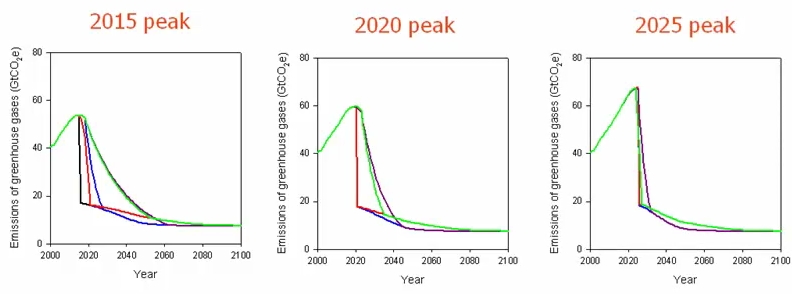
Moreover, to stabilize atmospheric concentrations at levels that will avoid dangerous climate change the entire world will need to peak its emissions  in the next few years followed by emissions reductions at hard to imagine rates over the next 40 years. The following chart shows the emissions reduction pathways that are needed in this century to give the world any hope of limiting warming to 2 degrees Centigrade. The later the peaking of global total emissions, the steeper the reduction pathways that are needed. (The different colored lines represent different emissions scenarios in the years ahead)


(Anderson, K.  2011)


And so, the US projected emissions reductions fall far short of the 25 to 40 %  emissions reductions below 1990 levels by 2020 that are likely necessary to put the world on a pathway that gives any hope of limiting warming to the dangerous 2 degree C warming limit that has been agreed to. Furthermore there is some inconclusive evidence that to prevent dangerous climate change the warming limit should be 1.5 degrees C, a matter that will  be investigated under the UNFCCC in the next few years.

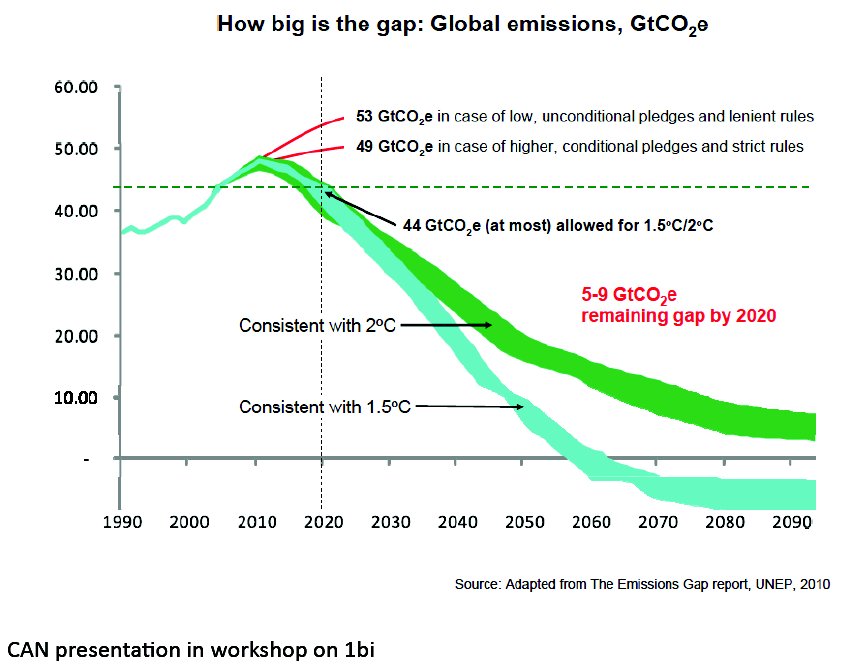
If a 1.5 degrees C warming limit should be the goal of the international community rather than 2 degree C, the international community will need to dramatically increase it emissions reductions ambitions to hard to imagine levels.  In fact, all of the commitments made by all nations under the UNFCCC fall far short of the emissions levels necessary to prevent the 2 degree C warming limit . The following chart describes the gap between the emissions reductions commitments that nations have been made under the UNFCCC.


According to a recent report by the United Nations Environment Program, to have any chance of limiting warming to 2 degree C total levels in 2020 must be no greater than 44 GtCO2e (with a range of: 41-47 GtCO2e). Afterwards, global emissions must steeply decline (a median of 2.5% per year, with a range of 2.0% to 3.0% per year) to 2050.

Because current global greenhouse gas emissions, based on 2010 data,  are estimated at 50.1 GtCO2e the world is emitting emissions 14% higher than the median estimate (44 GtCO2e) of the emission level in 2020 needed to have any hope of limiting warming to the 2 degree C target and global emissions are currently increasing at 2 to 3% per year, the world is running out time to prevent dangerous climate change.  (UNEP, 2011).

The following chart demonstrates the enormity of the challenge after 2020 to limit warming to 2 or 1.5 degrees Centigrade.

(CAN presentation)

Not only must global greenhouse gas emissions be reduced at difficult to imagine rates to avoid dangerous climate change, the United States must exceed these global reduction rates for two reasons according to any sense of basic fairness. First, US per capita emissions are among the highest in the world as we have seen above.  Second, the United States also exceeds all countries in the world in historical emissions. The following chart shows the proportion of global greenhouse gas emissions being emitted by the United States since the beginning of the industrial revolution.


Therefore the US will clearly need to reduce its emissions to even greater levels than those required of the entire world because its per capita emissions are higher than almost all nations and its historical emissions have disproportionally contributed to the elevated atmospheric greenhouse gas concentrations already causing some climate change harms. And so, the United States is challenged to make rapid reductions in greenhouse gas emissions greater than most any other country. This is not only an ethical obligation, it is foundational to any hope of avoiding harsh climate change.

The US media has utterly failed to report on the scale of this challenge. Educators around the world have also largely failed to educate civil society about the urgency of action on climate change. To minimize the threat of climate change, the world needs an “all-hands-on-deck” approach to climate change that is mindful of the scale of the challenge.


By:

Donald A. Brown

Scholar In Residence, Sustainability Ethics and Law

Widener University School of Law

dabrown57@gmail. com


Qatar: The Waiting for the United States Continues

The United States defended its track record on fighting climate change as the Qatar climate change negotiations began last week. The US representative Jonathan Pershing claimed that the United Sates was making “enormous” efforts to slow global warming and help the poor nations most affected by it. (Associated Press, 2012) Other countries have accused the United States of consistently blocking progress in the search for a global solution to climate change particularly since the George W. Bush administration abandoned the Kyoto Protocol, the 1997 treaty limiting emissions of heat-trapping gases by industrialized countries. As negotiators met for a two-week session in oil and gas-rich Qatar, U.S. delegate  Pershing suggested America deserves more credit and said: “Those who don’t follow what the U.S. is doing may not be informed of the scale and extent of the effort, but it’s enormous.” Pershing also noted that the Obama administration has taken a series of steps, including sharply increasing fuel efficiency standards for cars and trucks, and made good on promises of climate financing for poor countries. (Associated Press, 2012). Thus far, the United States has not articulated any willingness to go beyond the voluntary emissions reductions commitment it made in Copenhagen three years ago.

The US apparent unwillingness to reduce its greenhouse gas emissions beyond what it is already on track to achieve is of considerable controversy in the Qatar negotiations this week because of the growing scientific concern about the potential inevitability of catastrophic warming caused by human activities.  Probably at the top of the list in order of importance of all of the issues under negotiation in Qatar is the need to increase the ambitiousness of emissions reductions commitments by nations so that that future warming is limited to 2°C. Because nations have failed to make commitments to reduce global greenhouse gas emissions to levels that will limit future warming do 2°C, there is an increasing sense of urgency among climate scientists around the world on the need for all nations to significantly increase their greenhouse gas emissions reductions commitments to their fair share of safe global emissions. This will require most nations, but particularly high-emitting nations such as the United States, to greatly increase commitments beyond those that they had made in the Copenhagen Cop in 2009.

As we have written about extensively before on EthicandCliamte.org, the world has been waiting for over two decades for the United States to show leadership on climate change.  See, f0r instance, The World Waits In Vain For US Ethical Climate Change Leadership As the World Warms.  Although there are many countries other than the United States that have frequently failed to respond to what justice would require of them to reduce the threat of climate change, the United States, perhaps more than any other country, has gained a reputation in the international community for its consistent unwillingness to commit to serious greenhouse gas emissions reductions during the over two decades that world has been seeking a global agreement on how to respond to climate change. 
Because the United States is such a vital player in any global solution to climate change, the US lack of response to its obligations to reduce the global threat of climate change is widely seen as an immense impediment to an urgently needed global climate change solution. And so the world continues to wait for ethical leadership from the United States on climate change at a time when climate change damages are becoming more visible around the world.

The United States according to the World Resources Institute has recently made progress on its greenhouse gas emissions toward its voluntary target of reducing greenhouse gas emissions by 17% below 2005 emissions by 2020 to the extent that it may reduce its emissions by 9.5 %  by 2020. (WRI, 2012)  US ghg emissions reductions have been achieved in the United States due largely significant fuel switching in the electricity sector from coal to natural gas, an economic slowdown that began in 2008, and some federal and US state regulatory programs designed to reduce ghg emissions. Yet because the US projected reductions of 9.5% below 2005 in 2020 is equal to a 2% increase above 1990 levels in 2020 at a moment in history when many scientists believe that a reductions of 25 to 4o% below 1990 levels by 2020 are necessary to prevent dangerous climate change, the US projected reductions fall extraordinarily short of any reasonable US fair share of tolerable global emissions.

Because of these inadequate commitments from the United States, ECO, an NGO publication that reports on developments at UNFCCC negotiations, wrote the following letter to President Obama that we hereby reprint.

President Obama: We Hope for Change

In his victory speech after being re-elected to a second term, President Obama swelled the hopes once again of people around the world who care about climate change when he said, “We want our children to live in an America that is not burdened by debt, that is not weakened by inequality, that is not threatened by the destructive power of a warming planet.” Those hopes continued to swell when in a press conference a few days later, he responded to a question from the media on climate by saying that he planned to start “a conversation across the country…” to see “how we can shape an agenda that garners bipartisan support and helps move this agenda forward…and…be an international leader” on climate change. President Obama appears to understand that climate change is a legacy issue that was not adequately addressed during his first term in office.

The question therefore has to be, what next? In his second term, will President Obama deliver the bold action needed to reduce the threat of climate change to the US and the world, by shifting the US economy towards a zero carbon future, and making the issue a centerpiece of US foreign policy? In the aftermath of superstorm Sandy, and the drought, wildfires and other extreme weather events that have afflicted the US over the last year, it is clearly time for President Obama to press the reset button on climate policy, both nationally and internationally.

First, the world needs to hear from the President and his negotiating team here in Doha that they remain fully committed to keeping the increase in global temperature far below 2 degrees, that it is not only still possible but essential to do so, and that the USA is going to provide leadership in this collective effort.

The administration should then make clear how it will meet its current 17 percent reduction target. While US emissions are decreasing slightly – both as a result of the administration’s policies on renewable energy and vehicle fuel economy standards and because of sharply lower natural gas prices that have reduced coal use for electricity generation – it is unlikely that without additional regulation or legislation that the US will meet its 2020 target. The delegation should also clarify what the Obama Administration will do to put the US on track to the near-elimination of emissions by mid-century called for by the scientific community.

Finally, delegations need to hear that the US remains committed to meeting its fair share of the Copenhagen pledge of mobilizing $100 billion in climate finance per year by 2020, as well as which innovative finance options the administration is prepared to support to get there.

These four steps would go a long way to reset US climate diplomacy. They would show that instead of dragging the world down to the level of what is (not) possible in the USA, President Obama and his team are going to pull the US up to what the science and the world demands to avoid catastrophic climate change.

One last point: every coach knows that when you find your team down by several goals at half-time, a change in your game plan may not be enough; it may also be time to make some substitutions to the players on the field.

By:

Donald A. Brown

Scholar In Residence

Sustainability Ethics and Law

Widener University School of Law

dabrown57@gmail.com


The US Media’s Grave Failure To Communicate The Significance of Understanding Climate Change as A Civilization Challenging Ethical Issue.

I. Introduction

This is the fourth entry in a series that is examining grave communications failures of the US media in regard to climate change. In this series we examine how the American media has utterly failed to communicate to US citizens about five essential aspects of climate change that need to be understood to know why climate change is a civilization challenging problem that requires dramatic, aggressive, and urgent policy action to avoid harsh impacts to hundreds of millions of people around the world.  EthicsandClimate.org has recently developed a video that summarizes these failures: Five Grave Communication Failures of US Media on Climate Change at: http://blogs.law.widener.edu/climate/2012/10/15/five-grave-communications-failures-of-the-us-media-on-climate-change/

This is the third paper that examines in more detail the issues briefly examined in the video. In the last two entries we examined the failure of the US media to communicate about: (1) the strong scientific position on climate change, and (2) the magnitude of greenhouse gas emissions reduction necessary to avoid catastrophic climate impacts. In this post we look at the failure of the US press to communicate about the significance for policy of seeing climate change as an ethical issue.

Subsequent posts will examine the following additional communication failures of the US media:

  •  The consistent barrier that the United States has been in developing a global solution on climate change for over 20 years.
  •  The nature of the climate change disinformation campaign in the United States.

II. Significance of Understanding Climate Change as A Civilization Challenging Ethical Issue.

There has been almost no coverage in the American press about the ethical duties of governments, organizations, businesses, and individuals to reduce the threat of climate change other than occasional general assertions by some activists or members of a religious groups referring to climate change as a moral issue. When substantive issues about climate change policies have been debated in the United States, there has not been a whimper in the US press about the ethical dimensions of climate change in general or the ethical implications for specific issues under consideration.

 The evidence for this widespread failure to understand the practical significance of seeing climate change as a moral issue includes the almost universal failure of the press or advocates of climate change policies to ask businesses, organizations, or individuals who oppose national climate change policies on the grounds of economic cost alone, whether they deny that, in addition to economic interests, nations must comply with their obligations, duties, and responsibilities to prevent harm to millions of poor, vulnerable people around the world. In the United States and other high-emitting nations there is hardly a peep in the US media about the practical consequences of seeing climate change as a world-challenging ethical problem.

If climate change is understood as essentially an ethical problem, several practical consequences for policy formation follow. Yet it is clear that there has been widespread failure of those engaged in climate change policy controversies to understand the enormous practical significance for policy formation of the acknowledgement that climate change is a moral issue.

Given the growing urgency of the need to rapidly reduce global greenhouse gas emissions and the hard-to-imagine magnitude of global emissions reductions needed to stabilize atmospheric concentrations at reasonably safe levels, the failure of many engaged in climate change controversies to see the practical significance of understanding climate change as an ethical problem must be seen as a huge human tragedy.

Without doubt, there are several reasons why climate change must be understood essentially as a civilization challenging ethical problem. yet very few people appear to understand what practical difference for policy formation follows if climate change is understood as an ethical problem.

Why is climate change fundamentally an ethical problem?

First, climate change creates duties, responsibilities, and obligations because those most responsible for causing this problem are the richer developed countries or rich people in developed and developing countries, yet those who are most vulnerable to the problem’s harshest impacts are some of the world’s poorest people. That is, climate change is an ethical problem because its biggest victims are people who have done little to cause the immense threat to them.

Second, climate-change impacts are potentially catastrophic for many of the poorest people around the world. Climate change harms include deaths from disease, droughts, floods, heat, and intense storms, damages to homes and villages from rising oceans, adverse impacts on agriculture, diminishing natural resources, the inability to rely upon traditional sources of food, and the destruction of water supplies. In fact, climate change threatens the very existence of some small island nations. Clearly these impacts are potentially catastrophic. Yet there is growing evidence that greenhouse gas levels and resulting warming may be approaching thresholds that could lead to losing control over rising emissions.

Third, climate change must be understood to be an ethical problem because of its global scope. If other problems are created at the local, regional, or national scale, citizens can petition their governments to protect them from serious harms. But at the global level, no government exists whose jurisdiction matches the scale of the problem. And so, although national, regional, and local governments have the ability and responsibility to protect citizens within their borders, they have no responsibility to foreigners in the absence of international law. For this reason, ethical appeals are necessary to motivate governments to take steps to prevent their citizens from seriously harming foreigners.

Although a few people  have acknowledged that climate change must be understood as an ethical problem, the practical significance for policy formation that follows from this recognition appears to be not widely understood. The following are ten practical consequences, among many others, for policy formation that flow from the acknowledgement that climate change is an ethical problem. Although there are some climate change ethical issues about which reasonable ethical principles would reach different conclusions about what ethics requires, the following are conclusions about which there is a strong overlapping consensus among ethical theories. The ethical basis for these claims have been more rigorously worked out in prior articles on Ethicsandclimatge.org and are not repeated here.

If climate change is an ethical problem, then:

1. Nations or sub-national governments may not look to their domestic economic interests alone to justify their response to climate change because they must also comply with their duties, responsibilities, and obligations to others to prevent climate-change caused harms.

2. All nations, sub-national governments, businesses, organizations, and individuals must reduce their greenhouse gas emissions to their fair share of safe global emissions. Although different theories of distributive justice would reach different conclusions about what “fairness” requires quantitatively, most of the positions taken by opponents of climate change policies fail to pass minimum ethical scrutiny given the huge differences in emissions levels between high and low emitting nations and individuals and the enormity of global emissions reductions needed to prevent catastrophic climate change. Any test of  “fairness” must look to principles of distributive or retributive justice and must be supported by moral reasoning.

3. No nation may refuse to reduce its greenhouse gas emissions to its fair share of safe global emissions on the basis that some other nations are not reducing their emissions to their fair share of safe global emissions. All nations must reduce their greenhouse gas emissions to their fair share of safe global emissions without regard to what other nations do.

4. No national policy on climate change is ethically acceptable unless it, in combination with fair levels of greenhouse gas emissions from other countries, leads to stabilizing greenhouse gas atmospheric concentrations at levels that prevent harm to those around the world who are most vulnerable to climate change. This is so because any national position on climate change is implicitly a position on adequate global atmospheric greenhouse gas concentration stabilization level and all nations have a duty to prevent atmospheric greenhouse concentrations from exceeding levels that are harmful to others.

5. Because it has been scientifically well established that there is a great risk of catastrophic harm from human-induced change (even though it is acknowledged that there are remaining uncertainties about timing and magnitude of climate change impacts), no high-emitting nation, sub-national government, organization, business, or individual of greenhouse gases may use some remaining scientific uncertainty about climate change impacts as an excuse for not reducing its emissions to its fair share of safe global greenhouse gas emission on the basis of scientific uncertainty. The duty to prevent great harm to others begins once a person is on notice that they are potentially causing great harm, not when the harm is absolutely proven.

6. Those nations, sub-national governments, organizations, businesses, and individuals that are emitting greenhouse gases above their fair share of safe global emissions have obligations, duties, and responsibilities for the costs of adaptation or damages to those who are harmed or will be harmed by climate change.

7. Given the magnitude of potential harms from climate change, those who make skeptical arguments against the mainstream scientific view on climate change have a duty to submit skeptical arguments to peer-review, acknowledge what is not in dispute about climate change science and not only focus on what is unknown, refrain from making specious claims about the  mainstream science of climate change such as the entire scientific basis for climate change that has been completely debunked, and assume the burden of proof to show that emissions of greenhouse gases are benign.

8. Those nations or entities that have historically far exceeded their fair share of safe global emissions have some responsibility for their historic emissions. Although the date at which responsibility for historic emissions is triggered is a matter about which different ethical theories may disagree, at the very least nations have responsibility for their historical emissions on the date that they were on notice that excess greenhouse gas emissions were dangerous for others, not on the date that danger was proven.

9. In determining any nation’s fair share of safe global emissions, the nation must either assume that all humans have an equal right to use the atmosphere as a sink for greenhouse gases, or identify another allocation formula based upon morally relevant criteria. All nations have an ethical duty to explain why any deviation from per capita greenhouse gas emissions is ethically justified.

10. Some economic tools frequently used to evaluate public policy on climate change such as cost-benefit analysis that doesn’t acknowledge responsibility for allocating the burdens for reducing the threat of climate change on the basis of distributive justice are ethically problematic.

Given that climate change is obviously an ethical problem, and that if climate change is understood as an ethical problem it has profound significance for climate policy, the utter failure of the US media to cover climate change as an ethical problem is an enormous practical error and tragedy.

By:

Donald A. Brown

Scholar In Residence

Sustainability Ethics and Law

Widener University School of Law

dabrown57@gmail.com

In Praise and Criticism of the PBS Frontline Program, Climate of Doubt

On October 23, 2012,  the PBS program Frontline aired a program called Climate of Doubt.  available on the PBS website at www.pbs.org/frontline/  This program describes the success of right-wing organizations and some corporations in both undermining the public’s understanding of the mainstream scientific view about human-induced climate change and in preventing legislative action to reduce US greenhouse gas emissions. Climate of Doubt explains that the disinformation campaign has succeeded despite the fact that the vast majority of climate scientists that actually engage in climate change scientific research strongly support the consensus scientific view that humans are causing dangerous warming.

In a very introductory manner, the Frontline program explains how the climate change disinformation campaign has managed to weaken support for doing something about climate change and for this reason the program is a welcome addition to the otherwise largely non-existent US media coverage of who is behind the climate change disinformation campaign.

Although the Frontline program should be welcomed for bringing much needed attention to this tragic manipulation of a democracy,  at the same time the program can be criticized for missing important elements of the story necessary to get a full understanding  of the outrageousness,  if not criminality, of the climate change disinformation campaign.

Missing from the Frontline description of the disinformation campaign are:

(a) A stronger sense of the strength of the consensus view, (every academy of science in the world supports the consensus view, over a hundred scientific organizations whose members have relevant scientific expertise support the consensus view, much of the science that should have been the basis for US action on climate change was settled 150 years ago, and there are clear qualitative differences between peer-reviewed science and the manufactured, non-peer reviewed science usually relied upon by the disinformation campaign),

(b) A sense of the urgency for the need to make greenhouse gas emissions reductions as soon as possible to avoid dangerous climate change.

(c) The civilization challenging magnitude of the reductions that will be necessary to prevent dangerous climate change,

(d) The tactics of the disinformation campaign which cannot be understood as responsible skepticism, such as: (1)  making claims that not only have not been peer-reviewed but are at odds with well-settled  science, (2) cherry picking the science, (3) treating one study as undermining the entire body of climate science even though the issue in contention is not consequential in regard to the major mainstream scientific conclusions, (4) cyber-bullying scientists and journalists that publish statements that climate change is a significant threat, (5) making completely false claims that are either lies or reckless disregard for the truth such as the claim that the  entire scientific basis for action is a hoax when every academy of science supports the consensus view, and (6) the use of front groups and Astroturf groups that hide the real parties in interest behind the disinformation campaign, namely fossil fuel companies and free-market fundamentalist foundations.

(d) The fact that high-emitting nations and individuals are putting hundreds of millions of world’s poorest people at risk who have done nothing to cause the problem,

(e) The fact that the United States has been a major barrier to a global solution in climate negotiations for over two decades due to the disinformation campaign,

(f) The fact that even the Obama administration is unwilling to make commitments for emissions reductions consistent with any reasonable interpretation of the US fair share of safe global emissions,

(g) The fact that climate change must be understood as a moral and ethical issue, an understanding that undermines the purely US self-interested economic arguments made by those who oppose action on climate change,

(h) The fact that it already too late to prevent climate-change  caused  grave suffering for some people in some parts of the world and that the world has lost over twenty years during which action could have been taken to reduce the now enormous threat,

(i) The fact that hundreds of millions of people around the world who are most vulnerable to climate change’s worst threats have never consented to be put at risk while the United States waits for absolute certainty. and

(j) The fact that each year the United States has waited  to take action, the problem has become worse.

In summary, the Frontline program, although a welcome overdue US media analysis of the climate change disinformation campaign, fails to adequately explain why the disinformation campaign should be considered as some new kind of crime against humanity. The Frontline program give far to much attention to some of the climate deniers while failing to communicate adequately the strength of the consensus position.

Given what is at stake from climate change, ethics requires that those who want to discuss the uncertainties of climate change science must proceed with extreme care including limiting their claims to peer-reviewed science and not overstating the significance of individual studies.   Skepticism in science is the oxygen of science and therefor is a good thing, but many of the tactics of the disinformation campaign are clearly not responsible skepticism.  They are often deeply deceitful, ethically abhorrent disinformation.

Ethicsandclimate.org has  looked at the disinformation campaign in considerable more detail than the issues covered in the Frontline program in a four part series:

1. Ethical Analysis of the Climate Change Disinformation Campaign: Introduction to A Series Series.

2.Ethical Analysis of Disinformation Campaign’s Tactics: (1) Reckless Disregard for the Truth, (2) Focusing On Unknowns While Ignoring Knowns, (3) Specious Claims of “Bad” Science, and (4) Front Groups.

3.Ethical Analysis of Disinformation Campaign’s Tactics: (1) Think Tanks, (2) PR Campaigns, (3) Astroturf Groups, and (4) Cyber-Bullying Attacks.

4. Irresponsible Skepticism: Lessons Learned From the Climate Disinformation Campaign

Ethicsandclimate has also produced a video on why the climate change disinformation campaign is so ethically abhorrent. See. Why the Climate Change Is So Ethically Abhorrent.

By:

Donald A. Brown

Scholar In Residence, Sustainability Ethics and Law

Widener University School of  Law

dabrown57@gmail.com

Five Grave Communications Failures of the US Media On Climate Change-The Failure To Communicate The Strength of The Scientific Consensus

I. Introduction

The US media has utterly failed to communicate to the American people about five essential aspects of climate change that they need to understand to know why climate change is a civilization challenging problem that requires dramatic, aggressive, and urgent policy action to avoid harsh impacts to hundreds of millions of people around the world.  EthicsandClimate.org has recently developed a video on these failures entitled: Five Grave Communication  Failures of US Media On Climate Change 

We now provide a more detailed written description of these failures in this and subsequent posts. In this post we look at the first of these communications failures, namely the failure  to communicate to US citizens the strength and nature of the current scientific consensus position on climate change.

Subsequent posts will examine the following additional communication failures of the US media:

  • The magnitude of greenhouse gas emissions reductions that are necessary to prevent dangerous climate change.
  • The consistent barrier that the United States has been in finding a global solution on climate change for over 20 years.
  • The fact that climate change must be understood as a civilization challenging ethical problem, an understanding that is of profound significance for climate change policy formation.
  • The nature of the climate change disinformation campaign in the United States.

II. The Strength And Nature Of The Current Scientific Consensus Position On Climate Change.

Most US citizens are aware that there has been an ongoing debate about the science of climate change, yet most American are completely unaware of the strength of the “consensus” position on climate change.

The consensus position is understood to be that which has been articulated by the Intergovernmental Panel on Climate Change (IPCC). The IPCC was established by the World Meteorological Organization (WMO) and the United Nations Environment Program (UNEP) in 1988 to assess for governments the scientific, technical and socio-economic information relevant for the understanding of climate change, and to identify its potential impacts and options for adaptation and mitigation. (IPCC, 2010) The IPCC does not do original research but synthesizes and summarizes the extant peer-reviewed climate change science to make recommendations for governments and policy makers. (IPCC, 2010a) The consensus position is not the consensus on all scientific issues entailed by climate change. Yet, the consensus position has the following elements:

  • The planet is warming
  • The observable warming is very likely mostly caused by human activities
  • Under business as unusual human-induced warming will likely range from 2 to 5 degrees C (although it could be greater). This warming will harm some people more than others from rising seas, increased droughts and floods, increased storms, increased vector-borne disease, deaths from heat waves, reducing food productivity, and diminished availability to water.
  • To stabilize GHG in the atmosphere will require huge reductions from business as usual.

There are several strong reasons why the “consensus” view is  entitled to respect including the following:

One, recent reports have concluded that the vast majority of scientists actually doing research in the field support the consensus scientific view.

For example, a 2009 study–published in the Proceedings of the National Academy of Sciences of the United States–polled 1,372 climate researchers and resulted in the following two conclusions.

(i) 97-98% of the climate researchers most actively publishing in the field support the tenets of ACC (Anthropogenic Climate Change) outlined by the Intergovernmental Panel on Climate Change, and


(ii) The relative climate expertise and scientific prominence of the researchers unconvinced of ACC are substantially below that of the convinced researchers.


(Anderegga et. al 2010)

Another poll performed in 2009 of 3,146 of the known 10,257 Earth scientists concluded that 76 out of 79 climatologists who “listed climate science as their area of expertise and who also have published more than 50% of their recent peer-reviewed papers on the subject of climate change” believe that mean global temperatures have risen compared to pre-1800s levels, and 75 out of 77 believe that human activity is a significant factor in changing mean global temperatures. (Doran and Zimmerman, 2009)

Two, in response to arguments from some climate change skeptics, many scientific organizations with expertise relevant to climate change have endorsed the consensus position that “most of the global warming in recent decades can be attributed to human activities” including the following:
• American Association for the Advancement of Science
• American Astronomical Society
• American Chemical Society
• American Geophysical Union
• American Institute of Physics
• American Meteorological Society
• American Physical Society
• Australian Coral Reef Society
• Australian Meteorological and Oceanographic Society
• Australian Bureau of Meteorology and the CSIRO
• British Antarctic Survey
• Canadian Foundation for Climate and Atmospheric Sciences
• Canadian Meteorological and Oceanographic Society
• Environmental Protection Agency
• European Federation of Geologists
• European Geosciences Union
• European Physical Society
• Federation of American Scientists
• Federation of Australian Scientific and Technological Societies
• Geological Society of America
• Geological Society of Australia
• International Union for Quaternary Research (INQUA)
• International Union of Geodesy and Geophysics
• National Center for Atmospheric Research
• National Oceanic and Atmospheric Administration
• Royal Meteorological Society
• Royal Society of the UK

(Skeptical Science, 2010)

Three, the Academies of Science from nineteen different countries all endorse the consensus view. Eleven countries have signed a joint statement endorsing the consensus position.
They are:
• Academia Brasiliera de Ciencias (Brazil)
• Royal Society of Canada
• Chinese Academy of Sciences
• Academie des Sciences (France)
• Deutsche Akademie der Naturforscher Leopoldina (Germany)
• Indian National Science Academy
• Accademia dei Lincei (Italy)
• Science Council of Japan
• Russian Academy of Sciences
• Royal Society (United Kingdom)
• National Academy of Sciences (USA)

(Skeptical Science, 2010):

Among the academies of sciences around the world that have issued reports supporting the consensus view is the United States Academy of Sciences that has issued four reports.

From this it can be seen that the consensus view articulated by the IPCC is strongly supported by: (1) the vast majority of climate change scientists that actually do research on human-induced climate change (2) the most prestigious scientific organizations comprised of scientists with relevant climate change expertise, and (3) academies of sciences around the world, the very institutions that have been created to advise governments on complex scientific issues. For this reason, the IPCC consensus position is entitled to strong respect that, at the very minimum, climate change poses a legitimate significant threat to human well-being and the natural resources on which life depends.

In fact, some critics have contended that the IPCC reports tend to underestimate climate change dangers and risks because the process that leads to the IPCC conclusions give representatives from countries that have consistently opposed the adoption of international climate regimes power to pressure the IPCC scientists to report only the lowest common denominator. (For a discussion of the limits of IPCC, see, Brown, 2008) In fact observations of actual greenhouse gas atmospheric concentrations, temperatures, and sea level rise are near or exceeding the IPCC worst-case predictions. One recent comparison of greenhouse gas concentrations, temperatures, and sea-level rise observations versus predictions concluded:

Overall, these observational data underscore the concerns about global climate change. Previous projections, as summarized by the IPCC, have not exaggerated but may in some respects even have underestimated the climate changes that have been observed. 
(Rahmstorf et al., 2007)

It is important as a mater of ethics to remember that if the consensus view is wrong, it could be wrong in two directions. That is, not only could IPCC be overstating the magnitude and timing of climate change in the future, they may be understating the harshness of climate change harms.

And so, the most prestigious scientific organizations in the world support the consensus view on climate change.  Yet. the United States media has almost always failed to communicate this fact when discussing controversies about climate change science. Although the US media has from time to time acknowledged that most climate scientists support the consensus view, they have almost always failed to describe strength of the consensus view that becomes apparent when one understands the magnitude of support for the consensus view by the most prestigious scientific organizations end researchers described above.

Given the enormity and harshness of impacts to hundreds of millions of people around the world from climate change coupled with the fact that United States has a special responsibility for the civilization challenging problem because of the comparatively large levels of the emissions coming from America, the failure of the US media to describe strength the scientific consensus on change is a grave and tragic error.

References:

Agrarwala, Shardul and Stiener Anderson, 1999, Indispensability and Indefensibility?:
The United States In Climate Treaty Negotiations. ” 2w Governance 5, December 1999).

Brown, Donald, 2008, Ethical Issues Raised by the Work of the Intergovernmental Panel on Climate Change (IPCC): Report On The Bali Workshop (COP-13). Climate Ethics. http://rockblogs.psu.edu/climate/2008/02/report-on-the-workshop-at-the-13th-conference-of-the-parties-of-the-united-nations-framework-convention-on-climate-change.html

Doran, Peter T.; Maggie Kendall Zimmerman, 2009. Examining the Scientific Consensus on Climate Change, EOS 90 (3): 22-23

Intergovernmental Panel On Climate Change (IPCC), 2010a, History, http://www.ipcc.ch/organization/organization_history.htm

 Rahmstorf, Stepen, Anny Cazenave, John A. Church, James E. Hansen,
Ralph F. Keeling, David E. Parker, Richard C. J. Somervilles, 2007, Recent Climate Observations Compared to Projections, Science, Vol 316 , May 2007

Skeptical Science, 2010, What the Science Says: shttp://www.skepticalscience.com/global-warming-scientific-consensus-intermediate.htm (retrieved, Jan 3, 2011)


By:

Donald A. Brown

Scholar In Residence,

Sustainability Ethics and Law

Widener University School of Law

Dabrown57@gmail.com


Five Grave Communications Failures of The US Media On Climate Change

Video

This video examines 5 grave tragic communications failures of the US media on climate change.

These include the failure to communicate;

  1. The strength of the scientific consensus
  2. The civilization challenging nature of the magnitude of greenhouse gas emissions reductions needed to prevent dangerous climate change
  3. The barrier that the United States has been in international climate negotiations that have been ongoing since 1990 to achieve a global solution to climate change
  4. The essential ethical and moral nature of the climate change problem, a fact that has profound significance for policy formation
  5. The nature of the climate change disinformation campaign.


By: 

Donald A. Brown

Scholar In Residence

Sustainability Ethics and Law

Widener University School of Law

dabrown57@gmail.com