The Grave US Media Failure to Report On The Climate Change Disinformation Campaign

I. Introduction

This is the sixth in a series of articles that examines tragic communications failures of the US media about climate change. In this series we examine how the American media has utterly failed to communicate to US citizens about five essential aspects of climate change that need to be understood to know why climate change is a civilization-challenging problem that requires dramatic, aggressive, and urgent policy action to avoid harsh impacts to hundreds of millions of people around the world.  EthicsandClimate.org has developed a video that summarizes these failures: Five Grave Communication Failures of US Media on Climate Change that can be found at: http://blogs.law.widener.edu/climate/2012/10/15/five-grave-communications-failures-of-the-us-media-on-climate-change/

This is the fifth paper that examines in more detail the issues briefly examined in the video. In previous entries we examined the failure of the US media to communicate about: (a) the nature of the strong scientific consensus about human-induced climate change, (b) the magnitude of greenhouse gas emissions reductions necessary to prevent catastrophic climate change,(c) the practical significance for policy that follows from understanding climate change as essentially an ethical problem, and (e) the consistent barrier that the United States has been to finding a global solution to climate change in international climate negotiations.  In this paper we look at the failure of the US media to help educate US citizens about the well-financed, well-organized climate change disinformation campaign.

II. The US Media Failure to Educate American Citizens About The Climate Change Disinformation Campaign

For over 30 years, there has been a debate about climate change that most Americans are at least dimly aware of.  In this debate, sometimes those opposed to action on climate change are characterized as climate “skeptics.” Skepticism is the oxygen and catalyst of science and should be encouraged. Yet most Americans are completely unaware that a well-financed, well-organized climate change disinformation campaign has been operating for over two decades that has used tactics which cannot be classified as responsible skepticism. In fact, this campaign has been engaged in tactics that are deeply ethically abhorrent. To the extent that the US mainstream press has covered this controversy, it has reported on disputes between mainstream climate scientists and scientific skeptics and in so doing ignoring the ethically abhorrent tactics of the disinformation campaign discussed in this article and at the same time giving opposition to climate change policy legitimacy that the disinformation campaign does not deserve because its tactics cannot be understood as responsible skepticism. Also, as we have described in considerable detail in a prior entry, the mainstream press has utterly failed to cover the strength of the climate change scientific consensus position on climate change.

This disinformation campaign has largely been responsible that the United States failure to enact comprehensive climate change policies. Given the enormity, harshness, and destructiveness of climate change impacts, the duties that high-emitting countries like the United States have to not harm hundreds of millions of people around the world who are vulnerable to climate change, and the fact that the world has now lost several decades in finding a solution to climate change at a time when the world may be running out of time to prevent dangerous climate change, the failure of the US media to report on the nature of this campaign to the American people is a grave, tragic, and profound failure.

There is a growing peer-reviewed sociological literature on the disinformation campaign which describes this phenomenon as a counter-movement. (See, for example, McCright and Dunlap 2000: 559) A counter-movement is a social movement that has formed in reaction to another movement. (McCright and Dunlap 2000: 504.) The climate change disinformation campaign can be understood to be a continuation of the counter-movements that arose among US political conservatives in reaction to the environmental, civil rights, women’s rights, and anti-war movements that arose in the 1960′s in the United States. And so, the climate change disinformation campaign’s methods and processes can be understood to be an extension of strategies that had already been developed among some, although not all, conservatives to counter the environmental movement that had developed in the late 1960s and 1970s around other environmental issues such as air and water pollution, safe disposal of waste and toxic substances, and protection of wetlands and endangered species.

Yet the emergence of global warming as an issue in the 1980s with its potential for large-scale social change needed to ameliorate its threat was seen as more threatening to conservatives in regard to industry, prosperity, life-style, and the entire American-way of life, than were traditional pollution problems. (McCright and Dunlap 2000: 503) In other words, climate change directly threatened the central values of the US conservative movement even more than other environmental problems. (McCright and Dunlap 2000: 505) As a result climate change has become the key environmental focus of the US conservative movement.

In addition there have been some American industries whose welfare depends upon fossil fuel use have also participated in the disinformation campaign by funding this effort. The climate change disinformation movement can be understood to be comprised of many organizations and participants including conservative think tanks, front groups, Astroturf groups, conservative media, and individuals. This disinformation campaign frequently has used certain tactics to convince people and politicians that the science supporting climate change policies is flawed. The central claims of the climate change disinformation movement have been:

• There is no warming.
• Its not caused by humans.
• Reducing greenhouse gas emissions will cause more harm than good.
(McCright and Dunlap 2010: 111)

To support these claims, the climate denial machine frequently has made claims that: (a) mainstream climate scientists are corrupt or liars, (b) descriptions of adverse climate change impacts are made by “alarmists,” (c) scientific journals that publish climate related research are biased against skeptics, and (d)  mainstream climate science is “junk” science. The climate change disinformation machine also has made frequent ad hominem attacks on those who produce climate change science and sometimes has cyber-bullied both climate scientists and journalists.  In summary, the climate change disinformation campaign has engaged in these tactics and others identified in this paper that may not be classified as responsible skepticism, yet the US media has covered this campaign as if it was the output of reasonable scientific  skepticism.

The climate change disinformation campaign began in the 1980s when some of the same scientists and organizations that fought government regulation of tobacco began to apply the tactics perfected in their war on the regulation of tobacco to climate change. (Oreskes and Conway 2010:169-215). According to Pooley the disinformation campaign began “spinning around 1988 in response to the increasingly outspoken scientific community…” (Pooley 2010: 39) For almost 25 years this campaign has been waged to undermine support for regulation of greenhouse gases.

To say that the campaign has been “waged” is not to claim that it has been a tightly organized, completely coordinated effort by a few groups or individuals or that all participants have the same motives. In fact different participants may have radically different motives including the fact that some may be sincere, some appear to be motivated by protecting free markets without government intervention, and many appear to believe that no restriction on fossil fuel use can be justified without very high levels of proof of harms. Yet, these different participants, according to Newsweek, since the 1990s for the most part have acted in a well-coordinated campaign among contrarian scientists, free-market think tanks, and industry to create a fog of doubt around climate change. (Begley 2007) They have accomplished this through the production of advertisements, op-eds, lobbying, books, media attention, and quotations from skeptical scientists often associated with conservative think tanks. They have argued first that the world is not warming, measurements that indicate otherwise are flawed, any warming is natural, that is not caused by human activities, and if warming does occur it will be miniscule and harmless. (Begley 2007)

Different groups created this counter-movement often acting independently of each other, yet connected through the internet to create a denial machine that has effectively responded to any public pronouncement by scientists or journalists that have asserted that human-induced climate change is a serious problem. (Begley 2007) Conservative activists wrote hundreds of documents (including policy briefs, books, press releases, and op-eds), held numerous policy forums and press conferences, appeared regularly on television and radio programs, and testified at congressional hearings on global warming. (Dunlap and McCright 2008)

As a result of the internet communication between participants in this campaign, charges by one of the participants have been quickly transmitted to others creating an echo chamber of counter-claims made in opposition to the mainstream scientific view of climate change.

The disinformation campaign’s most important participants have been conservative think tanks according to the sociological literature. (Jaques et al 2008) As we shall see, these think tanks developed the ideas, communications and media strategies, literature and press releases that have been widely deployed in rhetorical strategies to defend conservative interests by creating doubt about mainstream climate change scientific claims.

Initially most of the funding for this disinformation campaign came from fossil fuel interests and corporations whose products produce high levels of greenhouse gas emissions. On October 21, 2010, John Broder of the New York Times reported that:

“the fossil fuel industries have for decades waged a concerted campaign to raise doubts about the science of global warming and to undermine policies devised to address it.” (Broder 2010)

According to Broder, the fossil fuel industry has:

“created and lavishly financed institutes to produce anti-global-warming studies, paid for rallies and Web sites to question the science, and generated scores of economic analyses that purport to show that policies to reduce emissions of climate-altering gases will have a devastating effect on jobs and the overall economy.” (Broder 2010)

Not surprisingly, the fossil fuel industry funded many of the initial efforts to prevent adoption of climate change policies. Both individual corporations such as ExxonMobil and Peabody Coal, as well as industry associations such as American Petroleum Institute, Western Fuels Associations, and Edison Electric Institute provided funding for individual contrarian scientists, conservative think tanks active in climate change denial, and a host of front groups that we will discuss below. (Dunlap and McCright 2011:148)

Although the initial funding in the campaign may have come from certain corporations, McCright and Dunlap argue that recently conservative, free-market, and anti-regulatory ideology and organizations have been the main forces fueling the denial machine first and foremost. (Dunlap and McCright 2011:144)

According to Dunlap and McCright the glue that holds the elements of the climate disinformation campaign together is a shared hatred for government regulation of private industry. (Dunlap and McCright 2011:144) And so, a staunch commitment to free markets and a disdain for government regulation are the ideas that most unite the climate denial community. (Dunlap and McCright 2011:144)

The mainstream conservative movement, embodied in conservative foundations and think tanks, quickly joined forces with the fossil fuel industry (which recognized very early the threat posed by recognition of global warming and the role of carbon emissions) and wider sectors of corporate America to oppose the threat of global warming, not as an ecological problem, but as a problem for unbridled economic growth. (Dunlap and McCright 2011:144) And so the disinformation campaign has been a movement that has been waged both by conservative organizations and some corporations.

To use the word “campaign” is not meant to connote an organized conspiracy led by one or a few entities who coordinate all actors, but rather a social movement that creates widespread, predictable, and strong opposition to climate change policy and that consistently uses scientific uncertainty arguments as the basis of its opposition. This movement is a campaign in the sense that it is a systematic response of aggressive actions to defeat proposals to limit greenhouse gas emissions even though no one organization is coordinating all other organizations or individuals that participate in responses. And although some of the actors may be sincere, the tactics discussed in this article are, as we shall see, ethically reprehensible.

Those engaged in this disinformation campaign can be distinguished from responsible climate skeptics because the climate change denial campaign is a collective social movement run by professional advocacy working to discredit climate change.” (Hoffman 2011: 5) As such, this movement is not engaged in reasonable scientific skepticism but advocacy that stresses scientific uncertainty. In fact McCright and Dunlap summarize the disinformation machine as having been engaged on misrepresenting, manipulating, and suppressing climate change research results. (McCright and Dunlap 2010: 111)

Although almost all of the disinformation campaign led opposition to climate change policies has been on the basis of inadequate scientific grounding for action, scientific arguments are usually coupled with economic arguments such as claims that climate change policies will destroy jobs, hurt specific industries, lower GDP, or are not justified by cost-benefit analysis.
Although these economic arguments often have their own ethical problems, a series on Ethicsandclimate.org has examined in considerable detail the ethical problems with tactics used by the disinformation campaign that rely on scientific uncertainty arguments.

The original organizations that sought to undermine public support on climate policies by exaggerating scientific uncertainty have expanded to include ideological think tanks, front groups, Astroturf groups (i.e. groups organized by industry that pretend to be a legitimate grassroots organization), and PR firm-led campaigns. (Oreskes and Conway 2010:169-215)
The tactics deployed by this campaign are now all well documented in the books and peer-reviewed sociological literature identified in the Appendix to this article. The tactics used by the climate change disinformation campaign have included the following ethically abhorrent tactics:

  • Lying or reckless disregard for the truth
  • Cherry picking the science
  • Cyber-bullying and ad hominem attacks on scientists and journalists
  • Manufacturing bogus, non-peer-reviewed science in fake conferences and publications
  • The use of ideological think tanks
  • The use of front groups that hide the real parties in interest
  • The use of fake grass-roots organizations known as Astroturf groups
  • Specious claims about “bad science” that are based upon the dubious assumption that no conclusions in science can be made until everything is proven with high levels of certainty.

EthicsandClimate.org has described this in a four part paper series and a three part video series that has demonstrated that these tactics are ethically abhorrent.

The four part written series can be found at:

1. Ethical Analysis of the Climate Change Disinformation Campaign: Introduction to a Series.

2.Ethical Analysis of the Disinformation Campaign’s Tactics: (1) Reckless Disregard for the Truth, (2) Focusing On Unknowns While Ignoring Knowns, (3) Specious Claims of “Bad” Science, and (4) Front Groups.

3.Ethical Analysis of Disinformation Campaign’s Tactics: (1) Think Tanks, (2) PR Campaigns, (3) Astroturf Groups, and (4) Cyber-Bullying Attacks.

4. Irresponsible Skepticism: Lessons Learned From the Climate Disinformation Campaign

 The three part video series can be found at:

Why The Climate Change Disinformation Campaign Is So Ethically Abhorrent

The Ethical Abhorrence of The Climate Change Disinformation Campaign, Part 2

The Ethical Abhorrence of the Climate Change Disinformation Campaign, Part 3

Although the mainstream US media has sometimes but infrequently covered the disinformation campaign, missing from their coverage has been:

(a) A stronger sense of the strength of the consensus view on climate change, (every academy of science in the world supports the consensus view, over a hundred scientific organizations whose members have relevant scientific expertise support the consensus view, much of the science that should have been the basis for US action on climate change was settled 150 years ago, and there are clear qualitative differences between peer-reviewed science and the manufactured, non-peer reviewed science usually relied upon by the disinformation campaign),

(b)  A description of the tactics of the disinformation campaign which cannot be understood as responsible skepticism, such as: (1)  making claims that not only have not been peer-reviewed but are at odds with well-settled science, (2) cherry picking the science, (3) treating one study as undermining the entire body of climate science even though the issue in contention is not consequential in regard to the major mainstream scientific conclusions, (4) cyber-bullying scientists and journalists that publish statements that climate change is a significant threat, (5) making completely false claims that are either lies or reckless disregard for the truth such as the claim that the entire scientific basis for action is a hoax when every academy of science supports the consensus view, and (6) the use of front groups and Astroturf groups that hide the real parties in interest behind the disinformation campaign, namely fossil fuel companies and free-market fundamentalist foundations.

(c) The fact that it already too late to prevent climate-change caused grave suffering for some people in some parts of the world and that the world has lost over twenty years during which action could have been taken to reduce the now enormous threat,

(d) The fact that hundreds of millions of people around the world who are most vulnerable to climate change’s worst threats have never consented to be put at risk while the United States waits for absolute certainty.

(e) The fact that for each year the United States has waited to take action, the problem has become worse.

Given what is at stake from climate change, the failure of the US media to cover the disinformation campaign is a tragic, profound, and grave error.  The mainstream US media has not only failed to cover this campaign, it has treated it as if it was reasonable scientific skepticism giving it a legitimacy that has increased its influence.

References:

Begley, S. (2007) Global Warming Deniers: A Well-Funded Machine, Newsweek, http://msl1.mit.edu/furdlog/docs/2007-08-13_newsweek_global_warming_denyers.pdf (visited Jan. 13, 2011)

Boycoff, J. and M. Boycoff (2004) Journalistic Balance as Global Warming Bias
Creating Controversy Where Science Finds Consensus Fair,
Fairness and Accuracy in Reporting, http://www.fair.org/index.php?page=1978

Broder, John, (2010) Climate Change Doubt Is Tea Party Article of Faith, New York Times, October 21, 2009, http://community.nytimes.com/comments/www.nytimes.com/2010/10/21/us/politics/21climate.html?sort=newest&offset=2


Dunlap, Riley E. and Aaron M. McCright (2008) A Widening Gap: Republican and Democratic Views on Climate Change. Environment 50 (September/October):26-35.

Dunlap, Riley E. and Aaron M. McCright (2010) Climate Change Denial: Sources, Actors and Strategies Pp. 240-259 in Constance Lever-Tracy (ed.), Routledge Handbook of Climate Change and Society London: Routledge.

Hoffman, Andrew J. (2011) Talking Past Each Other? Cultural Framing of Skeptical and Convinced Logics in the Climate Change Debate, Organization & Environment 24:3-33.

Jacques, Peter, Riley E. Dunlap, and Mark Freeman (2008) The Organization of Denial: Conservative Think Tanks and Environmental Skepticism, Environmental Politics 17:349-385.

McCright, Aaron M. and Riley E. Dunlap (2000) Challenging Global Warming as a Social Problem: An Analysis of the Conservative Movement’s Counter-Claims, Social Problems 47:499-522.

McCright, Aaron M. and Riley E. Dunlap (2010) Anti-Reflexivity: The American Conservative Movement’s Success in Undermining Climate Science and Policy, Theory, Culture and Society 26:100-133.

Oreskes, Naiomi and Erik Conway (2010) Merchants of Doubt, How a Handful of Scientists Obscured the Truth On Issues From Tobacco Smoke to Global Warming, Bloosmbury Press, New York.

Pooley, E. (2010) Climate Wars, True Believers, Power Broakers and The Fight to Save the Earth, Hyperion, New York


By:

Donald A. Brown

Scholar In Residence

Sustainability Ethics and Law

Widener University School of Law

dabrown57@gmail.com

The Grave US Media Failure to Communicate About The Consistent Barrier That The United States Has Been To Finding A Global Solution to Climate Change.

I. Introduction

This is the fifth in a series of articles that examines grave communications failures of the US media about climate change. In this series we examine how the American media has utterly failed to communicate to US citizens about five essential aspects of climate change that need to be understood to know why climate change is a civilization challenging problem that requires dramatic, aggressive, and urgent policy action to avoid harsh impacts to hundreds of millions of people around the world.  EthicsandClimate.org has developed a video that summarizes these failures: Five Grave Communication Failures of US Media on Climate Change that can be found at: http://blogs.law.widener.edu/climate/2012/10/15/five-grave-communications-failures-of-the-us-media-on-climate-change/

This is the fourth paper that examines in more detail the issues briefly examined in the video. In previous entries we examined the failure of the US media to communicate about: (a) the nature of the strong scientific consensus about human-induced climate change, (b) the magnitude of greenhouse gas emissions reductions necessary to prevent catastrophic climate change, and (c) the practical significance for policy that follows from understanding climate change as essentially an ethical problem.  In this paper we look at the failure of the US media help educate US citizens about the consistent barrier that the US has been in international climate negotiations that have sought for over twenty years to find a global solution to prevent harsh climate change impacts.

The last paper in the series will examine the failure of the US media to help Americans understand the well-organized, well-financed climate change disinformation campaign.

II. The World Waits In Vain For US Leadership On Climate Change.

Most Americans are completely unaware that the United States has consistently been a barrier to achieving a global solution to climate change despite the fact that the United States is an indispensable party to a global climate change solution. To understand the importance of the US solving the global climate change problem, one must keep in mind that: (a) the United States is by far the largest historical emitter of global greenhouse gases that have caused the existing problem, (b) the United States is near the top of national greenhouse gas emitters on a per capita basis, (c) the United States is second only to China in total tons of greenhouse gases emitted, and (d) the United States has the worst record among developed countries in making commitments to a global climate change solution.

Although the United States is an indispensable participant in solving climate change because of the size of the US contribution to the global problem, the United States has a dismal record in over twenty years of international efforts to achieve a global solution to this civilization-challenging global problem. In American Heat, Ethical Problems With the United States Response To Global Warming, (Brown, 2002), this writer documented in detail the negative role in achieving a global approach to climate change that the United States played in the first decade of climate change negotiations from the late 1980s through the year 2000. Among other things during the negotiations of the United Nations Framework Convention on Climate Change (UNFCCC) between 1990 and 1992, the United States, virtually standing alone, successfully prevented the UNFCCC from including enforceable national emissions reductions targets for developed nations.

In a book to be published this month, Navigating the Perfect Moral Storm, Climate Ethics, this writer documents in detail the failure of the United States to be a leader since the conclusions of the UNFCCC negotiations in 1992, (Brown 2012).

Among other things, since the UNFCCC negotiations:

  • The United States has been the only developed country in the world to fail to ratify to the Kyoto Protocol and thereby commit itself to a binding interim emissions reduction target.
  • George W. Bush announced that the United States was not only unwilling to ratify the Kyoto Protocol, it was withdrawing the United States from the Kyoto Treaty all together.
  • When President Obama was elected, there was wide-spread hope the United States would change course on climate change. Yet, the United States under President Obama has approached climate negotiations in Copenhagen in 2009, Cancun in 2010, and South Africa making only a voluntary commitment to reduce its greenhouse gas emissions by 17% below 2005 emissions levels by 2020 thereby making the US promise: (a) the weakest of all of the developed country commitments, and (b) far short of what is required of global greenhouse gas emissions reductions necessary to prevent dangerous climate change.
  • Although there is evidence that President Obama hope to make the United States, for the first time, a responsible participant in an adequate global approach to climate change, since the Republicans took over the US House of Representatives in November of 2010, the United States hast been unable to make meaningful national commitments on climate change and will not likely to be able to do so until well into 2013 at the very earliest.
  • There is no evidence that the United States is willing to make commitments to reduce its greenhouse gas emissions to  levels consistent with what the world needs to do to prevent dangerous climate change, a matter discussed in the second paper in this series.

Although there are several countries that have frequently failed to respond to what justice would require of them to reduce the threat of climate change, the United States, more than any other country, has consistently failed to respond to its ethical duties to reduce its emissions to the its fair share of safe global emissions during the over two decades that the world has been seeking a global agreement on how to respond to climate change.

Because the United States is such a vital player in any global solution to climate change, the United States response to its obligations to reduce the global threat of climate change has been an immense impediment to an urgently needed global climate change solution. And so the world continues to wait for ethical leadership from the United States on climate change as significant damages are becoming more visible around the world. As the world is running out of time to prevent significant climate change, the United States continues to ignore its global obligations. Yet coverage of climate change debates in the US media rarely mention the negative role the United States has been playing in developing a global solution.

The world awaits US leadership on climate change at a time when human-induced climate change harms are becoming more obvious. Yet there is little evidence that US citizens understand their obligations to poor people around the world for climate change damages and the United States has been significantly responsible for delays in reaching a global solution to climate change.  This is both a tragic failure of  domestic leadership and a failure of the US press to help educate Americans about the negative role the US has played in finding a global solution to climate change.

References:

Brown, D. (2002) American Heat: Ethical Problems With the United States Response to Global Warming, Roman and Littlefield.

Brown, D.  (2012) Navigating the Perfect Moral Storm, Climate Change Ethics, Routledge/Earthscan.

By:

Donald A. Brown

Scholar In Residence

Sustainability Ethics and Law

Widener University School of Law

dabrown57@gmail.com
The US Media’s Grave Communication Failure On The Magnitude Of GHG Emissions Reductions Necessary To Prevent Dangerous Climate Change

 I. Introduction

This is the third entry in a series that is examining grave communications failures of the US media in regard to climate change. In this series we examine how the American media has utterly failed to communicate to US citizens about five essential aspects of climate change that need to be understood to know why climate change is a civilization challenging problem that requires dramatic, aggressive, and urgent policy action to avoid harsh impacts to hundreds of millions of people around the world.  EthicsandClimate.org has recently developed a video that summarizes these failures: Five Grave Communication Failures of US Media on Climate Change at: http://blogs.law.widener.edu/climate/2012/10/15/five-grave-communications-failures-of-the-us-media-on-climate-change/

This is the second paper that examines in more detail the issues briefly examined in the video. In the last entry we examined the failure of the US media to communicate about the nature of the strong scientific consensus about human-induced climate change. In this post we look at the failure of the US press to communicate about the enormous magnitude of greenhouse gas emissions reductions necessary to prevent harsh climate change impacts.

Subsequent posts will examine the following additional communication failures of the US media:

  •  The consistent barrier that the United States has been in developing a global solution on climate change for over 20 years.
  •  The fact that climate change must be understood as a civilization challenging ethical problem, an understanding that is of profound significance for climate change policy formation.
  •  The nature of the climate change disinformation campaign in the United States.

II. Communication Failures On The Magnitude Of The GHG Emissions Reductions Necessary To Prevent Dangerous Climate Change

 Most Americans are completely unaware of the magnitude of global greenhouse gas emissions reductions necessary to prevent dangerous climate change. If US citizens don’t understand the size and scope of the problem, they will almost certainly refuse to support legislation and policies necessary to put the United States on an emissions reduction pathway that represents the US fair share of safe global emissions.  Because, as we discussed in the last entry, the scientific consensus is so strong that the world is headed to harsh and dangerous impacts, the US media’s failure to communicate clearly about the magnitude of the problem facing the world is a serious, grave, and tragic lapse.

No US national climate change strategy makes any sense unless it is understood to implicitly be a position on the US fair share of a global greenhouse gas emissions reductions pathway capable of preventing dangerous climate change. Yet when US federal climate change legislation was under consideration between 2009 and 2010, there was almost no public discussion about whether proposed US climate change legislation would reduce US greenhouse gas emissions to levels that represent the US fair share of safe global emissions.

To understand the urgency for civilization challenging emissions reductions it is necessary to understand: (a) what temperature increases will likely trigger harsh climate change impacts,  (b) what atmospheric concentrations of greenhouse gases will cause specific temperature increases that are of concern, and (c) what quantities of greenhouse gas emissions will exceed atmospheric greenhouse target concentrations. Only then can one understand the amount of global greenhouse gas emissions reductions from business as usual that are necessary to avoid dangerous climate change.

A. Dangerous Temperature Increases

The international community agreed at a meeting of the conference of the parties under the United Nations Framework Convention on Climate Change in Copenhagen in 2009 that the world must work together to limit warming to an additional 2oC to avoid rapid non-linear impacts from climate change. The 2oC warming limit was agreed to because there is widespread agreement among the vast majority of mainstream scientists that warming of more than 2oC significantly increases the probability of harsh climate impacts.

However, catastrophic harms, at least for some parts of the world, could be triggered by additional warming of less than 2oC because there is uncertainty about how the Earth will respond to different increases in temperatures. (Athanasiou and Bear 2002) The 2oC upper temperature limit is quite controversial scientifically because, as we shall see, some scientists believe that lower amounts of additional warming could set into motion rapid climate changes that could greatly harm people around the world and increases of as little as 1oC will likely greatly harm some people in some regions.

A report, “Assessment of Knowledge on Impacts of Climate Change,” prepared by the Potsdam Institute to examine the meaning of “dangerous” climate change under the UNFCCC supported the 2°C danger limit after a rigorous analysis of climate change impacts at various temperatures concluding:

Above 2°C the risks increase very substantially involving potentially large extinctions or even ecosystem collapses, major increases in hunger and water shortage risks as well as socio-economic damages, particularly in developing countries. (Hare 2003: 89)

Yet, even this report identified very serious global and regional impacts below 2°C. In fact, this report concluded that temperature increases below 1°C threaten highly vulnerable ecosystems and between 1°C and 2 °C increase the risks of damage for all ecosystems and particularly for some regional ecosystems. (Hare 2003: 89)

There is substantial scientific evidence that even a 1.5°C temperature limit would not be sufficient to protect those most vulnerable to climate change. For instance, a recent paper by Jim Hansen and seven other authors concluded that additional warming should be limited to 1°C warming to prevent serious harms. (Hansen et al 2008) To do this, existing atmospheric concentrations of CO2 must not only not be allowed to rise the small amount to 450 ppm CO2 from current levels of 394 ppm CO2 but must be reduced below existing levels to 350 ppm CO2. (Hansen et al. 2008) According to this paper, the world has likely already shot past the level of atmospheric greenhouse gas concentrations that will lead to dangerous climate change for many. According to Hansen and his collaborators, the world has already used up all of the assimilative capacity of the atmosphere and biosphere that has been available to buffer against dangerous climate change. As a result, this paper asserts that to prevent dangerous climate change the world must not only reduce its emissions but reduce existing greenhouse gas CO2 atmospheric concentrations from the current 394 ppm to 350 ppm CO2 to avoid dangerous climate change.

And so, although the international community agreed in Copenhagen to limit future warming to 2°C, this could prove to be a limit that is too high to protect millions around the world. As one observer recently noted:

We feel compelled to note that even a “moderate” warming of 2°C stands a strong chance of provoking drought and storm responses that could challenge civilized society, leading potentially to the conflict and suffering that go with failed states and mass migrations. Global warming of 2°C would leave the Earth warmer than it has been in millions of years, a disruption of climate conditions that have been stable for longer than the history of human agriculture. Given the drought that already afflicts Australia, the crumbling of the sea ice in the Arctic, and the increasing storm damage after only 0.8 °C of warming so far, calling 2°C a danger limit seems to us pretty cavalier.

(Real Climate 2009)

In thinking about an upper temperature limit, many scientists are concerned with avoiding runaway climate change. That is, they fear that global temperatures will exceed a tipping point that will trigger a release of stored carbon from the biosphere, an event that would cause further rapid climate change. Runaway climate change would mean that governments would lose the ability to control future climate change that they would otherwise have through reducing greenhouse gas emissions from fossil fuel combustion and deforestation. That is, runaway climate change means that human action would be unable to stop significant temperature increase without massive geo-engineering. (Washington and Cook 2011: 30-31) This is so because, among other things, there are vast amounts of methane stored in permafrost, methane hydrates on the ocean floor, and carbon in the forests that could be released as the world warms. If the world warms too much, increased temperatures could cause huge amounts of carbon to be released that would overwhelm the quantities of carbon being released through fossil fuel combustion and deforestation. This is known to be a possibility, because such releases of stored carbon have happened in Earth’s history and caused rapid non-linear Earth temperature changes.

And so, the magnitude of greenhouse gas reductions needed to prevent dangerous climate change is understood to be the reductions from business-as-usual that will allow atmospheric concentrations of greenhouse gases to be stabilized at levels that will limit warming to between 1 to 2°C with prudence calling for a 1°C limit. We now turn to what atmospheric greenhouse gas atmospheric concentrations levels are understood to prevent warming above these amounts.

B. Atmospheric Greenhouse Gas Stabilization Goal

The amount of warming that will be experienced from different greenhouse gas atmospheric concentrations is usually referred to as the issue of “climate sensitivity.” Climate sensitivity is somewhat uncertain as there are remaining scientific uncertainties about the magnitude of the positive and negative feedbacks in the climate system.

Climate sensitivity is usually defined to mean the amount of warming that the Earth will experience if atmospheric concentrations of CO2  reach 560 ppm of CO2  equivalent, where CO2  equivalent is the metric which translates other greenhouse gases into an equivalent level of CO2 . The IPCC in its Fourth Assessment Report (AR4) concluded that climate sensitivity is likely to be in the range 2 to 4.5 °C with a best estimate of about 3°C, and is very unlikely to be less than 1.5 °C. (IPCC 2007) The IPCC also noted that climate sensitivity values substantially higher than 4.5 °C cannot be excluded. And so the temperature change that the consensus view believes is likely if all of the greenhouse gases rise to 560 ppm carbon equivalent is somewhere between 2 °C and 4.5 °C with even higher temperatures possible. The current concentration of CO2 is 394 ppm. (CO2  Now 2012)

To operationalize an upper temperature limit, the international community must set an atmospheric greenhouse gas concentration stabilization limit. Since there is scientific uncertainty about how much warming will be experienced by different atmospheric greenhouse gas concentration levels, there is significant scientific controversy about what the greenhouse gas atmospheric stabilization target should be to achieve any warming limit.

Making the calculation of emissions reductions needed at any one time is complicated by the fact that how rapidly greenhouse gas emissions must be reduced is a problem that depends upon when global emissions reductions begin. The longer the international community waits to reduce greenhouse gas emissions, the steeper the necessary emissions reductions pathway becomes. It is relatively easy to calculate the amount of additional tons of emissions that can be allowed to stabilize atmospheric concentrations at a certain level such as 450 ppm CO2 but this number will depend upon when emissions reductions begin. At any time it is therefore possible to create a budget that identifies the total tons of emissions that can be allowed before a specific atmosphere concentration is exceeded but the longer the international community waits to begin to reduce emissions, the steeper the reductions must be.

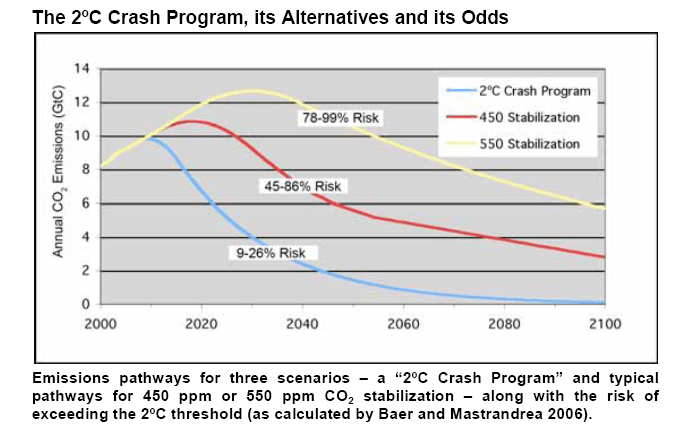
The magnitude of the challenge entailed by the need to set a greenhouse gas atmospheric concentration target becomes evident after looking at the probability of exceeding 2°C if CO2 equivalent targets are set at specific levels such as 450 or 550 ppm. In the following chart the colored lines represent emissions reduction pathways that would stabilize atmospheric concentrations of carbon dioxide equivalents at various levels. The yellow line is a pathway that would stabilize at 550 ppm. The red line is a reduction pathway that could stabilize carbon dioxide equivalent at 450 ppm. The numbers on the boxes on these two lines specify the probability of exceeding 2°C if atmospheric concentration levels are stabilized at these levels.

From this chart we therefore see that if atmospheric carbon dioxide is stabilized at 550 ppm there is between a 75% and 99% chance that the world will experience temperatures in excess of 2°C. Looking at the red line we see that even at a stabilization level of 450 ppm there is between a 45% and 86% chance that the world experience increases in temperature greater than 2°C. Because CO2 levels are already approaching 395 ppm and other greenhouse gases make current carbon dioxide equivalent levels in the vicinity of 430 ppm it becomes evident that the world is running out of time to stabilize atmospheric carbon dioxide levels in the atmospheric concentrations that would limit warming to 2°C. Because as we have seen it is possible that temperature increases as small as 1°C will create harsh impacts for some people in some parts of the world it becomes apparent that the need to reduce greenhouse gases aggressively, and dramatically, and urgently.

C. Percentage Reductions From Business As Usual Required To Stabilize Atmospheric Concentrations Of Greenhouse Gases

The startling magnitude of the challenge to the world from climate change becomes apparent upon reflection that the world is currently increasing greenhouse gas emissions  during the last decade of an average annual increase of 2.7%. (PBL 2012) Yet to stabilize carbon dioxide concentrations at about 450 ppm by 2050, global emissions will have to decline by about 60% from current levels. (Hossol 2011).  Because developing countries need to expand economic activity to escape grinding poverty according to one US White House paper, industrial countries greenhouse gas emissions would have to decline by about 80% by 2050. (Hossol 2011)

Given that greenhouse emissions are increasing year to year and that the entire world will need to reduce emissions by as much as 60% by 2050 to give any hope of remaining below 2°C, the challenge to the world is staggering. One observer sums up the situation as following:

The growth of emissions is making the task ahead more and more difficult. The longer we wait to start shrinking emissions, the faster we’ll have to shrink them to stay under budget. Here’s a visualization of what that means — some sample reduction curves with varying peak years (the four different lines are based on the four main IPCC scenarios):

(citing Anderson, K.  2011)

As you can see, if we delay the global emissions peak until 2025, we pretty much have to drop off a cliff afterwards to avoid 2 degrees C. Short of a meteor strike that shuts down industrial civilization, that’s unlikely.

This, then, is the brutal logic of climate change: With immediate, concerted action at global scale, we have a slim chance to halt climate change at the extremely dangerous level of 2°C. If we delay even a decade — waiting for better technology or a more amenable political situation or whatever — we will have no chance.

(Roberts 2011)

Although the challenge of achieving sufficient global greenhouse gas emissions to prevent 2°C is extraordinarily daunting, as we have explained above a 2°C warming limit may not prevent catastrophic harm because temperature increases more than 1°C may cause great harm.

International climate negotiations have sought to find a global solution to climate change since they began in 1990 and have struggled since then to reach a global deal among most countries to prevent dangerous climate change. Because global emissions continue to rise rather than decrease after 20 years since climate change negotiations began, the international community has lost several decades in finding a way to prevent dangerous climate change. And so, the human race may be running out of time to prevent dangerous climate change. Yet most Americans are unaware of the seriousness and urgency of the staggering problem we are facing. The US media has utterly failed to sound the alarm about the magnitude of the threat of climate change.

References:

Anderson, Kevin (2011)  Going Beyond Dangerous Climate Change, http://www.climatecodered.org/2011/12/professor-kevin-anderson-climate-change.html

 Athanasiou, T. and Bear, P. (2002), Dead Heat: Global Justice and Global Warming, Westminster, MD: Seven Stories Press, Canada.

CO2Now (2012)  Earth’s CO2 Now Home Page http://co2now.org/ (March 2012).

Hansen. J., Sato, M., Kharecha, P., Beerling, Masson-Delmotte, V., Pagani, M., Raymo, M., Royer, D., Zachos, J. (2008)  Where Should Humanity Aim? http://www.columbia.edu/~jeh1/2008/TargetCO2_20080407.pdf

Hare, W. (2003)  Assessment Of Knowledge On Impacts Of Climate Change – ‘Contribution To The Specification Of Art’, 2 of the UNFCCC, Berlin: Potsdam Institute for Climate Research, http://www.wbgu.de/fileadmin/templates/dateien/veroeffentlichungen/sondergutachten/sn2003/wbgu_sn2003_ex01.pdf

Hossol, Susan Joy (2011)  Emissions Reductions Needed To Stabilize Climate, Presidential Climate Project, http://climatecommunication.org/wp-content/uploads/2011/08/presidentialaction.pdf

Intergovernmental Panel on Climate Change (IPCC) (2001) this multi-volume work was published as: (i) Climate Change 2001: Synthesis Report; (ii) Climate Change 2001: The Scientific Basis; (iii) Climate Change 2001: Impacts, Adaptation & Vulnerability; (iv) Climate Change 2001: Mitigation, Geneva, Switzerland: Intergovernmental Panel on Climate Change. http://www.grida.no/publications/other/ipcc_tar/

Intergovernmental Panel on Climate Change (IPCC) (2007) Climate Sensitivity And Feedbacks, in Pachauri, R., and Reisinger, A. (eds) Climate Change 2007: Synthesis Report, Contribution of Working Groups I, II, and III to the Fourth Assessment Report of the Intergovernmental Panel on Climate Change, Geneva, Switzerland: Intergovernmental Panel on Climate Change, Available at: http://www.ipcc.ch/publications_and_data/ar4/syr/en/mains2-3.html

PBL, Netherlands Environmental Assessment Agency (2012) Trends in Global Co2 Emissions, 2012 Report. http://edgar.jrc.ec.europa.eu/CO2REPORT2012.pdf

Real Climate (2009) Hit the Brakes Hard,  http://www.realclimate.org/index.php/archives/2009/04/hit-the-brakes-hard/

Roberts, David  (2011) The Brutal Logic Of Climate Change, http://grist.org/climate-change/2011-12-05-the-brutal-logic-of-climate-change/

 Washington, H. and J. Cook (2011) Climate Change Denial: Heads in the Sand, by Climate Change Denial: Heads in the Sand, Earthscan, London and Washington

By:

Donald A. Brown

Scholar In Residence

Sustainability Ethics and Law

Widener University School of Law

dabrown57@gmail.com

In Praise and Criticism of the PBS Frontline Program, Climate of Doubt

On October 23, 2012,  the PBS program Frontline aired a program called Climate of Doubt.  available on the PBS website at www.pbs.org/frontline/  This program describes the success of right-wing organizations and some corporations in both undermining the public’s understanding of the mainstream scientific view about human-induced climate change and in preventing legislative action to reduce US greenhouse gas emissions. Climate of Doubt explains that the disinformation campaign has succeeded despite the fact that the vast majority of climate scientists that actually engage in climate change scientific research strongly support the consensus scientific view that humans are causing dangerous warming.

In a very introductory manner, the Frontline program explains how the climate change disinformation campaign has managed to weaken support for doing something about climate change and for this reason the program is a welcome addition to the otherwise largely non-existent US media coverage of who is behind the climate change disinformation campaign.

Although the Frontline program should be welcomed for bringing much needed attention to this tragic manipulation of a democracy,  at the same time the program can be criticized for missing important elements of the story necessary to get a full understanding  of the outrageousness,  if not criminality, of the climate change disinformation campaign.

Missing from the Frontline description of the disinformation campaign are:

(a) A stronger sense of the strength of the consensus view, (every academy of science in the world supports the consensus view, over a hundred scientific organizations whose members have relevant scientific expertise support the consensus view, much of the science that should have been the basis for US action on climate change was settled 150 years ago, and there are clear qualitative differences between peer-reviewed science and the manufactured, non-peer reviewed science usually relied upon by the disinformation campaign),

(b) A sense of the urgency for the need to make greenhouse gas emissions reductions as soon as possible to avoid dangerous climate change.

(c) The civilization challenging magnitude of the reductions that will be necessary to prevent dangerous climate change,

(d) The tactics of the disinformation campaign which cannot be understood as responsible skepticism, such as: (1)  making claims that not only have not been peer-reviewed but are at odds with well-settled  science, (2) cherry picking the science, (3) treating one study as undermining the entire body of climate science even though the issue in contention is not consequential in regard to the major mainstream scientific conclusions, (4) cyber-bullying scientists and journalists that publish statements that climate change is a significant threat, (5) making completely false claims that are either lies or reckless disregard for the truth such as the claim that the  entire scientific basis for action is a hoax when every academy of science supports the consensus view, and (6) the use of front groups and Astroturf groups that hide the real parties in interest behind the disinformation campaign, namely fossil fuel companies and free-market fundamentalist foundations.

(d) The fact that high-emitting nations and individuals are putting hundreds of millions of world’s poorest people at risk who have done nothing to cause the problem,

(e) The fact that the United States has been a major barrier to a global solution in climate negotiations for over two decades due to the disinformation campaign,

(f) The fact that even the Obama administration is unwilling to make commitments for emissions reductions consistent with any reasonable interpretation of the US fair share of safe global emissions,

(g) The fact that climate change must be understood as a moral and ethical issue, an understanding that undermines the purely US self-interested economic arguments made by those who oppose action on climate change,

(h) The fact that it already too late to prevent climate-change  caused  grave suffering for some people in some parts of the world and that the world has lost over twenty years during which action could have been taken to reduce the now enormous threat,

(i) The fact that hundreds of millions of people around the world who are most vulnerable to climate change’s worst threats have never consented to be put at risk while the United States waits for absolute certainty. and

(j) The fact that each year the United States has waited  to take action, the problem has become worse.

In summary, the Frontline program, although a welcome overdue US media analysis of the climate change disinformation campaign, fails to adequately explain why the disinformation campaign should be considered as some new kind of crime against humanity. The Frontline program give far to much attention to some of the climate deniers while failing to communicate adequately the strength of the consensus position.

Given what is at stake from climate change, ethics requires that those who want to discuss the uncertainties of climate change science must proceed with extreme care including limiting their claims to peer-reviewed science and not overstating the significance of individual studies.   Skepticism in science is the oxygen of science and therefor is a good thing, but many of the tactics of the disinformation campaign are clearly not responsible skepticism.  They are often deeply deceitful, ethically abhorrent disinformation.

Ethicsandclimate.org has  looked at the disinformation campaign in considerable more detail than the issues covered in the Frontline program in a four part series:

1. Ethical Analysis of the Climate Change Disinformation Campaign: Introduction to A Series Series.

2.Ethical Analysis of Disinformation Campaign’s Tactics: (1) Reckless Disregard for the Truth, (2) Focusing On Unknowns While Ignoring Knowns, (3) Specious Claims of “Bad” Science, and (4) Front Groups.

3.Ethical Analysis of Disinformation Campaign’s Tactics: (1) Think Tanks, (2) PR Campaigns, (3) Astroturf Groups, and (4) Cyber-Bullying Attacks.

4. Irresponsible Skepticism: Lessons Learned From the Climate Disinformation Campaign

Ethicsandclimate has also produced a video on why the climate change disinformation campaign is so ethically abhorrent. See. Why the Climate Change Is So Ethically Abhorrent.

By:

Donald A. Brown

Scholar In Residence, Sustainability Ethics and Law

Widener University School of  Law

dabrown57@gmail.com

Five Grave Communications Failures of the US Media On Climate Change-The Failure To Communicate The Strength of The Scientific Consensus

I. Introduction

The US media has utterly failed to communicate to the American people about five essential aspects of climate change that they need to understand to know why climate change is a civilization challenging problem that requires dramatic, aggressive, and urgent policy action to avoid harsh impacts to hundreds of millions of people around the world.  EthicsandClimate.org has recently developed a video on these failures entitled: Five Grave Communication  Failures of US Media On Climate Change 

We now provide a more detailed written description of these failures in this and subsequent posts. In this post we look at the first of these communications failures, namely the failure  to communicate to US citizens the strength and nature of the current scientific consensus position on climate change.

Subsequent posts will examine the following additional communication failures of the US media:

  • The magnitude of greenhouse gas emissions reductions that are necessary to prevent dangerous climate change.
  • The consistent barrier that the United States has been in finding a global solution on climate change for over 20 years.
  • The fact that climate change must be understood as a civilization challenging ethical problem, an understanding that is of profound significance for climate change policy formation.
  • The nature of the climate change disinformation campaign in the United States.

II. The Strength And Nature Of The Current Scientific Consensus Position On Climate Change.

Most US citizens are aware that there has been an ongoing debate about the science of climate change, yet most American are completely unaware of the strength of the “consensus” position on climate change.

The consensus position is understood to be that which has been articulated by the Intergovernmental Panel on Climate Change (IPCC). The IPCC was established by the World Meteorological Organization (WMO) and the United Nations Environment Program (UNEP) in 1988 to assess for governments the scientific, technical and socio-economic information relevant for the understanding of climate change, and to identify its potential impacts and options for adaptation and mitigation. (IPCC, 2010) The IPCC does not do original research but synthesizes and summarizes the extant peer-reviewed climate change science to make recommendations for governments and policy makers. (IPCC, 2010a) The consensus position is not the consensus on all scientific issues entailed by climate change. Yet, the consensus position has the following elements:

  • The planet is warming
  • The observable warming is very likely mostly caused by human activities
  • Under business as unusual human-induced warming will likely range from 2 to 5 degrees C (although it could be greater). This warming will harm some people more than others from rising seas, increased droughts and floods, increased storms, increased vector-borne disease, deaths from heat waves, reducing food productivity, and diminished availability to water.
  • To stabilize GHG in the atmosphere will require huge reductions from business as usual.

There are several strong reasons why the “consensus” view is  entitled to respect including the following:

One, recent reports have concluded that the vast majority of scientists actually doing research in the field support the consensus scientific view.

For example, a 2009 study–published in the Proceedings of the National Academy of Sciences of the United States–polled 1,372 climate researchers and resulted in the following two conclusions.

(i) 97-98% of the climate researchers most actively publishing in the field support the tenets of ACC (Anthropogenic Climate Change) outlined by the Intergovernmental Panel on Climate Change, and


(ii) The relative climate expertise and scientific prominence of the researchers unconvinced of ACC are substantially below that of the convinced researchers.


(Anderegga et. al 2010)

Another poll performed in 2009 of 3,146 of the known 10,257 Earth scientists concluded that 76 out of 79 climatologists who “listed climate science as their area of expertise and who also have published more than 50% of their recent peer-reviewed papers on the subject of climate change” believe that mean global temperatures have risen compared to pre-1800s levels, and 75 out of 77 believe that human activity is a significant factor in changing mean global temperatures. (Doran and Zimmerman, 2009)

Two, in response to arguments from some climate change skeptics, many scientific organizations with expertise relevant to climate change have endorsed the consensus position that “most of the global warming in recent decades can be attributed to human activities” including the following:
• American Association for the Advancement of Science
• American Astronomical Society
• American Chemical Society
• American Geophysical Union
• American Institute of Physics
• American Meteorological Society
• American Physical Society
• Australian Coral Reef Society
• Australian Meteorological and Oceanographic Society
• Australian Bureau of Meteorology and the CSIRO
• British Antarctic Survey
• Canadian Foundation for Climate and Atmospheric Sciences
• Canadian Meteorological and Oceanographic Society
• Environmental Protection Agency
• European Federation of Geologists
• European Geosciences Union
• European Physical Society
• Federation of American Scientists
• Federation of Australian Scientific and Technological Societies
• Geological Society of America
• Geological Society of Australia
• International Union for Quaternary Research (INQUA)
• International Union of Geodesy and Geophysics
• National Center for Atmospheric Research
• National Oceanic and Atmospheric Administration
• Royal Meteorological Society
• Royal Society of the UK

(Skeptical Science, 2010)

Three, the Academies of Science from nineteen different countries all endorse the consensus view. Eleven countries have signed a joint statement endorsing the consensus position.
They are:
• Academia Brasiliera de Ciencias (Brazil)
• Royal Society of Canada
• Chinese Academy of Sciences
• Academie des Sciences (France)
• Deutsche Akademie der Naturforscher Leopoldina (Germany)
• Indian National Science Academy
• Accademia dei Lincei (Italy)
• Science Council of Japan
• Russian Academy of Sciences
• Royal Society (United Kingdom)
• National Academy of Sciences (USA)

(Skeptical Science, 2010):

Among the academies of sciences around the world that have issued reports supporting the consensus view is the United States Academy of Sciences that has issued four reports.

From this it can be seen that the consensus view articulated by the IPCC is strongly supported by: (1) the vast majority of climate change scientists that actually do research on human-induced climate change (2) the most prestigious scientific organizations comprised of scientists with relevant climate change expertise, and (3) academies of sciences around the world, the very institutions that have been created to advise governments on complex scientific issues. For this reason, the IPCC consensus position is entitled to strong respect that, at the very minimum, climate change poses a legitimate significant threat to human well-being and the natural resources on which life depends.

In fact, some critics have contended that the IPCC reports tend to underestimate climate change dangers and risks because the process that leads to the IPCC conclusions give representatives from countries that have consistently opposed the adoption of international climate regimes power to pressure the IPCC scientists to report only the lowest common denominator. (For a discussion of the limits of IPCC, see, Brown, 2008) In fact observations of actual greenhouse gas atmospheric concentrations, temperatures, and sea level rise are near or exceeding the IPCC worst-case predictions. One recent comparison of greenhouse gas concentrations, temperatures, and sea-level rise observations versus predictions concluded:

Overall, these observational data underscore the concerns about global climate change. Previous projections, as summarized by the IPCC, have not exaggerated but may in some respects even have underestimated the climate changes that have been observed. 
(Rahmstorf et al., 2007)

It is important as a mater of ethics to remember that if the consensus view is wrong, it could be wrong in two directions. That is, not only could IPCC be overstating the magnitude and timing of climate change in the future, they may be understating the harshness of climate change harms.

And so, the most prestigious scientific organizations in the world support the consensus view on climate change.  Yet. the United States media has almost always failed to communicate this fact when discussing controversies about climate change science. Although the US media has from time to time acknowledged that most climate scientists support the consensus view, they have almost always failed to describe strength of the consensus view that becomes apparent when one understands the magnitude of support for the consensus view by the most prestigious scientific organizations end researchers described above.

Given the enormity and harshness of impacts to hundreds of millions of people around the world from climate change coupled with the fact that United States has a special responsibility for the civilization challenging problem because of the comparatively large levels of the emissions coming from America, the failure of the US media to describe strength the scientific consensus on change is a grave and tragic error.

References:

Agrarwala, Shardul and Stiener Anderson, 1999, Indispensability and Indefensibility?:
The United States In Climate Treaty Negotiations. ” 2w Governance 5, December 1999).

Brown, Donald, 2008, Ethical Issues Raised by the Work of the Intergovernmental Panel on Climate Change (IPCC): Report On The Bali Workshop (COP-13). Climate Ethics. http://rockblogs.psu.edu/climate/2008/02/report-on-the-workshop-at-the-13th-conference-of-the-parties-of-the-united-nations-framework-convention-on-climate-change.html

Doran, Peter T.; Maggie Kendall Zimmerman, 2009. Examining the Scientific Consensus on Climate Change, EOS 90 (3): 22-23

Intergovernmental Panel On Climate Change (IPCC), 2010a, History, http://www.ipcc.ch/organization/organization_history.htm

 Rahmstorf, Stepen, Anny Cazenave, John A. Church, James E. Hansen,
Ralph F. Keeling, David E. Parker, Richard C. J. Somervilles, 2007, Recent Climate Observations Compared to Projections, Science, Vol 316 , May 2007

Skeptical Science, 2010, What the Science Says: shttp://www.skepticalscience.com/global-warming-scientific-consensus-intermediate.htm (retrieved, Jan 3, 2011)


By:

Donald A. Brown

Scholar In Residence,

Sustainability Ethics and Law

Widener University School of Law

Dabrown57@gmail.com


Five Grave Communications Failures of The US Media On Climate Change

Video

This video examines 5 grave tragic communications failures of the US media on climate change.

These include the failure to communicate;

  1. The strength of the scientific consensus
  2. The civilization challenging nature of the magnitude of greenhouse gas emissions reductions needed to prevent dangerous climate change
  3. The barrier that the United States has been in international climate negotiations that have been ongoing since 1990 to achieve a global solution to climate change
  4. The essential ethical and moral nature of the climate change problem, a fact that has profound significance for policy formation
  5. The nature of the climate change disinformation campaign.


By: 

Donald A. Brown

Scholar In Residence

Sustainability Ethics and Law

Widener University School of Law

dabrown57@gmail.com

An Ethical Analysis of Mitt Romney’s Climate Change Views-Part Two

Video

This is the second video looking at Mitt Romney’s statements on climate change through an ethical lens. In the first video, we examined critically Romney’s justifications for non-action on climate change that there wasn’t sufficient evidence that humans are causing warming and that the United States should not tackle the problem because it was a global problem. See:

An Ethical Analysis of US Presidential Candidate Mitt Romney’s Views on Climate Change 

Ethicsandclimate has also examined President Obama’s views on climate change in two entries. See:

By:

Donald A. Brown

Scholar In Residence

Sustainability Ethics and Law

Widener University School of Law

dabrown57@gmail.com


The Practical Importance For Policy Of Ignoring The Ethical Dimensions of Climate Change

 I. Introduction

 Here we  examine the practical importance of identifying and expressly examining ethical issues that must be faced in policy formation as policy is debated and unfolds.

What distinguishes ethical issues from economic and scientific arguments about climate change is that ethics is about duties, obligations, and responsibilities to others while economic and scientific arguments are usually understood to be about “value-neutral” “facts” which once established have usually been deployed in arguments against action on climate change based upon self-interest. For instance, proponents of climate change often argue that costs of action to reduce the threat of climate change to a nation such as the United States should not be accepted because it is not in the US economic interest.

By ethics we mean, the domain of inquiry that examines claims that under certain facts, something is right or wrong, obligatory or non obligatory, or when responsibility attaches to human action.  Since policy disputes are about what should be done given certain facts, ethical claims are usually already embedded in arguments about what should be done about policy questions, yet the ethical basis of these claims are often hidden in what appear, at first glance,  to be “value-neutral” scientific and economic arguments. As a result, the ethical bases for arguments in support or in opposition to policy action on climate change are frequently ignored in policy debates. a phenomenon frequently discussed in EthicsandClimate.org

II. The Consequence For Policy Of Ignoring Ethical Issues. 

If the ethical issues raised by climate change policies are ignored, several consequences for policy follow. The failure to examine arguments opposing climate change policies trough an ethical lens virtually guarantees that:

  •  Those opposing climate change policies on ethically dubious grounds will not be challenged on the basis of their ethically problematic positions.
  • Those making economic arguments based upon short-term narrow self-interest will not be forced to admit that those causing climate change have duties, responsibilities, and obligations to others who can do little to reduce climate change’s threat but who are most vulnerable to climate change’s harshest consequences.
  •  The ethical dimensions of economic arguments will remain hidden in public debates in cases where economic arguments against climate change policies appear to based on “value-neutral” economic “facts” although the calculations of the “facts” contain ethically dubious calculation procedures such as: (a) discounting future benefits that make benefits to others experienced in the middle to long-term virtually worthless as a matter of present value. (b) economic arguments usually only calculate the value of things harmed by climate change on the basis of market-value thus translating all things including human life, plants, animals, and ecological systems into commodity value, or (c) the economic calculations often ignore distributive justice issues including the fact that some people and places will be much more harshly impacted by climate change than others.
  • Important ethical issues entailed by decision-making in the face of scientific uncertainty will remain hidden including: (a) Who should have the burden of proof? (b) What quantity of proof should satisfy the burden of proof when decisions must be made in the face of scientific uncertainty? (c) Whether the victims of climate change have a right to participate in decisions that must be made in the face of uncertainty? and, (d) Whether those causing climate change have obligations to act now because if the world waits to act until all uncertainties are resolved it will likely be too late to prevent catastrophic impacts to others and to stabilize greenhouse gas atmospheric concentrations at safe levels?
  • Because no national, regional, local, business, organization, or individual climate change strategy makes sense unless it is understood to be implicitly a position on its duties and obligations to others to prevent climate change, whether the strategy is just or fair in relationship to the entity’s obligations to others will go unexamined.
  •  Given that the world needs a global solution to climate change, and that only just solutions to climate change are likely to be embraced by most governments, barriers to finding an acceptable global solution will continue.
  • Unjust climate change policies will be pursued that exacerbate existing injustices in the world.
  • Because those who cause climate change are ethically responsible for damages caused by them, funding for adaptation projects needed by those most vulnerable to climate change will not be generated.
  • Because no nation may ethically use as an excuse for non-action on climate change that it need not reduce its greenhouse gases to its fair share of safe global emissions until other nations act, nations will continue to inappropriately refuse to act on the basis that other nations have not acted.
  • Because the amount of reductions that nations should achieve should be based upon principles of distributive justice and not-self interest, nations will continue to make commitments to reduce their emissions based upon self-interest rather than what is their fair share of safe global emissions.

III. Whose Ethics Counts?

Climate change raises not one civilization challenging ethical issue, but a host of them including:

  •  What greenhouse gas atmospheric concentration stabilization goal should be agreed to by all nations?
  • What is each nation’s fair share of safe global emissions?
  • Who is responsible for paying for the costs of climate change adaptation needs or damages in poor, vulnerable nations?
  • Ethical issues that arise when arguments are made against action on the basis of scientific uncertainty or cost to national economies?
  • Are individuals, sub-national governments, organizations, and businesses responsible for climate change?
  •  What ethical issues arise from the solutions to climate change such as geo-engineering, nuclear power, or biofuels, just to name a few?
  • Are nations responsible for historical emissions?

These and other very challenging ethical questions need to be faced when climate change policies are developed. Yet a reasonable question might be asked at this stage about whose ethics should count in resolving these questions given that there are different ethical theories that are supported by different people that might reach different conclusions about what ethics requires.

We would agree that climate change raises some civilization challenging ethical questions about which different respectable ethical theories might reach different conclusions about what should be done.  However, the fact that different ethically acceptable positions may lead to different ethical conclusions about climate change issues does not lead to ethical agnosticism or even confusion about all climate change issues including some of the most important ethical questions that must be faced in climate change policy formation. Three possibilities exist:

  •  For some climate change ethical questions, there is an overlapping consensus among ethical theories about what ethics requires.
  •  For some climate change issues, ethics issue spotting sometimes leads to conflicts among ethical theories about what ethics requires.
  •  For some climate change issues, ethical issue spotting may lead to disagreement among ethical theories about what should be done yet very strong agreement that some positions taken on these issues are ethically bankrupt even though there is disagreement on what ethics requires.

Although it is beyond the scope of this paper,  there are some climate change ethical issues about which there appears to be agreement about what ethics requires. For instance, most cultures and religions support variations of the golden rule that holds that individuals should not be able to severely harm others because of economic self-interest, polluters should pay for harm that they caused, and nations should prevent their citizens from harming others beyond their boarders.

More importantly, even on matters about which there are legitimate differences about what ethics requires, there appears to be ethical agreement that the position of some nations are ethically bankrupt despite disagreement about what ethics requires.

For this reason, ethical issue spotting often can lead to narrowing positions in contention to those that pass minimum ethical scrutiny.  For this reason alone, spotting the ethical issues that arise in policy formation may be key to making progress.

And so, perhaps the most important practical consequence of spotting the ethical issues raised by climate change is that failure to do so will likely create a missed opportunity to make progress to an urgently needed global solution.

By:

Donald A. Brown

Scholar In Residence, Sustainability Ethics and Law

Widener University School of Law

dabrown57@gmail.com


How US Climate Change Law Must Be Reconciled With Existing International Law and Ethical Obligations.


The following video explains how US law on climate change must be upgraded  to be consistent with a body of international law on climate change that has developed over the past 20 years as well as ethical obligations the United States has under law and ethical theory.

Debate about climate change policy in the United States has almost always assumed that US policy-makers can look to US economic interests alone in establishing US climate change policies. This video explains why US domestic law on climate change must be consistent with existing provisions of international law and US ethical obligations,


httpv://www.youtube.com/watch?v=yXPIU09jgzY


The site will soon post a written summary of the material in this video,

]

By:


Donald A. Brown

Scholar in Residence,

Sustainability Ethics and Law

Widener University School of Law

dabrown57@gmail.com


The Silence of US President Obama on Climate Change-A Serious Ethical Lapse?

Editor’s note on the following entry. On the very day that the following entry was posted, President Obama mentioned climate change for the first time in a long time  in a speech at the University of Iowa by claiming that recent fleet fuel efficiency standards adopted by his administration will make climate change less threatening for the planet. (See Obama Speech) Yet, it is too early to tell whether President Obama will speak out strongly on climate change in a way that the following post argues is his ethical responsibility. We also note that this speech does not include many of the ideas about climate change that the following post argues should be part of the US President’s message on climate change.

—————————————————————————-


US President Obama has been silent on climate change for two years even when discussing related issues such as the severe drought affecting large parts of the United States.  With the exception of a Rolling Stone article in which President Obama was quoted as saying that he expected climate change to become an issue in the upcoming presidential election, nothing has been heard from the US President on climate change since the US Congress failed to pass a climate bill in 2010. (To see the Obama quote on climate change, see Wenner 2012.) The US Environmental Protection Agency (EPA) in the Obama administration has been somewhat quietly issuing regulations under the Clean Air Act that will create very modest US reductions of greenhouse gas emissions from some new stationary and mobile sources, yet these regulations will not come close to reducing US greenhouse gas emissions to levels that represent the US fair share of safe global emissions. (For a discussion of US EPA regulations on greenhouse gases, see, EPA 2012) Although US EPA has today announced a new fleet fuel efficiency rule for US automakers that will double fleet efficiency by 2025, these rules will not produce overall US greenhouse emissions reductions congruent with levels the consensus scientific view has concluded are necessary to avoid dangerous climate change. (For a description of the EPA auto rules, see Vlassic, 2012)  Although the majority of US citizens now believe climate change is human-caused according to recent polls, very few Americans seem to understand the civilization challenging scope of the problem, a fact that can be attributed to a failure of US political leadership.

Several commentators have strongly criticized President Obama for failing to make climate change a political issue for the last two years.  For instance, Joe Romm of Climate Progress has frequently written critically about President Obama’s silence including a recent article entitled The Sounds of Silence on Science: The Country Is on Fire, But Obama Isn’t (Romm 2012).

Those criticizing US President Obama for failing to make climate change a high profile political issue in the last several years often point to the practical need to build a political mandate in the US to enact federal climate change legislation coupled with the urgency of the need to reduce greenhouse gas emissions. Unless climate change is kept alive as a political issue, so the argument goes, no US congressional action is likely. And so the US White House silence on climate change has been criticized as a practical political failure to make progress on an issue about which the world is running out of time to prevent dangerous harms.

In addition to being a practical political failure, can the White House silence on climate change also be understood to be a serious ethical and moral failure even if legislative action is not likely because of the current political opposition by those who control Congress?  If the US President’s silence  is an ethical issue, then the President should talk about climate change not solely as a consideration in developing  political strategy, but because he has a duty to do so.

A strong argument can be made that the failure of the head of state in a high-emitting country to encourage his or her country’s citizens to reduce greenhouse gas emissions is not just a practical political mistake but a serious ethical failure. This is so because, among other reasons, all nations have duties that they have expressly acknowledged in several international agreements including the United Nations Framework Convention on Climate Change (UNFCCC) to prevent activities within their jurisdiction from causing harm of to others beyond their borders. In the UNFCCC, nations have agreed to:

  • Recalling also that States have, in accordance with the Charter of the United Nations and the principles of international law, the sovereign right to exploit their own resources pursuant to their own environmental and developmental policies, and the responsibility to ensure that activities within their jurisdiction or control do not cause damage to the environment of other States or of areas beyond the limits of national jurisdiction (UN 1992a: Preface, emphasis added).
  •  The Parties should protect the climate system for the benefit of present and future generations of humankind, on the basis of equity and in accordance with their common but differentiated responsibilities and respective capabilities. Accordingly, the developed country Parties should take the lead in combating climate change and the adverse effects thereof (UN 1992a: Art. 3, emphasis added).
  •  The Parties should take precautionary measures to anticipate, prevent, or minimize the causes of climate change and mitigate its adverse effects. Where there are threats of serious or irreversible damage, lack of full scientific certainty should not be used as a reason for postponing such measures, taking into account that policies and measures to deal with climate change should be cost-effective so as to ensure global benefits at the lowest possible cost (UN 1992a: Art 3, emphasis added).

 These provisions of international law have been agreed to by all nations and establish clear national responsibilities for developed nations in particular to prevent harm from climate change to others beyond their jurisdiction, to help pay for damages of those beyond their borders who are harmed by domestic activities, and to not use scientific uncertainty as an excuse for failing to take protective action.  And so, the above international law provisions, among others, make it clear that nations have responsibilities, duties, and obligations to others to prevent climate change damage- caused harms.

 In addition to these agreed to international norms almost all ethical theories require that individuals refrain from harming others without regard to where they are located. In addition almost all religions have versions of the Golden Rule that also create a mandate to not harm others. Because government action is a way for individuals to achieve their collective individual ethical responsibilities, governments should act in conformance with the obligations of individuals required by the Golden Rule.

 Climate change is a problem caused by some who are emitting greenhouse gases at levels above their fair share of safe global emissions. In addition, climate change is not just a civilization challenging future problem but a current problem which is already causing human deaths and harms to ecological systems around the world in the form of diseases, drought, floods, and damages from intense storms. In addition, the mainstream scientific view holds that the current harms to human health and ecological systems now visible will grow in the years ahead putting tens of millions of the world’s poorest people at great risk to harsh consequences.

As chief executive officer of the United States, the US President has the responsibility to assure that the nation complies with its international obligations. The inability of the US President to convince the US Congress to pass climate change legislation is not an excuse for him or her to be silent on climate change as long as the United States could make progress in reducing its emissions through other means.

Without doubt, government leaders and especially the President could help citizens understand that responsible citizenship requires them to refrain from unnecessary or wasteful activities that create greenhouse gas emissions.  The US President could encourage US citizens, states, sub-national governments, organizations, and businesses to take steps to reduce their carbon footprint through voluntary actions, measurement of greenhouse gas emissions, development of plans that set voluntary targets for emissions reductions, and monitoring achievements.

The US President also could give positive publicity to individuals, local and regional governments, universities, businesses and organizations that achieve notable success in reducing greenhouse gas emissions.

President Obama should also speak up forcefully against the climate change disinformation campaign that is now well-documented while reminding Americans that the US Academy of Sciences has concluded at least four times over the last several decades that human-induced warming is a great risk to people and ecological systems around the world. (For a discussion of US Academy of Science Reports on climate change, see Brown 2011)

The US President should also help US citizens understand that reducing US greenhouse gas emissions is not only in the US interest but also something which is strongly required by ethics and justice. If he did this, he would help US citizens respond to those who oppose climate change policies on economic grounds alone, that in addition to US economic interests, Americans have responsibilities to the victims of climate change to  prevent the harsh climate change impacts which  are predicted by mainstream science.

And so, US presidential leadership is urgently needed to help minimize the harm that US greenhouse gas emissions are now contributing to in parts of the world. Those who have followed international climate negotiations since they began in the late 1980s know that the US has not only failed to adopt a climate change national strategy that it could commit to help create a global solution to the global problem of human-induced warming but has often been a barrier in international negotiations seeking to achieve a just global solution.

And so the failure of US national leadership on climate change is a significant ethical failure. Every day the US waits to take meaningful action to reduce the threat of climate change, the problem gets worse. Two years of silence, is two years of missed opportunity to begin to align US greenhouse emissions with US ethical obligations. The United States has failed for over 30 years since the US Academy of Sciences first warned Americans that human-induced climate change was a looming threat. (For a discussion of reports of the US Academy of Science, see Brown, 2011.) After 30 years of US inaction on climate change, the US President has a duty to loudly speak up and encourage US citizens to reduce the threat of climate change.

References:

Brown, Donald (2011) The US Academy of Sciences’ Reports On Climate Change and The US Moral Climate Change Failure. EthicsandClimate.org. http://blogs.law.widener.edu/climate/2011/05/25/praise_and_ethical_criticism_of_the_united_states_academy_of_sciences_reports_on_climate_change/

Romm, Joe (2012) The Sounds of Silence on Science: The Country Is on Fire, But Obama Isn’t, Climate Progress,  http://thinkprogress c.org/climate/2012/08/15/696291/the-sounds-of-silence-on-science-the-country-is-on-fire-but-obama-isnt/

United Nations (UNFCCC) (1992) ‘United Nations Framework Convention on Climate Change’, UN Document, A: AC237/18, 29 May 1992.

United States Environmental Protection Agencey (EPA) (2012) What is EPA Doing? Climate Change, http://www.epa.gov/climatechange/EPAactivities.html

Vlassic. Bill (2012) US Sets High Long-Term Fuel Efficiency Rules for Automakers, New York Times, August 29, 2012: B!

Wenner, Jann (2012) Ready for a Fight: The Rolling Stone Interview of Obama, Rolling Stone, http://www.google.com/url?sa=t&rct=j&q=&esrc=s&source=web&cd=1&ved=0CCIQFjAA&url=http%3A%2F%2Fwww.rollingstone.com%2Fpolitics%2Fnews%2Fready-for-the-fight-rolling-stone-interview-with-barack-obama-20120425&ei=G-g7UIb_DYK56wHs5YHQDg&usg=AFQjCNFNQr8p0NP4-39vBQkEEL8Git1O2A&sig2=NwVTv8vmklSpVFwu_-kLJA


By:

Donald A. Brown

Scholar In Residence, Sustainability Ethics and Law

Widener University School of Law

dabrown@mail.widener.edu