On the Extraordinary Urgency of Nations Responding To Climate Change on the Basis of Equity.

400ppm

This  article seeks to explain in understandable terms why nations must not only aggressively respond to climate change but respond at levels required of them by equity if the world is going to have any hope of avoiding dangerous climate change. And so, this article seeks to help citizens around the world understand why their nations must create climate change policies consistent with their equitable obligations and that if their nations fail to respond on the basis of equity, there is vey little hope of an adequate global solution emerging that has any potential of avoiding catastrophic climate change.

Once again there has been some renewed interest in responding to climate change this week in response to the announcement by the National Oceanic and Atmospheric Administration (NOAA) that carbon dioxide (CO2) atmospheric concentrations have reached 400 ppm (parts per million). This concentration of CO2 is not only higher than experienced in the last 3 million years of Earth’s history  (Kunzig, 2013), it is additional evidence that the world is rapidly running out of time to prevent dangerous climate change.  NOAA posted on its website Wednesday night, May 9, that the daily average for CO2 was 400.03 ppm. (Kunzig, 2013)   The last time the concentration of the CO2 reached this mark, horses and camels lived in the high Arctic and seas were at least 30 feet higher. (Kunzig, 2013) This sea level  rise would  inundate major cities around the world and cause harm to hundreds of millions around the world when temperatures finally responded to these elevated greenhouse gas (ghg) atmospheric concentrations.

Although this story made it to the front page of the New York Times, (see Schuetze 2013), the US press continues to fail to educate American citizens fully about the seriousness of the problem that the world is facing particularly in regard to the urgent need of nations to take immediate steps to reduce their emissions to their fair share of safe global ghg emissions.  Ethicsandclimate.org has previously examined the failure of the US press to communicate to American people the importance of the equity issue in formulating US policy. (See, The US Media’s Grave Failure To Communicate The Significance of Understanding Climate Change as A Civilization Challenging Ethical Issue.Yet, as we will explain, in light of the rapidly decreasing amount of time remaining for the world to prevent dangerous climate change, there is now more than ever a need to increase political support at the national level around the world for the adoption of policies on climate change that reflect each nation’s fair share of safe global emissions.

rich countriesWhen almost all nations around the world agreed to the 1992 United Nations Framework Convention on Climate Change (UNFCCC), they promised  to adopt policies and measures to limit warming based upon “equity” to prevent dangerous anthropogenic interference with the climate system. (UNFCCC, Art. 3) Up until very recently it was possible for nations to ignore that they had a responsibility to reduce their ghg emissions to levels based upon “equity.” And so many, if not most, nations have been entering international climate negotiations as if they need only look to their national economic interest to determine what ghg emissions reductions commitments they need to make under the UNFCCC. However, now that the world is running out of time to prevent dangerous climate change, the urgent need of nations to reduce their emissions to levels required of them on the basis of equity and basic fairness is now obvious and undeniable. This was not the case only a few years ago.  For instance, just three years ago it was possible for the United States to ignore what was required of it as a matter of basic fairness because nations were happy when the United States made any commitment to reduce its ghg emissions having refused to do so from the early 1990s through 2010. Any US commitment was viewed as a positive step. And so, when President Obama made a voluntary commitment in 2010 in Copenhagen to reduce US emissions by 17% below 2005 levels by 2020, it was widely celebrated throughout the international community even though most observers knew this commitment was far short of what justice required of the United States. Yet just two years later in Qatar, the same US commitment was almost universally condemned on justice grounds. (See: Qatar: Bumping Up Against Climate Change Limitations On Human Activities Makes Ethical and Justice Issues Unavoidable) 

The importance of each government entity’s responsibility to limit their emissions to their fair share of safe global emissions has become undeniably obvious to most observers of international climate negotiations now that it has become clear to all that there is precious little time for the global community to avoid dangerous climate change. The central importance of the need to get nations to respond to climate change on the basis of “equity” becomes very obvious once a number of scientific aspects of climate change are fully understood. However, too few people understand these scientific aspects of climate change and the press is failing to educate citizens about these issues.

Slide2


To fully understand the importance of national responses on the basis of “equity” it is necessary to understand some features of climate change that make it unlike any other environmental problem facing the world. The atmosphere is like a bathtub, it has limited volume. Nations have been filling up the atmospheric bathtub since the beginning of the industrial revolution in the late 1790s. Because CO2 is long-lived in the atmosphere, the bathtub continues to fill up with CO2 even if rates of CO2 emissions slow down somewhat unless all ghg emissions are reduced to the rate at which the Earth’s natural carbon cycle can remove CO2, an amount which is less than 20% of existing emissions levels. Decreasing ghg emissions does not prevent global atmospheric concentrations from increasing unless they are cut back globally by huge amounts. And so to prevent dangerous climate change nations have to do much more than cut back on the ghg emissions levels that they are entering the atmosphere, they have to cooperate to prevent the level in the bath tub from reaching levels that will cause dangerous climate change. As we shall see, this is a level that the world is fast approaching. Furthermore because CO2 is well mixed in the atmosphere it makes no difference where on Earth the ghgs come from, the atmospheric concentrations of ghg continue to rise without regard to location of the source of emissions.

What makes the current climate change threat so ominous is that the levels of CO2 that have been building up for over 200 years are quickly approaching levels that could trigger dangerous climate change as emissions are increasing in many parts of the world.

In our experience, most Americans don’t understand the scale of the climate change facing the world. In Copenhagen in 2010 the international community agreed to set as a goal warming limit of 2°C not withstanding there are some scientific evidence to believe that the warming limit should be lower at 1.5 °C. The 2°C warming limit was chosen because there is strong scientific evidence that warming above 2°C could trigger rapid nonlinear climate change thereby threatening hundreds of millions of people around the world and the ecological systems on which they depend. Even if 2°C warming doesn’t trigger nonlinear warming, this amount of warming will cause great harm around the world to people and places that have done little to cause climate change.

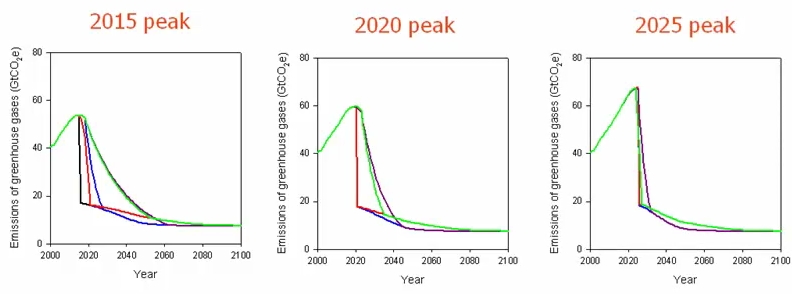
The following graph describes the staggering challenge facing the world if the international community desires to limit warming to 2°C.  The graph depicts three different emissions reductions pathways where the steepness of ghg emissions reductions needed to limit 2°C depend upon when global emissions levels peak, that is in 2015, 2020, or 2025. Despite over twenty years since the international community agreed in 1992 to adopt policies and measures based upon equity to prevent dangerous climate change, global ghg emissions levels continue to rise despite a global economic turn down in 2008. Global CO2 emissions grew 3 percent in 2011 and were estimated to rise 2.6 in 2012. (Morello, 2012).  Since the international community began to negotiate a climate change solution, rather then emissions levels diminishing they have  grown to 58 percent above the 1990 emissions level in 2012 (Morello, 2012). And so, the world is facing the urgent need to reduce ghg emissions at hard to imagine rates as seen in the following graph where the different colored lines on this chart represent different assumptions about climate sensitivity. This graph shows that if the world waits to act together to prevent ghg emissions from rising until 2020 or 2025, the world will need to reduce ghg emissions at staggering reduction levels after the peak years.

three reductions pathways


(Anderson, K.. 2012)

On the basis of the magnitude of the ghg emissions reductions challenge facing the world, mainstream scientists around the world are now emphatically trying to get the world’s attention about the urgency of the need to act dramatically to prevent dangerous climate change. Yet there has been little discussion in the media about the importance of equity in national responses to this global emergency coupled with the fact that one needs to understand other aspects of the climate change problem to fully understand the importance of requiring nations to reduce their emissions based upon “equity.”

Once one identifies an atmosphere ghg concentration level that will serve as a goal for preventing dangerous warming it is a relatively straightforward calculation to identify the remaining amounts of ghg emissions that can be emitted worldwide to prevent atmospheric ghg concentrations from exceeding the maximum concentration goal. This calculation is the basis for determining an emissions budget. Because there is some uncertainty about climate sensitivity, that is how much warming the Earth will experience at different atmospheric ghg concentrations, different atmospheric ghg concentration goals create different levels of probability of limiting warming to 2°C.  The following chart identifies the quantity of ghg emissions in gigatons of CO2 equivalent that the world may emit to achieve different levels of probability that the 2° C warming limit will not be exceeded. Therefore we see from this chart that if the entire world is assumed to be allowed to emit no more than 886 gigatons (Gt) of CO2 equivalent, this budgetary limit creates between a 8% and 37%, with a best estimate of 20%, probability that temperatures will exceed the warming limit of  2°C.   At the upper end of this chart, a 1437 Gt CO2 budgetary limit creates a probability of between 29 to 70 probability, with a best estimate of 50%, that the  2°C warming limit will be exceeded.

The chart also shows that if the world emits ghgs at levels projected at 56 Gt per year, then, assuming that the world chooses to live with a budget of 886 Gt CO2 which gives the world an 80% probability that future warming will be limited to 2°C, then after12 years there will be zero emissions left in the budget.  The chart also demonstrates that even if the world chooses to run the risk of accepting a 50% probability that the 2°C warming will be exceeded then world can only emit greenhouse gases at projected levels for 22 years.
budget

As gloomy as this picture in regard to the remaining global ghg emissions budget, we have not yet explained why getting nations to commit to reduce their emissions to levels required of them by equity is so important and indispensable for thinking clearly about how the world must respond to the threat of climate change. And so, now, for the first time, we can explain the importance of “equity” in guiding international responses to climate change.


Slide3


Returning to the use of a bathtub as a metaphor for the atmosphere, we note that there is already elevated levels of ghg (metaphorically water) in the bathtub that have risen to current levels from over 200 years of human activities. That is CO2 has increased in the atmosphere from 280 ppm to 400 ppm since the beginning of the industrial revolution. If we assume that atmospheric concentrations of CO2 equivalent should be limited to 450 ppm to give the world a 50% chance of keeping warming from exceeding the 2°C warming limit, atmospheric concentrations have increased already by120 ppm from pre-industrial levels and only 50 ppm of atmospheric space are  left to allocate to the entire world.  The 120 ppm increase in atmospheric CO2 concentrations that has already been put into the bathtub by human activities has overwhelmingly been caused by activities in some rich, developed countries much more than poor developing countries.  The following chart shows which countries have contributed the most elevated concentrations of CO2 in the atmosphere.
cummualative over time

(EPA, 2002)

And so some countries more than others have contributed far more than others to elevated ghg concentrations. Given that there’s only 50 ppm of atmospheric space left to allocate (assuming and atmospheric goal of 450ppm giving approximately a 50 % chance of exceeding  the 2°C) and some developing countries desperately need to use the remaining atmospheric space to escape grinding poverty, it is obviously unfair or inequitable to require all countries to reduce emissions by the same amount.

Percapita nationaFurthermore, the above chart demonstrates that some countries including the United States, Canada,  and Australia, for instance, far exceed others in per capita levels of emissions from their citizens compared to other countries such as India.

If it is determined that the entire world must reduce its emissions by 80% below 1990 levels to prevent dangerous climate change, high-emitting nations or governments around the world, including the US, Canada, and Australia, will need to reduce their emissions to even greater levels on the basis of equity and fairness. To require each nation or government to reduce emissions by the same percentage amount would freeze into place unjust emission levels for high-emitting governments and very low emissions rates for poor developing countries.  For this reason, almost all the nations of the world, including the United States in 1992 when it ratified the UNFCCC, agreed that each nation must reduce its emissions on the basis of “equity” to prevent dangerous climate change. (UNFCCC, 1992: Art 3, Para 1) If all nations need only reduce their emissions by equal percentage amounts, then a high-emitting nation like the United States that emits ghg at rate of 17.3 tons per capita would be allowed to emit at a level 10 times more per capita than a country like Vietnam that emits 1.7 tons of ghg per capita. (World Bank, 2012b) As a result, all nations have agreed that national targets must be based upon fairness or equity.

Given that the entire world has only 50 ppm of atmospheric space left to allocate to give the world a reasonable expectation of preventing dangerous climate change, the equitable and fairness dimensions of national ghg emissions reductions commitments become obvious and crucial to increasing the ambition of nations to reduce their ghg emissions. Yet most citizens seem completely unaware of the equity issues entailed by climate change and many high-emitting nations are ignoring their equitable responsibilities.

However, the ability of nations to ignore what equity requires of them will become more and more difficult as the world wakes up to the hard-to-imagine stringent carbon budget that the world must face to avoid catastrophe warming. In addition the longer nations wait to respond to climate change on the basis of equity, the more difficult it will be in the future to do so because the steepness of their emissions reductions pathways needed to comply with what equity requires increases the longer nations wait to respond appropriately.

References:

Anderson, Ken, (2012) , Climate Change Going Beyond Dangerous, Brutal Numbers, Tenous Hope,  http://whatnext.org/resources/Publications/Volume-III/Single-articles/wnv3_andersson_144.pdf

EPA, (2002), CO2 emissions by country (http://www.epa.gov/climatechange/emissions/)

Kunzig, Robert, (2013) National Geographic News,  Climate Milestone: CO2 Level Passes 400 ppm,  National Geographic, http://news.nationalgeographic.com/news/energy/2013/05/130510-earth-co2-milestone-400-ppm/

Morello, (2012), Global CO2 Emissions from Fossil-Fuel Burning Rise into High-Risk Zone, Scientific American, http://www.scientificamerican.com/article.cfm?id=global-co2-emissions-from

Open Source, (2013) http://ossfoundation.us/projects/environment/global-warming/what-we-dont-know

 World Bank, (2012), CO2 Emissions (Metric Tons Per Capita), http://data.worldbank.org/indicator/EN.ATM.CO2E.PC

United Nations Framework Convention on Climate Change  (UNFCCC), (1992), http://unfccc.int/essential_background/convention/background/items/1349.php


By:

Donald A. Brown

Scholar In Residence,

Sustainable Development Ethics and Law

Widener University School of Law

dabrown57@gmail. com

Agenda 21: A Guide for the Perplexed: Disinformation Campaign About Sustainable Development Emerges In the United States

Editor’s note: The following guest entry by Professor John Dernbach of Widener University School of Law is being reproduced here because it is a response to an emerging disinformation campaign about sustainable development that appears to be  growing in the United States recently. This attack on sustainability and reasonable land use planning raises many of the same ethical issues discussed frequently on Ethicsandclimate under the topic of “climate change disinformation campaign.” Future posts on this web site will further develop the ethical issues entailed by this kind of attack on sustainable development because such attacks raise ethical issues for climate change policy formation as climate change policies should consider environmental, economic, and social goals of policies, the essential idea of sustainable development. In the following post, Professor Dernbach explains the emerging disinformation campaign which untruthfully characterizes Agenda 21, the international agreement on sustainable development which was finalized at the 1992 Earth Summit in Rio de Janeiro. The attacks attempt to convince citizens and local and regional governments that reasonable land use planning is the implementation of a United Nations scheme that will decrease individual liberty and diminish property rights.  This post was originally posted on the website of the American College of Environmental Lawyers at http://www.acoel.org/post/2013/03/27/AGENDA-21-A-GUIDE-FOR-THE-PERPLEXED-.aspx

Agenda 21: A Guide for the Perplexed

At a local government meeting on a land use plan, officials hear opposition based on the claim that it is tainted by Agenda 21.  A state public utility commission considering smart meters hears similar claims.  They are confused: what is Agenda 21 and why does it matter?

A well organized campaign against Agenda 21, spread by the Tea Party, Glenn Beck, and the John Birch Society, exists well outside the realm of ordinary environmental law work.  But it is beginning to affect that work.  The real target of this campaign, moreover, is not Agenda 21 but sustainable development—a common sense approach to reconciling environment and development that provides the basis for our environmental and land use laws.  Environmental lawyers thus need a basic understanding of what Agenda 21 is and what it is not.

Agenda 21 is a comprehensive public strategy for achieving sustainable development. It was endorsed by the U.S. (under the presidency of George H.W. Bush) and other countries at the U.N. Conference on Environment and Development in 1992.  Agenda 21 stands for two broad propositions: 1) environmental goals and considerations need to be integrated into all development decisions, and 2) governments and their many stakeholders should work out the best way to integrate environment and development decisions in an open and democratic way.

Agenda 21 contains an almost encyclopedic description of the best ideas for achieving sustainable development that existed in 1992.  On land use, it specifically counsels respect for private property.    It contains a detailed description of the role that many nongovernmental entities, including business and industry, farmers, unions, and others, should play in achieving sustainability.

Agenda 21 endorses, and to a great degree is based upon, ideas that were already expressed in U.S. environmental and natural resources laws.  Its core premise is espoused in the National Environmental Policy Act of 1969.  Long before Agenda 21, NEPA set out “the continuing policy of the Federal government” to “create and maintain conditions under which man and nature can exist in productive harmony, and fulfill the social, economic, and other requirements of present and future generations of Americans” (42 U.S.C. § 4331).

Ironically, Agenda 21 was never taken seriously as such in the United States; there has never been much enthusiasm here for following international agreements.  It is not a legally binding treaty; it contains no provisions for ratification, for example.  Agenda 21 also says nothing about new ideas like green building, smart growth, and smart meters.  But sustainable development as an idea—achieving economic development, job creation, human wellbeing, and environmental protection and restoration at the same time—is gaining traction.

In response, opponents are attacking sustainability by making false statements about Agenda 21.  They say that Agenda 21 is opposed to democracy, freedom, private property, and development, and would foster environmental extremism.  For many opponents, the absence of a textual basis in Agenda 21 for such claims (in fact, the text explicitly contradicts all of these claims) is not a problem.  First, they are attacking a document that is not well known, and so they count on not being contradicted.  Second, the false version of Agenda 21 fits a well known narrative that is based on fear of global governance and a perceived threat of totalitarianism, and on distrust of the United Nations.  Indeed, the absence of information to support such fears only deepens their perception of a conspiracy.  According to this view, moreover, people who talk about sustainable development without mentioning Agenda 21 are simply masking their true intentions.

Far-fetched, you say?  Well, consider this: in 2012, Alabama adopted legislation that prohibits the state or political subdivisions from adopting or implementing policies “that infringe or restrict private property rights without due process, as may be required by policy recommendations originating in, or traceable to ‘Agenda 21’” (Ala. Code § 35-1-6).  This, of course, could chill a variety of otherwise ordinary state and local decisions.  Similar bills are pending in state legislatures across the country.

In a variety of other places, elected officials and professional staff who have worked with stakeholders for years to produce specific land use and energy proposals find their work mischaracterized as the product of Agenda 21, even though they have never heard of it.   Agenda 21’s lack of direct relevance to the specific proposals should, but does not always, provide an answer to such claims.

The campaign against Agenda 21 has no serious empirical or textual foundation.  But it can work against sustainability and good decisions—and cost time and money—when clients and their lawyers don’t recognize it for what it is.

By:

Professor John Dernbach

Distinguished Professor

Widener University School of Law.

A video: Why Politicians May Not Rely On Their Own Uninformed Opinion On Climate Change Science.

http://ethicsandclimate.org/wp-content/uploads/2013/02/slide4.jpgThis 11 minute video examines why politicians, unlike many ordinary citizens,  may not rely upon their own uninformed opinion on climate change science as a basis for refusing to support climate change policies. The video argues that politicians have responsibilities that ordinary citizens do not have to protect others from harms that their constituents are causing others.


This video follows the last entry on this subject:

Why Politicians May Not Ethically Rely on Their Own Uninformed Opinion About Climate Science and 10 Questions That The Press Should Ask Politicians About Climate Science In Light of This Responsibility.

By:

Donald A. Brown

Scholar In Residence, Sustainability Ethics and Law

Widener University School of Law

dabrown57@gmail.com


Why Politicians May Not Ethically Rely on Their Own Uninformed Opinion About Climate Science and 10 Questions That The Press Should Ask Politicians About Climate Science In Light of This Responsibility.

Marco Rubio, a US Senator from Florida, recently said that he was not sure the climate change was human caused. This is one of the reasons why he’s unwilling to support US government action to reduce the threat of climate change.  Many other US politicians have also recently said they will not support legislation to reduce US greenhouse gas emissions because they are not convinced that climate change happening or is human-caused. In fact, 7 out of 8 Republican candidates for the US presidency proclaimed they didn’t believe that climate change was a problem. (Skeptical Science) When these politicians are asked about the basis for their positions on climate change, they almost always respond by saying such things as they “have heard that there is a disagreement among scientists” or similar responses that strongly suggest they have informed an opinion on climate change science without any understanding of the depth of the scientific evidence on which the scientific consensus view 0f climate change has been based. For instance, US politicians frequently assert that it is an open question whether humans are causing the undeniable warming that the Earth is experiencing, thus exposing ignorance of dozens of lines of independent robust evidence of human causation including attribution studies, finger print analyses,  strong evidence that correlates fossil fuel use to rising atmospheric concentrations of greenhouse gases, and other physical and chemical evidence.

Although ordinary individuals may have no duty to go beyond their own personal opinion about the science of climate change, government officials who have the power to enact policies that could present catastrophic harm to millions of people around the world may not as a matter of ethics justify their refusal to support policies to reduce the threat of climate change on the basis of their uninformed opinions on climate science. This is so because government officials, unlike ordinary citizens, have the power to prevent or minimize great harms to millions of people around the world that mainstream scientists have concluded that their constituents or governments that they represent are causing or contributing to. That is, a government officials have more responsibility than the average citizen to understand the state of climate change science because the government official can uniquely prevent harm that their constituents or governments are causing. And so, when government officials with the power to enact climate change policies are on notice that respectable scientific evidence supports the conclusion that their constituents or governments are likely causing great harm, they may not appeal to their uninformed opinion on climate science as justification for not taking action.


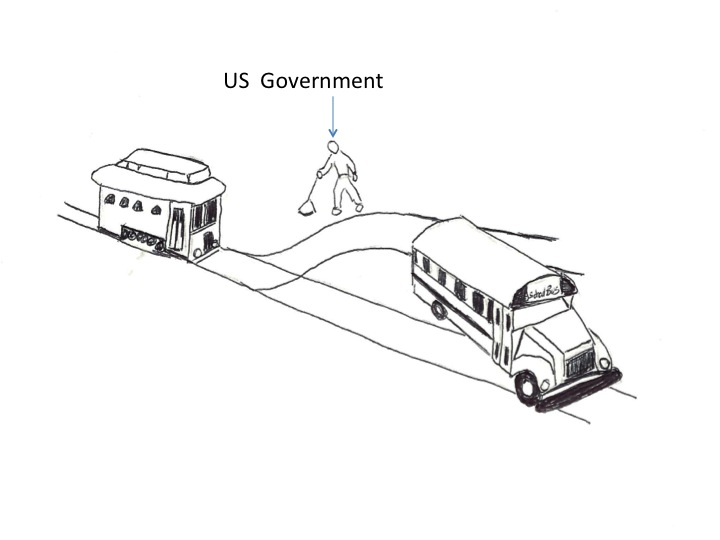
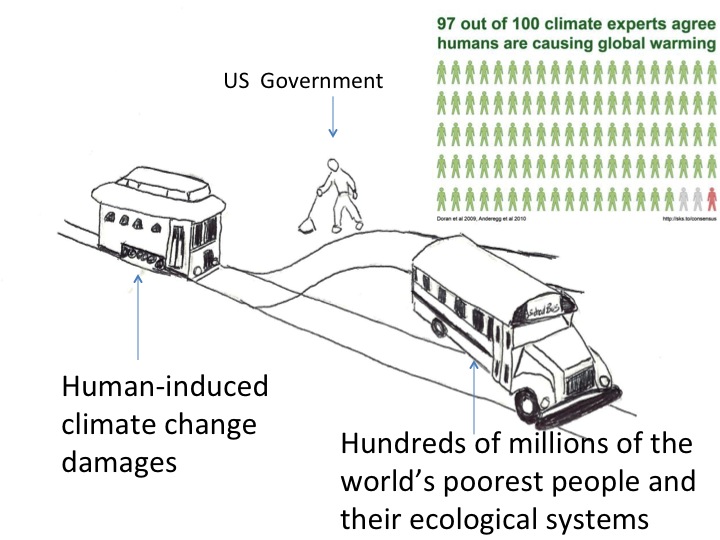
The government official is like the railroad official who has been told by employees who are in a position to know the location of the company’s trains that there is a runaway train hurtling toward a bus full of children that is stuck on the track, when the official has the ability to divert the train onto a track on which no humans will be harmed.

In the case of climate change, government officials should know that 97 of every 100 scientists that actually do peer-reviewed climate science research and in the  United States by the most prestigious scientific organizations including the US National Academy of Sciences that greenhouse gases coming from his constituents threaten catastrophic harm not only to his constituents but to millions of people around the world, most of whom have done little to cause climate change.

In the case of climate change, the US politician not only has the power, working with colleagues, to prevent great harm caused by his or her constituents, he or she has the responsibility to prevent his or her constituents from harming others outside United States. This responsibility was expressly agreed to by the United States when it ratified the United Nations Convention on Climate Change which contains the following acknowledgment of the US governments responsibility to prevent harm to those outside the United States in the convention’s Preamble:

Recalling also that States have, in accordance with the Charter of the United Nations and the principles of international law, the sovereign right to exploit their own resources pursuant to their own environmental and developmental policies, and the responsibility to ensure that activities within their jurisdiction or control do not cause damage to the environment of other States or of areas beyond the limits of national jurisdiction. (UNFCCC Preamble)

In the case of climate change, the people that will be harmed (those in our metaphorical bus) are not only the constituents of the politician but hundreds of millions of people around the world that have done little or nothing to cause climate change.


The vast majority of climate scientists and over 100 scientific organizations whose members have climate science expertise have concluded that humans are causing climate change and human-induced climate change creates catastrophic threats for the human race and particularly for hundreds of millions of poor people around the world who are most vulnerable to climate change impacts.  Although there are some differences among some mainstream scientists about some of the details of the consensus view, an open letter from the American Association for the Advancement of Science’s which was endorsed by 18 of the most prestigious scientific organizations in the United States summed up the nature of the scientific consensus as follows:

As you consider climate change legislation, we, as leaders of scientific organizations, write to state the consensus scientific view. Observations throughout the world make it clear that climate change is occurring, and rigorous scientific research demonstrates that the greenhouse gases emitted by human activities are the primary driver. These conclusions are based on multiple independent lines of evidence, and contrary assertions are inconsistent with an objective assessment of the vast body of peer- reviewed science. (AAAS 2009)

Though scientific consensus must always be open to responsible skepticism given: (a) the strength of the consensus on this topic, (b) the enormity of the harms predicted by the consensus view, (c) an approximately 30 year delay in taking action that has transpired since a serious climate change debate began in the United States in the early 1980s, (d)  a delay that has made the problem worse while making it more difficult to achieve ghg emissions reductions necessary to prevent dangerous climate change because of the steepness of reductions now needed, no politician can ethically justify his or her refusal to support action on climate change based upon a personal opinion that is not supported by strong scientific evidence that has been reviewed by scientific organizations with a wide breadth of interdisciplinary scientific expertise.  Because any further delay will make the climate change threat worse, US politicians have a duty to support policies that will reduce the threat of climate unless they can produce strong scientific evidence that has been fully vetted by respectable scientific institutions that climate change is not the threat entailed by the scientific consensus view.

In this situation the government official has a strong duty to go beyond his or her own uninformed opinion about whether humans are causing dangerous climate change. They must justify their refusal to act on strong, peer-reviewed scientific evidence that is accepted by mainstream scientific institutions that have the breadth of expertise to consider one study in the context of thousands of other studies in climate change science. And so, government officials may not justify their refusal to act simply on the basis of  their personal opinion.

Because politicians have an affirmative duty to initially rely upon mainstream scientific views in regard to human activities that could cause great harm, the press has a journalistic duty to help citizens understand any politician’s views that oppose action on climate change policies on scientific grounds. The US press has almost always failed to probe the justifications of those opposing action on climate change on scientific grounds. For this reason, journalists should ask politicians that claim there is not sufficient scientific support for government action climate change the following questions:

1. What specific scientific references and sources do you rely upon to conclude that there is a reasonable scientific dispute about whether human actions are causing dangerous climate change?

2. Are you aware that the United States Academy of Sciences and almost all respected scientific organizations whose membership includes scientists  with expertise relevant to climate change science support the scientific consensus view that holds has that the planet is warming, that the warming is mostly human caused, and that harsh impacts from warming are very likely under business-as-usual?

3.  On what basis do you disregard the conclusions that humans are causing dangerous climate change held by the United States Academy of Sciences, over a hundred scientific organizations whose membership includes experts with expertise relevant to the science of climate change, and 97 percent of scientists who actually do peer-reviewed research on climate change?

4. When you claim that the United States need not adopt climate change policies because adverse climate change impacts have not yet been proven, are you claiming that climate change skeptics have proven that human-induced climate change will not create adverse impacts on human health and the ecological systems of others on which their life often depends and if so what is that proof?

5. When you claim that the United States should not adopt climate change policies because there is scientific uncertainty about adverse climate change impacts, are you arguing that no action of climate change should be taken until all scientific uncertainties are resolved given that waiting to resolve all scientific uncertainties before action is taken will very likely make it too late to prevent dangerous human-induced climate change harms according to the consensus view?

6. Do you deny that those who argue that they should be allowed to continue to emit greenhouse gases at levels that may be dangerous should assume the burden of proof that their actions are safe given the strength of the consensus view on climate change science?

7. Do you deny that those who are most vulnerable to climate change’s harshest potential impacts have a right to participate in a decision about whether to act to reduce the threat of climate change in the face of scientific uncertainty?

8. Given that in ratifying the United Nations Framework Convention on Climate Change (UNFCCC) the Untied States in 1992 agreed to the following under Article 3, do you believe the United States is now free to ignore this promise by refusing to take action on climate change on the basis of scientific uncertainty?

The Parties should take precautionary measures to anticipate, prevent or minimize the causes of climate change and mitigate its adverse effects. Where there are threats of serious or irreversible damage, lack of full scientific certainty should not be used as a reason for postponing such measures, taking into account that policies and measures to deal with climate change should be cost-effective so as to ensure global benefits at the lowest possible cost.

(UNFCCC, Art 3)

 9. If you claim that the climate change impacts predicted by the Intergovernmental Panel on Climate Change (IPCC) have not reached a level of scientific certainty that warrants action, do you agree that climate change impacts predicted by IPCC could be wrong in both directions, potentially leading to even harsher adverse impacts than those predicted?

10. Given that for over 20 years since international climate change negotiations began, the United States has refused to commit to reduce its greenhouse gas emissions based upon the justification that there is too much scientific uncertainty to warrant action, if it turns out that human-induced climate change actually greatly harms the health and ecological systems on which life depends of others, should the United States be responsible for the harms that could have been avoided if preventative action had been taken earlier?

By:

dabrown57@gmail.com

Donald A. Brown

Scholar In Residence,

Sustainability Ethics and Law

Widener University School of Law


A short video : Can The United States Justify Its Unwillingness to Reduce Its GHG Emissions on the Basis of US Economic Interest Alone?

Some US politicians claim that the US need not reduce its GHG emissions because it is not in the US economic interest to do so. This short vide explains why the US has ethical duties to the rest of the world to reduce US ghg emissions, not only economic interests.

By:

Donald A Brown
Scholar in Residence, Sustainability Ethics and Law

Widener University School of Law

dabrown57@gmail.com


The Climate Change Disinformation Campaign: What Kind Of Crime Against Humanity, Tort, Human Rights Violation, Malfeasance, Transgression, Villainy, Or Wrongdoing Is It? Part One: Is The Disinformation Campaign a Crime Against Humanity or A Civil Tort?

I. Introduction. The French philosopher Diderot said that skepticism in all things is the first step on the road to the truth.  Although responsible scientific skepticism about climate change science is a good thing that should be encouraged, as we have written about frequently on Ethicsandclimate.org, there has been a well-organized, well-funded disinformation campaign about the science of climate change that has used tactics that are deeply ethically reprehensible.  In this entry we continue to explore how society should classify this very harmful development.

The tactics deployed by this campaign are now all well documented in the books and peer-reviewed sociological literature identified in the Appendix to this article. The tactics used by the climate change disinformation campaign have included the following ethically abhorrent tactics:

  • Lying or reckless disregard for the truth
  • Cherry picking the science
  • Cyber-bullying and ad hominem attacks on scientists and journalists
  • Manufacturing bogus, non-peer-reviewed science in ideological organized conferences and publications that don’t subject conclusions to peer-review
  • The use of ideological think tanks to promote the views of ideological skeptics
  • The use of front groups and fake grass-roots organizations known as Astroturf groups that hide the real parties in interests
  • Specious claims about “bad science” that are based upon the dubious assumption that no conclusions in science can be made until everything is proven with high levels of certainty

These tactics obviously do not constitute responsible scientific skepticism but disinformation, misinformation, propaganda, and even intimidation in the case of cyber-bullying.

EthicsandClimate.org has described this disinformation campaign in a four part paper series and a three part video series that has examined these ethically abhorrent tactics in considerable detail.

The four part written series can be found at:

1. Ethical Analysis of the Climate Change Disinformation Campaign: Introduction to a Series.

2.Ethical Analysis of the Disinformation Campaign’s Tactics: (1) Reckless Disregard for the Truth, (2) Focusing On Unknowns While Ignoring Knowns, (3) Specious Claims of “Bad” Science, and (4) Front Groups.

3.Ethical Analysis of Disinformation Campaign’s Tactics: (1) Think Tanks, (2) PR Campaigns, (3) Astroturf Groups, and (4) Cyber-Bullying Attacks.

4. Irresponsible Skepticism: Lessons Learned From the Climate Disinformation Campaign.

The three part video series can be found at:

Why The Climate Change Disinformation Campaign Is So Ethically Abhorrent.

The Ethical Abhorrence of The Climate Change Disinformation Campaign, Part 2.

The Ethical Abhorrence of the Climate Change Disinformation Campaign, Part 3.

In this entry we continue to examine how we should classify this kind of disinformation, an important question because the disinformation campaign is, we believe, a new kind of assault on humanity which raises questions about how we should classify it and how society should sanction disinformation about potentially very harmful human behavior. We first examine the basis for claiming that the disinformation campaign is a crime against humanity.

II. Crime Against Humanity

Because the international community has lost over twenty years in developing an adequate solution to climate change, a matter discussed in considerable detail in this writer’s recent book Climate Change Ethics, Navigating the Perfect Moral Storm, in no small measure due to the climate change disinformation campaign and given that the international community is now running out of time because of this delay to prevent dangerous climate change, the  disinformation campaign is likely responsible for huge quantities of human suffering.  That is this delay is causing or increasing the severity of droughts, floods, adverse human health impacts, intense storm damage, and heat related deaths among others adverse impacts.  Without doubt the failure to act in the last twenty years is putting hundreds of millions of people at great risk including some the world’s poorest people and the ecological systems on which their lives depend.

Given the scale of these impacts, what sense can be made of a claim that  the tactics of the disinformation campaign (to be distinguished from responsible scientific skepticism) is some new kind of crime against humanity.

Crimes against humanity are understood to be grave offenses that are part of a widespread or systematic attack against a civilian population.

In 2002, the International Criminal Court (ICC) was established in The Hague (Netherlands) and the Rome Statute provides for the ICC to have jurisdiction over genocide, crimes against humanity, and war crimes. The definition of what is a “crime against humanity” are contained in Article 7 of the Rome Statute which says that:

For the purpose of this Statute, “crime against humanity” means any of the following acts when committed as part of a widespread or systematic attack directed against any civilian population, with knowledge of the attack: (a) Murder; (b) Extermination; (c) Enslavement; (d) Deportation or forcible transfer of population; (e) Imprisonment or other severe deprivation of physical liberty in violation of fundamental rules of international law;  (f) Torture; (g) Rape, sexual slavery, enforced prostitution, forced pregnancy, enforced sterilization, or any other form of sexual violence of comparable gravity; (h) Persecution against any identifiable group or collectivity on political, racial, national, ethnic, cultural, religious, or gender, or other grounds that are universally recognized as impermissible under international law, in connection with any act referred to in this paragraph or any crime within the jurisdiction of the Court; (i) Enforced disappearance of persons; (j) The crime of apartheid; (k) Other inhumane acts of a similar character intentionally causing great suffering, or serious injury to body or to mental or physical health.

Thus far only these very odious acts have been recognized as crimes against humanity. Furthermore only crimes that have been committed in nations that have consented to the jurisdiction of the International Criminal Court (ICC) may be prosecuted in the ICC. Because the United States has not consented to the ICC and many of the activities of the disinformation campaign have taken place in the United States, it is not likely that fossil fuel companies who have participated in in the disinformation campaign could be prosecuted for a crime against humanity even if the court construes the tactics of the disinformation campaign as “inhumane acts of a similar character intentionally causing great suffering.” Furthermore it is not clear that the disinformation campaign constitutes a “systematic attack against a civilian population” as defined in the ICC statute. Therefor although the  disinformation campaign can be understood as a new kind of assault on humanity, it does not obviously fit the definition of crime against humanity under the ICC.

And so, although a strong case can be made that the intentional acts of those participating in  the disinformation campaign are metaphorically some kind of new crime against humanity, it is not likely that these acts would be construed to be legally prosecutable as crimes against humanity under existing international law.

Before accusing someone of a crime, it is also necessary to be able to prove that they knew or should have known that that they were misleading people in ways that could cause damage or harm. One might ask whether anyone engaging in the tactics discussed in this series on the disinformation campaign is ethically blameworthy. Some skeptics, for instance, who engage in the ethically dubious practice of stressing unknowns while ignoring the large body of well-settled science are simply expressing their opinions or their interpretations of what they know about the science. If people have a right to free speech, it follows that people should be able to express their views on climate science freely, even if their views are based upon incomplete knowledge of the peer-reviewed science on which the consensus view has been based.

Yet there is abundant evidence that some of those participating in climate change disinformation campaign were being advised by scientists advising them that the mainstream scientific view was entitled to strong scientific respect, yet they persisted in spreading claims that there was no scientific basis for concern about human-induced climate change.

Furthermore, those funding the disinformation campaign consistently funded organizations and individuals that were regularly making demonstratively false claims about the state of climate change science or claims made in reckless disregard for the truth.

And so, some of the activities of those engaged in the disinformation campaign could likely be prosecuted on criminal grounds provided a court had jurisdiction to make criminal determinations in such matters under a law that criminalized known false claims about very dangerous behavior.  Given the immensity of the harm from the climate change disinformation campaign, a case can be made that new laws criminalizing disinformation on matters as dangerous as climate change are warranted where the disinformation is transmitted to protect economic interests.

III. Civil Liability Under Common Law for Disinformation

A tort is a violation of civil duties, that is a tort, in common law jurisdictions, is a civil wrong. Tort law deals with situations where a person’s behavior has unfairly caused someone else to suffer loss or harm. A tort is not necessarily an illegal act but an act that causes harm. The law allows anyone who is harmed to recover their loss.

We begin with a specific case,  Kivalina vrs ExxonMobil Corporation, because although this case has now been dismissed, the plaintiffs in this case set out in the complaint assertions they claimed they could prove about the actions of the defendants actions, the majority of which were fossil fuel companies,  that are are relevant to to the disinformation campaign.

Kivalina v. ExxonMobil Corporation, et al. is a lawsuit filed on February 26, 2008 in a US district court asking for climate change damages from flooding to the Alaskan village of Kavalina. This case has subsequently been dismissed by the US Court of Appeals for the Ninth Circuit in October of 2012 on the basis that climate change raises political issues that need to be decided by legislative action rather than by  a court.

Nevertheless, the allegations made by the plaintiff, an Alaskan village,  asserted that some of the defendants including ExxonMobil Corporation, BP America, Inc., Chevron Corporation, ConocoPhillips Company,  Peabody Energy Corporation, American Electric Power Company, Inc, Duke Energy Corporation, and The Southern Company, conspired to misinform the public on the science of climate change either individually or through their various front groups or  industry trade associations. The complaint in this case further asserted that the object of the conspiracy was to create unwarranted doubts about the existence of global warming and its causes among the public and that the defendants did this to protect their economic interests.

The plaintiffs also claimed that some of the  defendants have conspired to mislead the public about the science of global warming creating flooding harms to the Village of Kivalina.

The plaintiffs alleged that the defendants  also funded “front groups,” including ƒƒphony citizens’ organizations and bogus scientific bodies, to regularly publish views expressing doubts about global warming in mainstream publications such as the Wall Street Journal. The plaintiffs also alleged that the defendants funded and circulated misleading advertising which questioned the “science” of global warming and human causation. The plaintiffs also alleged that defendants coordinated a “skeptics campaign” that include funding for energy industry groups and other public policy organizations which voiced skepticism regarding global warming, creating the appearance of numerous independent voices speaking out against global warming.

The plaintiffs further claimed that the defendants engaged in a civil conspiracy by ƒƒand through agreements to participate in the intentional creation, contribution to and/or maintenance of a public nuisance through global warming by undermining the public’s understanding of climate change science.

The plaintiffs also alleged that the fossil fuel companies were being told by scientists that were advising them that climate change was a serious threat, yet they continued to fund projects which sought to undermine the science.

The court finally dismissed the case on the ground that the “the solution to Kivalina’s dire circumstances must rest in the hands of the legislative and executive branches of our government, not the federal common law.” Kivalina may be the last blow for parties that are seeking to address climate change via the federal common law. Kivalina was the last in a series of cases seeking to recover damages from climate change under  theories of liability for a public nuisance. These other cases also have been dismissed on the grounds that climate change liability is a matter that must be resolved by legislatures not courts.  The opinion in the Kivalina case makes it clear that both abatement actions and monetary damage actions pertaining to greenhouse gas emissions have been displaced by the Clean Air Act. Most observers have concluded that  public nuisance litigation in the future will likely be litigated in the states, where common law public nuisance actions are still viable although efforts to address climate change via state common law have been unsuccessful (at least so far).

The apparent reasoning followed by the court in this case is that there is no right to damages from climate change under the theory of public nuisance in federal courts because climate change emissions now must be regulated under the federal Clean Air Act. In other words, federal statutory law has preempted the way in which greenhouse gas emissions will be regulated and the penalties that will be allowed for excess emissions. Such a decision is not understood to conclude that the defendants have not been harmed by the conspiracy of the defendants to mislead the public, only that there is no right to recover damages from this harmful behavior in US federal courts using common law tort theories.

And so the tactics employed by fossil fuel companies to undermine the public’s understanding of mainstream scientific conclusions about climate change may be a wrong without a civil remedy for damages under common law, at least in the United States. It is not clear, however, that civil liability for disinformation may not be adjudicated in courts outside the United States. Only time will tell.

Because climate change damages are likely to be so catastrophic for some people in some places, a case can be made that governments should create statutes that would impose severe financial penalties on parties that spread false information about very harmful behavior such as spreading misinformation about climate change.

Part II in this series will look at other legal theories for responding to the disinformation including human rights theories.

IV Conclusion

Thus far we have shown that although the climate change disinformation campaign is equal in destructive power to many human activities that are classified as crimes against humanity, yet the current international legal regime for prosecuting crimes against humanity does not provide an adequate remedy for climate change caused damages that have been caused by those participating in the disinformation campaign. This is so despite the fact that there is strong evidence that at least some of those participating in the disinformation campaign knew or should have known that they were spreading false information about the enormous threat of climate change and did so to protect economic interests.

We have also seen, there appears to be no civil law remedy for damages that tens of millions will experience at least in part because of tactics of the disinformation campaign. Yet a strong case can be made that there should be some civil legal remedy for those who have been harmed by the those responsible for the disinformation campaign.

By:

Donald A. Brown

Scholar In Residence, Sustainability Ethics and Law

Widener University School of Law

Appendix

Anderegg, William R. L., James W. Prall, Jacob Harold and Stephen H. Schneider. 2010. “Expert Credibility in Climate Change.” Proceedings of the National Academy of Sciences 107 (27):12107-12109.

Beder, Sharon. 1999. “Corporate Hijacking of the Greenhouse Debate.” The Ecologist 29 (March/April):119-122.

Bedford, Daniel. 2010. “Agnotology as a Teaching Tool: Learning Climate Science by Studying Misinformation.” Journal of Geography 109:159-165.

Bradley, R. 2011, “Global Warming and Political Intimidation, How Politicians Cracked Down On Scientists as the Earth Heated Up”, University of Massachusetts Press, 2011,

Dieltham, Pascal and Martin McKee. 2009. “Denialism: What Is It and How Should Scientists Respond?” European Journal of Public Health 19 (1):2-4.

Dunlap, Riley E. and Aaron M. McCright. 2008. “A Widening Gap: Republican and Democratic Views on Climate Change.” Environment 50 (September/October):26-35.

Dunlap, Riley E. and Aaron M. McCright. 2010. “Climate Change Denial: Sources, Actors and
Strategies.” Pp. 240-259 in Constance Lever-Tracy (ed.), Routledge Handbook of Climate Change and Society. London: Routledge.

Dunlap, Riley E. and Aaron M. McCright. 2011. “Organized Climate Change Denial.” Pp. 144-160 in J. S. Dryzek, R. B. Norgaard and D. Schlosberg (eds.), The Oxford Handbook of Climate Change. London: Oxford.

Edwards , P., 2010, “A Vast Machine, Computer Models, Climate Data, and the Politics of Global Warming,” MIT Press, Cambridge, Mass.

Freudenburg, William R., Robert Gramling, and Debra J. Davidson. 2008. “Scientific Certainty Argumentation Methods (SCAMs): Science and the Politics of Doubt.” Sociological Inquiry 78:2-38

Hoggan, J, 2009, “Climate Cover Up, The Crusade To Deny Global Warming”, , Greystone Books, 2009

Hoffman, Andrew J. 2011. “Talking Past Each Other? Cultural Framing of Skeptical and Convinced Logics in the Climate Change Debate.” Organization & Environment 24:3-33.

Jacques, Peter, Riley E. Dunlap and Mark Freeman. 2008. “The Organization of Denial: Conservative Think Tanks and Environmental Skepticism.” Environmental Politics 17:349-385.

Lahsen, Myanna. 1999. “The Detection and Attribution of Conspiracies: The Controversy over Chapter 8.” Pp. 111-136 in G.E. Marcus (ed.), Paranoia Within Reason: A Casebook on Conspiracy as Explanation. Chicago: University of Chicago Press.

Lahsen, Myanna. 2005. “Technocracy, Democracy, and U. S. Climate Politics: The Need for Demarcations.” Science, Technology & Human Values 30:137-169.

Lahsen, Myanna. 2007. “Experiences of Modernity in the Greenhouse: A Cultural Analysis of a Physicist “Trio” Supporting the Backlash Against Global Warming.” Global Environmental Change 18:204-219.

Lynch, Michael J., Ronald G. Burns and Paul B. Stretsky. 2010. “Global Warming and State-Corporate Crime: The Politicization of Global Warming under the Bush Administration.” Crime, Law and Social Change 50:213-239.

McCright, Aaron M. and Riley E. Dunlap. 2000. “Challenging Global Warming as a Social Problem: An Analysis of the Conservative Movement’s Counter-Claims.” Social Problems 47:499-522.

McCright, Aaron M. and Riley E. Dunlap. 2003. “Defeating Kyoto: The Conservative Movement’s Impact on U.S. Climate Change Policy.” Social Problems 50:348-373.

McCright, Aaron M. and Riley E. Dunlap. 2010. “Anti-Reflexivity: The American Conservative Movement’s Success in Undermining Climate Science and Policy.” Theory, Culture and Society 26:100-133.

McCright, Aaron M. and Riley E. Dunlap. 2011. “The Politicization of Climate Change and Polarization in the American Public’s Views of Global Warming, 2001-2010.” Sociological Quarterly 52:155194.

McCright, Aaron M. and Riley E. Dunlap. “Cool Dudes: The Denial of Climate Change among Conservative White Males.” Global Environmental Change 21: In press. doi:10.1016/j.gloenvcha.2011.06.003

Mooney, C., 2005, “The Republican War On Science,” Chris Mooney, Basic Books. 2005

Oreskes, Naomi and Erik M. Conway. 2008. “Challenging Knowledge: How Climate Science Became a Victim of the Cold War.” Pp. 55-89 in R. N. Proctor and L. Schiebinger (eds.), Agnotology: The Making and Unmaking of Ignorance. Stanford, CA: Stanford University Press.

Oreskes, Naomi, Erik M. Conway, and Matthew Shindell. 2008. “From Chicken Little to Dr. Pangloss: William Nierenberg, Global Warming, and the Social Deconstruction of Scientific Knowledge.” Historical Studies in the Natural Sciences 38: 109-52.

Oreskes, Naomi, and Erik M. Conway. 2010. “Merchants of Doubt: How a Handful of Scientists Obscured the Truth on Issues from Tobacco Smoke to Global Warming” New York: Bloomsbury Press.

Pooley, E., 2010, “Climate War, True Believers, Power Broakers and The Fight to Save the Earth,” Hyperion,

Powell, James Lawrence. 2011. “The Inquisition of Climate Science”. New York: Columbia University Press.
Washington, Haydn and John Cook. 2011. “Climate Change Denial: Heads in the Sand”. London: Earthscan.

Weart, Spencer. 2011. “Global Warming: How Skepticism Became Denial.” Bulletin of the Atomic Scientists 67 (1):41-50.

What You Need To Know to Understand the Scale of the Climate Change Problem and The Continuing US Press Failure to Report on the Urgency of this Civilization Challenging Threat


Climate Change Is  Real, Yet The US Press Is Not Reporting On The Urgency and Magnitude of the Problem


One can tell by how climate change policies are being debated around much of the world that few people, including many very educated people,  understand the scale and urgency of the problem now being articulated by the most prestigious scientific international institutions.  In this writer’s experience this is true not only of average citizens but also of most college students and academics that are not enrolled in climate science courses and by almost all press that periodically reports on this issue.

This entry describes what needs to be understood to evaluate the adequacy of the US response to climate change although the analysis contained here could be applied to almost any nation in the world. This is so because the adequacy of any national response to climate change must now be examined in light of the scale of the problem, yet few people understand the magnitude and urgency of this enormous threat.

In the wake of Hurricane Sandy and reports that 2012 was the warmest year in US history, climate change has been more visible in the US press recently.  Yet despite this increased attention, for the most part, the urgency and magnitude of the need to reduce greenhouse gas emissions entailed by the mainstream scientific understanding of this civilization challenging problem is not being covered by the US press.

In fact, some of the recent climate change reporting could be understood as actually misleading US citizens that the United States is making acceptable progress in reducing the threat of climate change. For instance, a Scientific American Report of October 2012 was titled: “U.S. May Come Close to 2020 Greenhouse Gas Emission Target“. This article said that the United States is likely to reduce its greenhouse gas emissions by 16.3 % from 2005 levels by 2020, falling just shy of the 17 % target pledged by President Obama at the 2009 climate talks in Copenhagen, Denmark.  Other projections of US emissions have found, however, that although the US emissions are dropping compared to 2005, it is not likely that the US will come close to achieving the 17% reduction goal without further legislative action because current reductions will lead a best to a 9% reduction by 2020. (See, for instance, WRI report)

For instance, the following graph from the World Resources Institute includes a projection of future US greenhouse emissions that predict US emissions will flatten out above the 17 % reduction goal by 2020.

(WRI, 2012)

Some media reporting on US emissions reductions leave the false impression that the United States is performing well in meeting its responsibilities to reduce greenhouse gas emissions because it is possible for the US to come close to meeting a US commitment made in Copenhagen in 2009 to reduce its emissions by 17% below 2005 emissions.  Missing from such reports is an analysis of projected US emissions reductions compared to the magnitude of global greenhouse gas emissions reductions needed to prevent catastrophic warming and the limited amount of time that the international community has to put global emissions on a reduction pathway that has some hope of avoiding rapid non-linear climate change.  That is, to evaluate the US performance in reducing its greenhouse emissions one must compare US emissions both at existing and future commitment levels with what is needed globally to avoid harsh impacts.

The following chart shows the emissions reduction commitments individual nations have made thus far including the United States and what emissions are projected if the United States meets its projected target (there are two numbers shown on this chart for each commitment to take into consideration certain contingencies).


(UNEP 2012)

This chart shows that the US commitment is among the lowest emissions reductions from 1990 levels compared to other developed nations.

The following chart compares total emissions from major national emitters  in regard to 1990, 2005, 2010, business as usual,  and projected emissions in 2020 and projected based upon emissions reduction commitments.

Although China will soon be emitting total emissions at levels twice as much as the United States, the following chart demonstrates that the US will still lead even China in per capita emissions.

To make sense of the performance on greenhouse gas emissions of any nation one must understand the magnitude of greenhouse gas emissions reductions necessary to prevent catastrophic warming.

The international community has agreed that future warming should be limited to 2 degrees C because greater warming is believed to create a risk of passing tipping points in the climate system that will trigger rapid increased warming with devastating consequences. Given this there is now a strong scientific consensus that the entire global community must limit its greenhouse gas emissions by as much as 25% to 40 % below 1990 emissions levels by 2020 to have any reasonable chance of avoiding dangerous climate change and that global emissions are still increasing between 2% and 3% per year, the challenge to the international community in regard to magnitude of emissions reductions needed is staggering. And so any national commitment to reduce greenhouse gas emissions must now be evaluated by examining whether the commitment is ambitious enough to prevent dangerous climate change given what is the nation’s fair share of safe global emissions.  A simple comparison of the US commitment with needed global emissions reductions clearly reveals that the US promise is woefully and utterly inadequate.  That is, the US commitment of 17%  below 2005 emissions is only a 4% reduction below 1990 emissions levels making it among the weakest of the developed nations’ promises to reduce emissions and far below of global emissions reductions needed to prevent rapid climate change.

Moreover, to stabilize atmospheric concentrations at levels that will avoid dangerous climate change the entire world will need to peak its emissions  in the next few years followed by emissions reductions at hard to imagine rates over the next 40 years. The following chart shows the emissions reduction pathways that are needed in this century to give the world any hope of limiting warming to 2 degrees Centigrade. The later the peaking of global total emissions, the steeper the reduction pathways that are needed. (The different colored lines represent different emissions scenarios in the years ahead)


(Anderson, K.  2011)


And so, the US projected emissions reductions fall far short of the 25 to 40 %  emissions reductions below 1990 levels by 2020 that are likely necessary to put the world on a pathway that gives any hope of limiting warming to the dangerous 2 degree C warming limit that has been agreed to. Furthermore there is some inconclusive evidence that to prevent dangerous climate change the warming limit should be 1.5 degrees C, a matter that will  be investigated under the UNFCCC in the next few years.

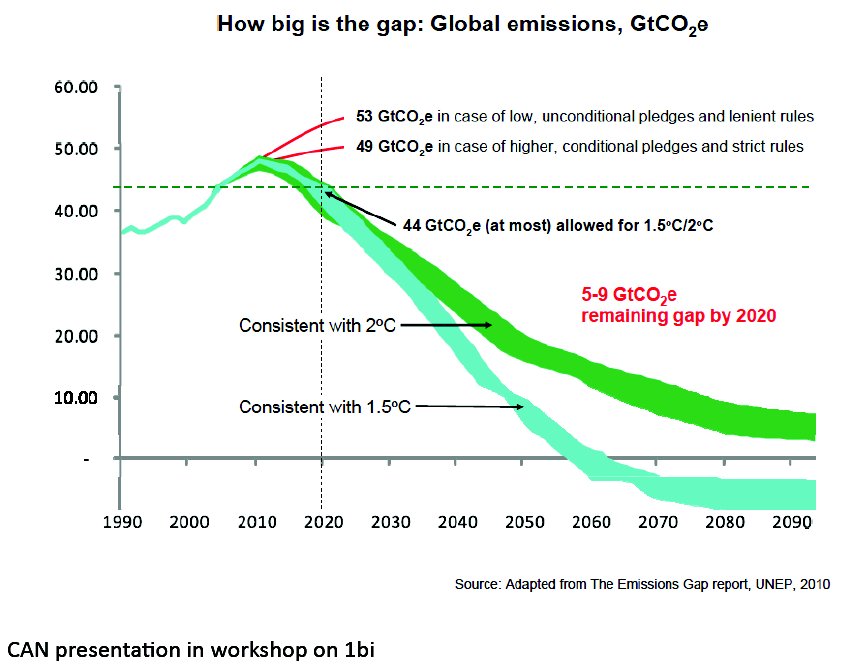
If a 1.5 degrees C warming limit should be the goal of the international community rather than 2 degree C, the international community will need to dramatically increase it emissions reductions ambitions to hard to imagine levels.  In fact, all of the commitments made by all nations under the UNFCCC fall far short of the emissions levels necessary to prevent the 2 degree C warming limit . The following chart describes the gap between the emissions reductions commitments that nations have been made under the UNFCCC.


According to a recent report by the United Nations Environment Program, to have any chance of limiting warming to 2 degree C total levels in 2020 must be no greater than 44 GtCO2e (with a range of: 41-47 GtCO2e). Afterwards, global emissions must steeply decline (a median of 2.5% per year, with a range of 2.0% to 3.0% per year) to 2050.

Because current global greenhouse gas emissions, based on 2010 data,  are estimated at 50.1 GtCO2e the world is emitting emissions 14% higher than the median estimate (44 GtCO2e) of the emission level in 2020 needed to have any hope of limiting warming to the 2 degree C target and global emissions are currently increasing at 2 to 3% per year, the world is running out time to prevent dangerous climate change.  (UNEP, 2011).

The following chart demonstrates the enormity of the challenge after 2020 to limit warming to 2 or 1.5 degrees Centigrade.

(CAN presentation)

Not only must global greenhouse gas emissions be reduced at difficult to imagine rates to avoid dangerous climate change, the United States must exceed these global reduction rates for two reasons according to any sense of basic fairness. First, US per capita emissions are among the highest in the world as we have seen above.  Second, the United States also exceeds all countries in the world in historical emissions. The following chart shows the proportion of global greenhouse gas emissions being emitted by the United States since the beginning of the industrial revolution.


Therefore the US will clearly need to reduce its emissions to even greater levels than those required of the entire world because its per capita emissions are higher than almost all nations and its historical emissions have disproportionally contributed to the elevated atmospheric greenhouse gas concentrations already causing some climate change harms. And so, the United States is challenged to make rapid reductions in greenhouse gas emissions greater than most any other country. This is not only an ethical obligation, it is foundational to any hope of avoiding harsh climate change.

The US media has utterly failed to report on the scale of this challenge. Educators around the world have also largely failed to educate civil society about the urgency of action on climate change. To minimize the threat of climate change, the world needs an “all-hands-on-deck” approach to climate change that is mindful of the scale of the challenge.


By:

Donald A. Brown

Scholar In Residence, Sustainability Ethics and Law

Widener University School of Law

dabrown57@gmail. com


Qatar: The Waiting for the United States Continues

The United States defended its track record on fighting climate change as the Qatar climate change negotiations began last week. The US representative Jonathan Pershing claimed that the United Sates was making “enormous” efforts to slow global warming and help the poor nations most affected by it. (Associated Press, 2012) Other countries have accused the United States of consistently blocking progress in the search for a global solution to climate change particularly since the George W. Bush administration abandoned the Kyoto Protocol, the 1997 treaty limiting emissions of heat-trapping gases by industrialized countries. As negotiators met for a two-week session in oil and gas-rich Qatar, U.S. delegate  Pershing suggested America deserves more credit and said: “Those who don’t follow what the U.S. is doing may not be informed of the scale and extent of the effort, but it’s enormous.” Pershing also noted that the Obama administration has taken a series of steps, including sharply increasing fuel efficiency standards for cars and trucks, and made good on promises of climate financing for poor countries. (Associated Press, 2012). Thus far, the United States has not articulated any willingness to go beyond the voluntary emissions reductions commitment it made in Copenhagen three years ago.

The US apparent unwillingness to reduce its greenhouse gas emissions beyond what it is already on track to achieve is of considerable controversy in the Qatar negotiations this week because of the growing scientific concern about the potential inevitability of catastrophic warming caused by human activities.  Probably at the top of the list in order of importance of all of the issues under negotiation in Qatar is the need to increase the ambitiousness of emissions reductions commitments by nations so that that future warming is limited to 2°C. Because nations have failed to make commitments to reduce global greenhouse gas emissions to levels that will limit future warming do 2°C, there is an increasing sense of urgency among climate scientists around the world on the need for all nations to significantly increase their greenhouse gas emissions reductions commitments to their fair share of safe global emissions. This will require most nations, but particularly high-emitting nations such as the United States, to greatly increase commitments beyond those that they had made in the Copenhagen Cop in 2009.

As we have written about extensively before on EthicandCliamte.org, the world has been waiting for over two decades for the United States to show leadership on climate change.  See, f0r instance, The World Waits In Vain For US Ethical Climate Change Leadership As the World Warms.  Although there are many countries other than the United States that have frequently failed to respond to what justice would require of them to reduce the threat of climate change, the United States, perhaps more than any other country, has gained a reputation in the international community for its consistent unwillingness to commit to serious greenhouse gas emissions reductions during the over two decades that world has been seeking a global agreement on how to respond to climate change. 
Because the United States is such a vital player in any global solution to climate change, the US lack of response to its obligations to reduce the global threat of climate change is widely seen as an immense impediment to an urgently needed global climate change solution. And so the world continues to wait for ethical leadership from the United States on climate change at a time when climate change damages are becoming more visible around the world.

The United States according to the World Resources Institute has recently made progress on its greenhouse gas emissions toward its voluntary target of reducing greenhouse gas emissions by 17% below 2005 emissions by 2020 to the extent that it may reduce its emissions by 9.5 %  by 2020. (WRI, 2012)  US ghg emissions reductions have been achieved in the United States due largely significant fuel switching in the electricity sector from coal to natural gas, an economic slowdown that began in 2008, and some federal and US state regulatory programs designed to reduce ghg emissions. Yet because the US projected reductions of 9.5% below 2005 in 2020 is equal to a 2% increase above 1990 levels in 2020 at a moment in history when many scientists believe that a reductions of 25 to 4o% below 1990 levels by 2020 are necessary to prevent dangerous climate change, the US projected reductions fall extraordinarily short of any reasonable US fair share of tolerable global emissions.

Because of these inadequate commitments from the United States, ECO, an NGO publication that reports on developments at UNFCCC negotiations, wrote the following letter to President Obama that we hereby reprint.

President Obama: We Hope for Change

In his victory speech after being re-elected to a second term, President Obama swelled the hopes once again of people around the world who care about climate change when he said, “We want our children to live in an America that is not burdened by debt, that is not weakened by inequality, that is not threatened by the destructive power of a warming planet.” Those hopes continued to swell when in a press conference a few days later, he responded to a question from the media on climate by saying that he planned to start “a conversation across the country…” to see “how we can shape an agenda that garners bipartisan support and helps move this agenda forward…and…be an international leader” on climate change. President Obama appears to understand that climate change is a legacy issue that was not adequately addressed during his first term in office.

The question therefore has to be, what next? In his second term, will President Obama deliver the bold action needed to reduce the threat of climate change to the US and the world, by shifting the US economy towards a zero carbon future, and making the issue a centerpiece of US foreign policy? In the aftermath of superstorm Sandy, and the drought, wildfires and other extreme weather events that have afflicted the US over the last year, it is clearly time for President Obama to press the reset button on climate policy, both nationally and internationally.

First, the world needs to hear from the President and his negotiating team here in Doha that they remain fully committed to keeping the increase in global temperature far below 2 degrees, that it is not only still possible but essential to do so, and that the USA is going to provide leadership in this collective effort.

The administration should then make clear how it will meet its current 17 percent reduction target. While US emissions are decreasing slightly – both as a result of the administration’s policies on renewable energy and vehicle fuel economy standards and because of sharply lower natural gas prices that have reduced coal use for electricity generation – it is unlikely that without additional regulation or legislation that the US will meet its 2020 target. The delegation should also clarify what the Obama Administration will do to put the US on track to the near-elimination of emissions by mid-century called for by the scientific community.

Finally, delegations need to hear that the US remains committed to meeting its fair share of the Copenhagen pledge of mobilizing $100 billion in climate finance per year by 2020, as well as which innovative finance options the administration is prepared to support to get there.

These four steps would go a long way to reset US climate diplomacy. They would show that instead of dragging the world down to the level of what is (not) possible in the USA, President Obama and his team are going to pull the US up to what the science and the world demands to avoid catastrophic climate change.

One last point: every coach knows that when you find your team down by several goals at half-time, a change in your game plan may not be enough; it may also be time to make some substitutions to the players on the field.

By:

Donald A. Brown

Scholar In Residence

Sustainability Ethics and Law

Widener University School of Law

dabrown57@gmail.com


Qatar Climate Change Negotiations: An Open Letter To US President Obama From the World’s Poorest Nations.

I. Introduction

Over the next few weeks EthicsandClimate.org will be focusing on the upcoming Qatar climate negotiations, the 18th Conference of the Parties (COP-18) that will be held from November 26th to December 7th. In future entries, we will discuss in detail COP-18’s progress in achieving a global solution to climate change particularly to see the extent to which this meeting makes progress on the following minimum criteria for any post-Kyoto agreement that ethics requires.  That is, we will examine whether the Qatar proceedings:

  • Obtain commitments on  greenhouse emissions reductions sufficient to assure that the international community is on a greenhouse gas emissions reduction pathway that will prevent dangerous climate change. This is sometimes referred to as the environmental sufficiency criteria.
  •  Begin to base differences among national allocations on the basis of equity and justice. This is sometimes referred to as the equity criteria.
  • Assure that those responsible for climate change provide adequate and predictable adaptation funding to enable developing countries, and in particular the most vulnerable developing countries,  to do what is necessary to avoid climate change damages in cases where it is possible to take action and to prevent damages, or be compensated for climate change damages in cases where it is impossible to take protective action. We refer to this as the just adaptation criteria.

As we have argued in the past on EthicsandClimate, the success of any global approach to climate change depends upon the extent to which those countries with the largest emissions are willing to make  significant commitments particularly in regard to the three criteria identified above although there are many other issues that will arise in the international climate negotiations that Ethicsanclimate.org  will follow. In this regard, the United States in an indispensable element in any satisfactory international climate change regime. For this reason, we begin this analysis of the Qatar COP with the following open letter from some of the world’s poorest countries to US President Obama that was published in the Guardian.

II. Open Letter to US President Obama

Dear President Obama:

As the lead negotiator for the world’s 48 Least Developed Countries (LDCs) in the United Nations climate change negotiations, I congratulate you on your re-election. I also want to express my admiration for your response to superstorm Sandy: without the preparations that you made, the impacts to those hit by the storm would have been even more devastating. As communities in the north-east work to rebuild and recover, the world has an opportunity to begin a new, reality-based conversation about climate change.

I write with a simple request: as this discussion continues in the world’s most developed countries, remember those who live in its poorest regions. Remember that as a result of climate change, this kind of fatal weather event has become commonplace for us while we lack the infrastructure and resources to adequately protect our citizens.

As researchers at Brown University’s climate and development lab have shown, climate-related disasters such as droughts, extreme temperatures, floods, and hurricanes have caused an estimated 1.3 million deaths since 1980. Two-thirds of these deaths (over 909,000) occurred in the least developed countries. We are only 12% of the world’s population, but we suffer the effects of climate-related disasters more than five times as much as the world as a whole.

Given this reality and your early commitment to leading a science-directed discussion about the changing climate, I was surprised that you only mentioned climate change in your re-election campaign a few times, and not once in your three debates with Mitt Romney. We know that 70% of US citizens now recognise the reality of human-caused climate change. As the world’s largest economy, the US has a unique opportunity and responsibility to take bold action on this issue. Indeed, the wellbeing of the citizens of your nation and mine depends on your ability to lead at this critical juncture. It is time to end the climate silence.

Later this month, representatives of the world’s nations will meet in Doha, Qatar, for the annual negotiations on the UN climate change treaty. When you were first elected president, your words gave us hope that you would become an international leader on climate change. But you have not lived up to this promise. The framework that you put in place sets the planet on course to warm dangerously, and delays action until 2020 – this will be too late. This year’s meeting in Qatar may be our last chance to put forward a new vision and plan to reverse this course. Your legacy, and the future of our children and grandchildren depend on it. We ask you to lead in two ways.

First, join with the European Union, the LDCs and the Alliance of Small Island States in taking on ambitious national commitments to reduce climate pollution. Go beyond the commitments that you made in Copenhagen in 2009. The climate is changing faster than we thought, and we must respond with increased ambition.

Second, provide adequate funding to help the LDCs and other vulnerable nations to adapt to this new climate reality. In 2010, the wealthiest countries directed about $1.5bn to help developing countries adapt to a changing climate. Over the same period, they spent over $400bn subsidising fossil fuel industries. They gave the main contributors to human-caused climate change more than 250 times the support they offered those whom it harms most.

Countries from Gambia and Haiti, to Malawi and Bangladesh need the “predictable and adequate” funding promised in Copenhagen so that they can take simple steps to protect their citizens. This means moving drinking water and irrigation wells away from coasts, where saltwater is intruding into aquifers; it includes developing drought-resistant crops and helping small farmers in fragile, semi-arid regions survive. We have to prepare roads and cities, villages and farms for floods, hurricanes and heat waves. We need to equip people with the weather prediction, early warning systems and emergency response that citizens of the developed countries take for granted.

With 20 years of international climate change negotiations behind us, there is simply no longer time or cause for wealthy countries to continue to stall in taking real action to fulfill the promises they have made. Having the wealthy nations reduce their greenhouse gas emissions steeply is fundamental, but helping the poorest of us cope with its impacts is an immediate necessity.

Mr President, remind the world that the devastation of climate change is shared by all its citizens. Remember that this reality is changeable. Make changing it your legacy.

Pa Ousman Jarju is the chair of the Least Developed Countries group at the UN climate change negotiations.

(Guardian, 2012)

References:

The Guardian, (2012)  An Open Letter to Obama From the World’s Poorest Countries,  http://www.guardian.co.uk/environment/blog/2012/nov/08/obama-climate-change-poorest-countries

By:

Donald A. Brown

Scholar In Residence, Sustainability Ethics and Law

Widener University School of Law

dabrown57@gmail.com.

An Ethical Examination of How The US Press Has Covered Links Between Hurricane Sandy and Climate Change


US President Obama and New Jersey Governor Chris Christie Inspect Damages from Hurricane Sandy., October 31, 2012

I-Introduction

In this paper we examine through an ethical lens how the controversy about links between Hurricane Sandy and climate change have been covered by the US media. In the last two weeks the mainstream media has awoken, at least temporarily, from a slumber about climate change because of the enormous damages from Sandy and their potential links to human-induced warming. Although this renewed attention to climate change should be welcomed, in the last entry on EthicsandClimate.org we identified several crucial missing features of climate change in the renewed press coverage of climate change that citizens need to know to understand why climate change is such a civilization challenging threat. These missing features include: (a) the nature of the strong scientific consensus about climate change, (b) the magnitude and urgency of the emissions reductions necessary to prevent dangerous climate change, (c) the barrier that the United States has been to finding a global solution for over 20 years, (d) the nature of the climate change disinformation campaign, and (e) the significance for policy of the fact that climate change is a civilization challenging ethical problem.

Ethicsandclimate.org has frequently explained the practical significance for policy of the fact that climate change is a civilization challenging ethical problem. We now look at the recent press coverage of the links between hurricane damage and climate change to identify how recognition of the ethical dimensions of climate change would affect the way the press covers links between hurricane damage and climate change.

II. Scientifically Understood Links Between Hurricane Sandy and Climate Change

Hurricane Sandy has produced a flurry of media activity on the possible links between climate change and the damage from Sandy in the Northeastern United States.  For a sampling of various ways the US media has discussed possible ways of understanding this connection see the blog Residence on Earth: Articles about Hurricane Sandy and Climate Change.

Much of the press coverage makes the claim that there are links between Hurricane Sandy and climate change by pointing to the elevated ocean temperatures that have been caused by human-induced climate change, increased wind speed that is fueled by elevated ocean water temperatures, greater amounts of water that is transported into the atmosphere from the oceans in a warming world and dumped as rain during the storms, and rising sea levels that make storm surges worse.

Those opposing action on climate change often deny that one can link Hurricane Sandy to climate change.

A website whose mission is to oppose action on climate change, ClimateDepot, lists the following statements, among many others, of those who claim that there is no link between Hurricane Sandy and climate change:

  • Meteorologist Hoerling of NOAA: ‘The immediate cause is most likely little more than the coincidental alignment of a tropical storm with an extratropical storm. Both frequent W. Atlantic in Oct….nothing unusual with that’
  • Prof. Pielke Jr.: ‘We’ve done long-term trends with respect to hurricane damage in the United States, and it’s very safe to say that regardless of how [Sandy] plays out, there’s a century-long time series with no trend in it — and that’s in damage, the number of landfalls, or the intensity of storms at landfall. So, if you are looking for signals of long-term climate change, focusing in on any one storm is the wrong way to go about it to begin with’
  • Houston Chronicle’s Science guy Eric Berger: ‘…it is a big stretch to go from there to blaming Sandy on climate change. It’s a stretch that is just not supported by science at this time’

(Climatedepot 2012)

The mainstream scientific view on climate change, a view as we have previously explained in Ethicsandclimate.org that is supported by every Academy of Science in the world, almost all scientific organizations whose members have expertise relevant to climate science, and over 97% of scientists that do peer-review climate change science, holds that human-induced climate change is making the world warmer and sea level rise in predictable and measurable amounts. The mainstream view also holds that a warmer world will create more intense storms for a variety of reasons including that there will be more water vapor in the atmosphere in a warming world. There is now very strong evidence that the frequency of extreme weather events is increasing even if the record is not yet clear as to whether hurricanes are increasing in frequency.

Scientists know with high levels of certainty that climate change has increased Earth’s temperature, and that this warming has fueled more heat waves, more intense precipitation, more intense droughts, and more wildfires.

It is also true that scientists dont know for sure that climate change will make hurricanes more frequent but if hurricanes are formed they will increase damages because:

  • Higher sea levels will make storm surges more destructive
  • Warmer sea surface temperatures will fuel wind speed

Other potential links between Sandy and climate change are:

  • More moisture in the atmosphere causes larger amounts of rain fall
  • The unusual path of Sandy may have been affected by an unusual high pressure system which has links to climate change.

(Romm, 2012a)

As Joe Romm has stated:

The answer to the oft-asked question of whether an event is caused by climate change is that it is the wrong question. All weather events are affected by climate change because the environment in which they occur is warmer and moister than it used to be….

(Romm, 2012a)

Because very destructive hurricanes existed before impacts from climate change were measurable, one cannot simply point to high damages alone from a hurricane and deduce that the damages by themselves unequivocally demonstrate the link between hurricane damages and climate change. However one can point to elevated sea levels and sea surface temperatures caused by climate change and conclude that the hurricane damages will on average increase because of climate change.

We therefore conclude that strong connections can be made about the damages to be expected from hurricanes even though one cannot attribute the initiation of any hurricane to climate change alone.

III. Ethics, Hurricanes, and Climate Change.

So far, almost the entire controversy  created by Hurricane Sandy and its connection to climate change as discussed in the US media has been about whether one can attribute direct causation of Sandy to climate change. This is a scientific question and as we have seen there are strong scientific grounds for linking the magnitude of damages from Sandy to climate change, despite the fact that some uncertainties still remain about whether climate change increases the frequency of hurricanes. This issue has not been completely resolved.

Interest in the US press about whether there are links between climate change and hurricane damages appears to be motivated largely by the question of whether adopting climate change policies in the US will prevent even costlier damages to the United States.  Most of the press coverage about links between Sandy and climate change follows this line of reasoning at least implicitly. That is the press coverage has treated issues about connections between Sandy and climate change as an issue of interest relevant to national calculations of costs and benefits that would flow from adopting climate change policies. Yet such reasoning ignores several ethical conclusions entailed by understanding that climate change could greatly increase harms to some. These conclusions are:

  • Those causing potential serious harms to others have duties and responsibilities to those that they may harm including those outside the United States, and not just economic interests in preventing harms to themselves,
  • It is not necessary to establish complete proof that one is harming others before duties to avoid potential harm to others are triggered. A person need only be on notice that his or her actions may be harming others to establish the duty to cease activities that could harm them particularly in cases where the harm to others is grave and the uncertainties cannot be resolved in a timely fashion before the harms are experienced.
  • The stronger the possibility that one may harm others, the greater the duty to avoid activities that may harm them.

This ethical reasoning exposes serious problems with how the press has covered the controversy about links between climate change and Hurricane Sandy. The press has treated the issue as if  only two possibilities exist. Either there is a link between climate change and the damage caused by Sandy or there is no link. As we have seen this framing ignores the responsibilities of those putting others at risk  that are entailed once it is established that links are likely. As we have seen, the science of climate change has long passed this threshold trigger for action.

The US press has also largely ignored likely ties to climate change when extreme weather events in the last few years have taken place in other parts of the world that have wrecked havoc on hundreds of thousands of people including killer floods in Pakistan, Brazil, China, and Australia.  The Intergovernmental Panel on Climate Change issued a report in March of last year that linked climate change to increased extreme weather around the world including floods, heat waves, droughts, and heavy precipitation. (IPCC 2012).  And so, the US press coverage of Hurricane Sandy can be criticized for not helping Americans understand links between their greenhouse gas emissions and other extreme weather damages around the world. High levels  of greenhouse gas emissions in the United States are harming others around the world through extreme weather events.

References:

Romm, Joe (2012a), How Does Climate Change Make Superstorms Like Sandy More Destructive? http://thinkprogress.org/climate/2012/10/31/1117091/how-does-climate-change-make-hurricanes-like-sandy-more-destructive/

Romm, Joe (2012b), Must-Read Trenberth: How To Relate Climate Extremes to Climate Change http://thinkprogress.org/climate/2012/03/25/451347/must-read-trenberth-how-to-relate-climate-extremes-to-climate-change/

Intergovernmental Panel on Climate Change (IPCC) (2012). Managing the Risks of Extreme Events and
Disasters to Advance Climate Change Adaptation http://www.ipcc.ch/news_and_events/docs/srex/srex_press_release.pdf

By:

Donald A. Brown

Scholar In Residence,

Sustainability Ethics and Law

Widener University School of Law

dabrown57@gmail.com