An Ethical Analysis of Warsaw COP-19 Outcomes In Light of the Ethical Dimensions of Climate Change.

warsAW POLS
I. Introduction. 

If climate change is a world challenging ethical and justice problem, what can we learn from the state of recognition of this fact from the recently concluded Warsaw climate negotiations?

The 19th Conference of the Parties (COP-19) under the United Nations Framework Convention on Climate Change (UNFCCC) and the 9th Meeting of the Parties to the Kyoto Protocol (MOP-9) completed its work on Saturday 23, 2013 in Warsaw. COP-19/COP 9 was seen by most observers as another in a series of extraordinarily serious failures of the international community to find a global solution to climate change, a tragic outcome in light of the hard-to-imagine global greenhouse gas (ghg) emissions reductions that the mainstream scientific community is now saying are urgently needed to prevent dangerous climate change. Yet the November meeting did produce a few very, very modest results that managed to keep the slim hope alive that an adequate global solution to climate change will be worked out in 2015.

We here review the outcomes of Warsaw through an ethical lens to determine and draw attention on the ethical issues that need to be emphasized as the world approaches the next negotiations in Lima, Peru in December.

jutice climateA major hope for the Warsaw COP was to make significant progress on negotiation of new treaty which is to be completed in 2015 in Paris as agreed to in climate talks in Durban, South Africa in 2011. (UNFCCC, 2011 ) The Durban COP decided to create a global climate agreement applicable to all parties by 2015—known as the Durban Platform—with the goal of keeping average global temperature rise to 2° C, the level that scientists claim is necessary to avoid the worst impacts of global warming. A main task for the parties in Warsaw was to establish a process and timetable for creating the new agreement to be finalized by 2015.

Other major issues in Warsaw included whether the international community would make progress on: (a) implementing past promises for funding needed climate adaptation in developing countries, (b) creating an institutional response to nations and peoples who suffer losses and damages from climate change, and (c) creating an institutional response to forest degradation and destruction.

At the center of the most contentious issues at COP-19/MOP-9 were conflicts about what justice and equity require of nations to respond to climate change.

A. Pathway to An Adequate New Climate Change Agreement.

The agreement to be completed in 20I5 under the Durban Platform will take the form of a “protocol, another legal instrument or an agreed outcome with legal force,” and will be applicable to all Parties.

An adequate global climate change treaty will need to limit total global ghg emissions to levels which will prevent atmospheric ghg concentrations from accumulating to dangerous levels and to do this any solution will also need to allocate total global emissions levels among all nations. Therefore nations must agree to commit to limit their emissions to their share of safe global emissions if there is any hope of preventing harsh climate impacts.

climate justiceSince COP-18 in Qatar last year, there have been two prestigious scientific reports that have made it clear that much greater ambition from nations on their previous ghg emissions reductions commitments is urgently needed. In September of this year, the Intergovernmental Panel on Climate Change (IPCC) issued a report on the Physical Basis of Climate Change and in November the United Nations Environment Program (UNEP) released its Emissions Gap Report. Both reports contain information that lead to the conclusion that the international community is quickly running out of time to prevent dangerous climate change.

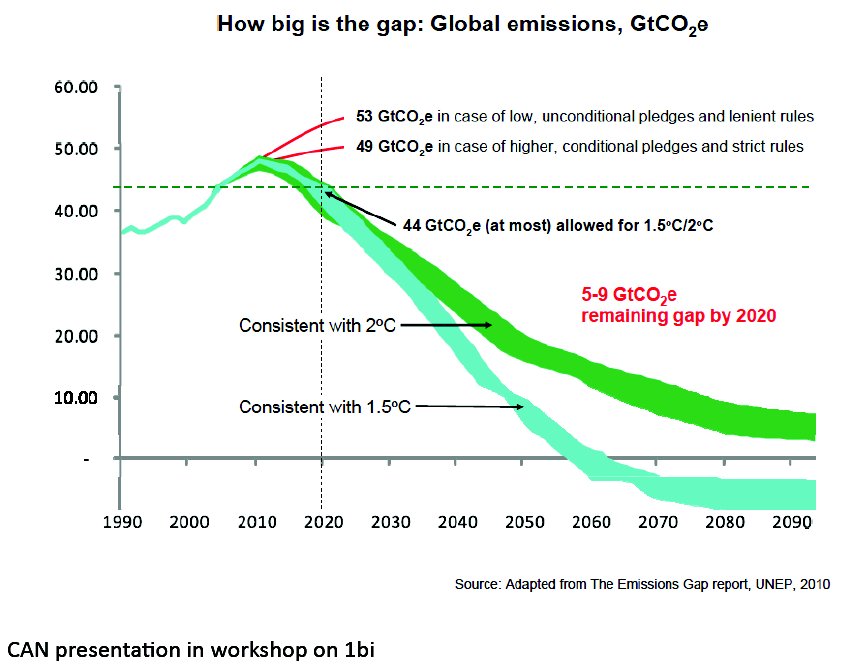
nw book advThe UNEP report is particularly relevant to the short-term situation that was the focus of the Warsaw meeting given that the international community has agreed to limit future warming to prevent catastrophic warming to 2° C or perhaps 1.5° C if studies that are now underway demonstrate that a 1.5° C warming limit is necessary to prevent catastrophic harms. The UNEP report found that even if nations meet their current climate pledges, ghg emissions in 2020 are likely to be 8 to 12 gigatonnes of CO2 equivalent (GtCO2e) above the level that would provide a reasonable chance of avoiding the 2° C warming limit.

To be on track to stay within the 2° C target and head off very dangerous climate change, the report concluded that emissions should be a maximum of 44 GtCO2e by 2020 to set the stage for further huge cuts needed to keep warming from exceeding the 2° C target.

Since total global ghg emissions in 2010 already stood at 50.1 GtCO2e, and are increasing every year, reaching a 44 GtCO2e target by 2020 is extraordinarily daunting and much greater ambition is needed from the global community than can be seen in existing national ghg emissions reduction commitments.

Moreover if the world continues under a business-as-usual scenario 2020 emissions are predicted to reach 59 GtCO2e. And so increasing the ambition of national ghg commitments is urgently needed to provide any reasonable hope of limiting warming to non-catastrophic levels. For this reason there was some hope before Warsaw that some nations would make significant increases in their previous ghg emissions reduction commitments. This did not happen. Not one single country increased its previous emissions reductions commitments in Warsaw and Australia and Japan announced they were lowering prior promises.

There is a growing consensus among many observers of international negotiations that the international community will fail to increase ghg emissions reductions commitments to levels that will avoid dangerous climate change unless nations take their ethical obligations to other nations and vulnerable people seriously. Nations continue to enter climate negotiations as if only their own economic interests count. And so, most nations are continuing to ignore their responsibilities to other nations and people when making national commitments on ghg emissions reductions.

To change this, the UNFCCC should require that when nations make emission reduction commitments they must explain three things. First, what ghg atmospheric concentration level is their target designed to achieve. Second, what is their assumption about the remaining ghg emissions budget that the entire international community must stay within to avoid dangerous climate change. Third on what equitable principle is their national target based to that would achieve the safe atmospheric ghg concentration level. In short, nations should be required to explain expressly how their emissions reduction target has been developed in consideration of equity and distributive justice.

The September IPCC report contained an emissions budget on total CO2 emissions for the entire world. If the international community limits ghg emissions to the budget amounts, there is 66% chance of preventing very dangerous warming. The IPCC said that for warming to remain below dangerous levels, the total amount of CO2 equivalent that may be emitted is 431 gigatons. This further means that the budget would be completely used up by current emissions by around 2044, just over 30 years from now. If ghgs other than CO2 that are being emitted around the world are taken into consideration, the remaining CO2 equivalent emissions budget is reduced to approximately 270 gigatons. This fact has led many climate scientists to strongly warn the international community that it is running out of time to prevent dangerous climate change because the world will exceed the budget in 25 years at current emissions rates.

In light of these reports, UNFCCC Executive Secretary of the UNFCCC Christiana Figueres said at the beginning of COP-19 that: “Global greenhouse gas emissions need to peak this decade, and get to zero net emissions by the second half of this century.

In addition to increasing national ghg emissions reductions commitments in the short-term there was some hope that Warsaw would put into place initial elements of an emissions reduction framework that would be included in the new treaty to be completed in 2015. Yet this did not happen either.

The only positive outcome of COP-19 in regard to  adequate ghg emissions reductions commitments was a decision that all nations would submit their new ghg emissions reduction commitments by the “first quarter of 2015” in time for consideration during the final treaty negotiations in Paris that year.

There was intense disagreement in Warsaw about whether levels of historical emissions should be taken into consideration in allocating national emission ghg reductions levels under the new treaty. The U.S. and European Union blocked a proposal supported by 130 nations including Brazil and China that would use pollution levels dating back to the industrial revolution to help set limits on emissions in the future. According to a November 16th New York Times report, discussions on equity and justice became an emotionally charged flash point in Warsaw.

No nation should be able to escape explaining the ethical principles on which its ghg emissions reduction commitment is based. In a previous entry in Ethics and Climate we explained why strong ethical claims can be made that nations have clear duties to reduce their emissions to their fair share of safe global emissions.


loss and damage

B. Funding for Adaptation.

In 2009, developed countries committed to annually mobilize $100 billion from public and private sources for climate mitigation and adaptation by 2020 in developing countries. Countries also agreed to the creation of the Green Climate Fund, or GCF, which would provide a significant portion of the $100 billion commitment.

For the most part promises to provide specific amounts of funding have not materialized. As a result the Group of 77 developing nations and China unsuccessfully pushed in Warsaw for specific funding pledges for the period before 2020.

Although there were several countries in Warsaw that made small new pledges for funding for adaptation, for the most part the developed nations have failed to identify specific amounts of funding consistent with prior promises. A decision was made that simply requests that developed countries to submit specific pledges at workshops to be convened on the issue and asks developing nations to submit ideas for a high-level ministerial dialogue on climate finance every two years, starting in 2014 and ending in 2020.

COP-19 also approved a decision urging the fledgling GCF to ensure it is operational in time to begin receiving funds next year. The decision calls for “ambitious and timely contributions” by developed countries to the fund before the next round of high-level talks in Peru.

All high-emitting nations must be required to explain, as a matter of ethics and distributive justice,  why they are not responsible for their equitable share of adaptation costs for vulnerable developing nations. In so doing they should be forced to explain whether they disagree with the “polluter pays” principle.

In a previous entry in Ethics and Climate we explained the basis for concluding that high-emitting nations have strong ethical duties to fund reasonable adaptation measures in vulnerable poor countries.

C. Loss and Damages

During COP-18 in Doha, Qatar last year, the parties agreed to establish at COP 19 in Warsaw institutional arrangements to address loss and damage in developing countries that are particularly vulnerable to the adverse effects of climate change

Issues entailed by discussions on creating an institutional response to losses and damages from human-induced climate change were particularly contentions in Warsaw. High-emitting developed nations have been particularly concerned about creating an institution that would act as a mechanism to compensate nations and peoples who are harmed by human-induced climate change.

Two questions in particular about the prospective mechanism caused controversy in Warsaw. The first was whether a new mechanism would be an independent entity within the UNFCCC, which already contains two semi-independent institutions on mitigation and adaptation. Negotiators from low-lying islands and other developing countries argued that devastating human-induced climate change damages are now visible around the world and therefore a new separate loss and damages mechanism under the UNFCCC is needed.

Some developed countries supported the creation of a mechanism but opposed the creation of a new independent funding institution and argued that losses and damages funding should fall under the adaptation framework.

A Warsaw decision established an entity called the “Warsaw Mechanism,” which would fall under the adaptation framework. However, in a concession to vulnerable nations, the decision included a provision to reassess the mechanism after three years. Most of the details of the. role, funding, and makeup of this mechanism await future likely very contentious negotiations

The United States and other nations have resisted discussing responsibilities for loss and damages from climate change for several reasons including the fact that assigning specific responsibility for harms is a difficult question about which reasonable people may disagree.  These countries should be required to explain why they are ignoring the “polluter pays” principle and ethical responsibility that is entailed by basic principles of distributive justice.  In a previous entry in Ethics and Climate we explained the basis for concluding that high-emitting nations have strong ethical duties to compensate losses and damages from human-induced climate change particularly in vulnerable poor countries.

D. Preventing Deforestation and Degradation, REDD+

Since 2005, UNFCCC negotiations have worked on establishing a program on reducing emissions for deforestation and degradation of forests usually referred to as REDD+. Conquering deforestation is an important element in a global solution to climate change as emissions from loss of forests represents approximately 20 percent of worldwide greenhouse gas emissions.

Establishing REDD+ has been challenging for several reasons including establishing credible quantitative measures for measuring precisely the amount of emissions saved from programs that prevent emissions from deforestation, assuring that the emissions saved by funded REDD+ projects  are permanent, and determining how investments in deforestation programs might work with other market mechanisms under the UNFCCC.

Warsaw made considerable progress on for REDD+ issues that included a series of seven decisions that outline issues relating to payments to developing countries implementing REDD+ projects, a framework for establishing a formal REDD+ mechanism, some rules for creating performance-based financing mechanisms, and forest monitoring systems, and establishing forest reference levels among other issues.

Because all high-emitting nations have clear ethical responsibilities to reduce ghg emissions to their fair share of safe global emissions, high-emiting nations should be required to explain how they will reduce their ghg emissions to their  fair share of safe global emissions if they do not financially support programs that reduce forest degradation.

The next COP will be held in Lima, Peru in December of 2014 which will mostly focus on the details of the new international climate agreement that is scheduled to be completed in 2015.

Conclusion

Ethics and justice issues were central to the most contentious disputes in Warsaw particularly in regard to ghg emissions reduction commitments and funding for adaptation and loss and damages. This fact was recognized by the international media covering Warsaw more frequently than ever before as we have explained in a previous entry here on Ethicsandclimate.org. Yet neither nations or the press covering Warsaw appear to be recognizing the significance for climate policy of the equity, ethics, and justice issues. For this reason, there is a continuing urgent need to increase awareness around the world of the practical significance of the ethics and justice issues for policy.

E.,Lyman and D. Scott ,  Warsaw Climate Talks Produce Progress On Finance, Loss and Damage, Forests, BNA, http://www.bna.com/warsaw-climate-talks-n17179880357/ . (last visited Dec., 14, 2013)

Figueries, Christina, UNFCCC: Warsaw COP “pivotal moment to step up climate action”, Clean Technology, http://cleantech.cleantechpoland.com/?page=news&id=113&link=unfccc-warsaw-cop-pivotal-moment-to-step-up-climate-action- . (last visited Dec., 18, 2013)

Intergovernmental Panel on Climate Change, (IPCC, 2013),The Physical Basis for the Science, http://www.ipcc.ch/report/ar5/wg1/#.UqwUWKX_MpE. (last visited Dec., 14, 2013)

A. Morales, 2013, U.S., EU, Reject Brazilian Call for Climate Equity Metric, Bloomzberg News,  No, http://www.bloomberg.com/news/2013-11-15/u-s-eu-reject-brazilian-call-for-climate-equity-metric.html, (last visited  Dec 18, 2013)

Roz, Pidcock, Carbon briefing: Making sense of the IPCC’s new carbon budget, http://www.carbonbrief.org/blog/2013/10/carbon-briefing-making-sense-of-the-ipcc’s-new-carbon-budget/(last visited Dec., 19, 2013)

Stephen Meyers and Nicholas Kulish, , Growing Clamor About Inequities of Climate Crisis, New York Times, November 16, 2013, http://www.nytimes.com/2013/11/17/world/growing-clamor-about-inequities-of-climate-crisis.html?_

United Nation Environment Program (UNEP), 2013, Emissions Gap Report, 2013, http://www.unep.org/publications/ebooks/emissionsgapreport2013/

United Nations Framework Convention on Climate Change, (UNFCCC, 2011)(FCCC/CP/2011/9/Add.1, http://unfccc.int/bodies/body/6645.php.  (last visited Dec, 15, 2013)

UNFCCC, 2013, Further Advancing the Durban Platform Draft Decision-/CP.19, http://unfccc.int/files/meetings/warsaw_nov_2013/decisions/application/pdf/cop19_adp.pdf (last visited Dec.16, 2013)

UNFCCC,  2013, Work Program On Long-Term Finance, Decision -/CP.19, http://unfccc.int/files/meetings/warsaw_nov_2013/decisions/application/pdf/cop19_ltf.pdf

UNFCCC Decision, 2013, Approaches To Address Loss And Damage Associated With Climate Change Impacts In Developing Countries That Are Particularly Vulnerable To The Adverse Effects Of Climate Change To Enhance Adaptive Capacity FCCC/CP/2012/L.4/Rev.1, http://unfccc.int/resource/docs/2012/cop18/eng/l04r01.pdf (lasted visited December 17, 2013)

UNFCCC Decision, -/CP.19, Warsaw Mechanism for Loss and Damages Associated With Climate Change Impacts, https://unfccc.int/files/meetings/warsaw_nov_2013/decisions/application/pdf/cop19_lossanddamage.pdf (last visited  Dec 16, 2013)


By:

Donald A. Brown

Scholar In Residence and Professor

Sustainability Ethics and Law

Widener University School of Law

Visting Professor, Nagoya University, Nagoya, Japan

Part Time Professor, Nanjing University of Information Science and Technology, Nanjing China.

dabrown57@gmail.com


US Media Finally Acknowledges That Ethics and Justice Issues Are At the Center of Contention in Climate Change Negotiations, Yet Has Not Caught On to the Significance of This for US Policy.


climate justicenow

During the climate negotiations in Warsaw that concluded late Saturday, some of the most prominent US media institutions  finally acknowledged that ethics and justice issues were at the very center of the most contentious issues in dispute.

For instance, the New York Times ran a story on November 16 entitled: Growing Clamor About Inequities of Climate Crisis. This article expressly acknowledged that growing demands about ethics and justice have become an emotionally charged flash point at the Warsaw climate negotiations

The Washington Post reported that: Hundreds of activists march for climate on sidelines of UN talks in Warsaw and in this story there was acknowledgment that the ethics and justice issues were the central focus of unresolved issues on national ghg emissions reduction commitments and funding needed funding for poor, vulnerable nations for adaptation and climate change caused losses and damages.

Bloomsberg News also ran a story entitled:  U.S., EU, Reject Brazilian Call for Climate Equity Metric. This story described great disagreements among nations on how to allocate national emissions targets on the basis of equity.

This recent recognition of the importance of ethics and justice issues in international climate change negotiations marks a possible sea change in on how the US press has thus far covered international climate change issues. Yet it is too early to predict such a transformation will actually take place and reason to believe that the US media still does not understand the practical importance for US climate policy that an ethical focus on climate change entails. In fact there is no evidence that the US press understands the policy significance for the US if climate change is understood as a civilization challenging global distributive justice problem.

As we have frequently reported in EthicandClimate.org  over the last several years, (See articles on the website on the US media in the Index), the US media has been utterly ignoring the climate change justice issues that increasingly have become the most contentious issues in dispute in the international search for a global solution to climate change.

movbilization for clima justice

Although there has been a US press presence at international climate negotiations since they began over 20 years, the US media reports on the climate negotiations has usually focused on the failures and small success of previous negotiations. Also, sometimes the US press also has reported on specific disagreements among nations on contentious issues in negotiations. And so, the US media has covered climate negotiations like they would a baseball game, that is they usually focus on the score, who batted in the runs, and who prevented runs from scoring.

In the meantime, during the debates about US domestic policy on climate change that have been taking place for almost thirty years, the US media has reported on climate issues almost exclusively by focusing on issues of scientific certainty about climate change impacts and economic cost to the US economy.  This phenomenon is partly attributable to the fact that economic interests opposed to US climate change policies have skillfully and successfully framed the US climate change debate as a matter about which there is insufficient scientific evidence or too much adverse impact on the US economy to warrant action. And so, although climate change is a civilization challenging problem of distributive justice, the US media has largely ignored the justice issues particularly in regard to their significance for US policy. For  instance, if the the US not only has economic interests in the climate change policies in political debate but also obligations and duties to poor vulnerable nations to not cause them great harm from US ghg emissions, the United States may not justify failure to act to reduce its ghg emissions on the basis of economic cost to the US.

Yet now that the scientific community is telling the world that is running out of time to prevent dangerous climate change and that there is a very small amount of ghg emissions that can be admitted by the entire world if the international community seeks to have any reasonable hope of avoiding dangerous climate change, the ethics and justice issues are becoming undeniable and it is almost possible to ignore that the ethics and justice issues are at the very center of international disputes about how to structure a global climate solution. And so, cries about the justice issues will mostly likely continue to become louder in the future. This is so because if the entire global community must limit total global ghg emissions to a specific number of tons of ghgs and this number requires radical ghg emissions reductions from the entire global community, the obvious question becomes what is any nation’s fair share of allowable emissions.  And so, issues of climate justice may no longer be ignored, in fact, the longer the world waits to arrive at a global solution to climate change the more important and visible the ethics and justice issues will become. For this reason, it will become more and more difficult for the US press to ignore the practical significance of ethics and justice questions.

new book description for website-1_01At the center of the Warsaw negotiations was not only the question of what was each countries fair share of safe total allowable greenhouse gas submissions, but also what does justice require of high-emitting  countries to both pay for the costs of climate adaptation and compensation for damages for poor vulnerable countries that have done very little to cause climate change.

And so this new interest in ethics and justice about climate issues could become a growing media focus. However, this recent new interest of the US media is not evidence that the US press has begun to pay attention to the implications of these issues for US climate change policy. In fact, there is no evidence that the US media has figured out how the ethics and justice issues will need to radically transform how domestic climate change policy is debated in the United States. We will know that the US media this is seriously paying attention to the ethical dimensions of climate change if it examines the following questions when it covers US climate change policy debates.

1. What is the ethical justification for any proposed US greenhouse gas reduction target in light of the fact the US has duty to reduce its emissions to the US fair share of safe global emissions. In setting a ghg emissions reduction target, what ethical obligations to nations and people outside the US has it taken into account.

2. If the United States is a very large emitter of gigs compared to most other nations in terms of historical and per capita emissions, why doesn’t the United States have an ethical duty to fund reasonable climate change adaptation measures in and losses and damages of poor developing countries that have done little or nothing to cause human-induced warming.

3. If a US politician argues in opposition to proposed US climate policies on the basis of cost to the US economy, why doesn’t that politician acknowledge that in addition to US economic economic interests, that the United States has duties to people around the world and future generations to reduce ghg US emissions.

4. If United States actually has ethical duties for the rest of the world to reduce its ghg emissions to its fair share of safe global emissions, why is there no national policy encouraging everyone in the United States including individuals and corporations to reduce unnecessary ghg emissions.

5. On what basis may the United States argue that it need not reduce US ghg emissions to its fair share of safe global missions because China or some other developing country has not yet adopted strong climate change policies, given that any US ghg emissions in excess of the US fair share of safe total omissions is harming hundreds of thousands of people around the world and the ecological systems on which life depends.

By:

Donald A. Brown

Scholar In Residence and Professor,

Widener University School of Law

Harrisburg, Pa.

Visiting Professor,  Nagoya University School of Law

Nagoya, Japen

Part-time Professor,  Nanjing University of Information Science and Technology

Nanjing, China

dabrown57@gmail.com


Retrospective Moral Intuitions on Equity Dominate the Warsaw Talks as the UN Climate Conference Transitions into its Second Week.

warsaw

Editor’s note: The following entry is a report from Idil Boran who shares her views about the ethical issues in play in the Warsaw Climate Negotiations at the end of the first week. Ethicsandclimate.org  has posted three of several articles to be posted which are looking at the ethical issues entailed by the Warsaw agenda. This series will continue this week. At the conclusion of the Warsaw meeting, the series will review how the ethical issues were dealt with in Warsaw.

Idil Boran is  attending the Warsaw negotiations and is Associate Professor and Director of the Certificate Program in Practical Ethics, Department of Philosophy, York University, Toronto, Canada.  For inquiries, contact iboran@yorku.ca


Retrospective Moral Intuitions on Equity Dominate the Warsaw Talks as the UN Climate Conference Transitions into its Second Week


The 19th Conference of the Parties at the United Nations Framework Convention on Climate Change (UNFCCC) is taking place in Warsaw, Poland’s capital, through November 11-22, 2013.  As the first week of the conference ended, the delegates have taken a break on Sunday to prepare for the second week.  The discussions at the National Stadium in Warsaw, the official venue of COP 19, have so far been tense, which is to be expected.  This is in many respects a critical year for climate negotiations.  With 2015 in the horizon, pressure is building up to establish the details of a possible new treaty to be adopted in 2015 as the outcome of the Durban Platform for Enhanced Action.

Two issues came the forefront on the first week, setting the tone for the week to come.

  1. Historical emissions

Brazil put forward a proposal, supported by China, to use historical emissions levels going back to the industrial turn of mid-nineteenth century, in order to determine how much countries should be allowed to emit in the future.  Both the European Union and the United States have categorically rejected this proposal.  This issue is clearly highly divisive.  Yet, at the same time, a focus on past emissions has long been a recurrent rationale at COP meetings, as it resonates in the minds of many negotiating parties as a possible starting point for establishing fair terms of cooperation.

  1. Loss and damage

An agreement in principle was reached in Doha, Qatar, at COP 18 in 2012 to include a “loss and damage” clause in the new treaty.  Prompted by the destruction in the aftermath of typhoon Haiyan, last week’s discussions were heavily focused on claims of compensation against loss and damage associated with climate change.  The suggested scheme, supported by many developing countries, is that developed countries would pay compensation to developing countries experiencing a weather-related disaster. There are difficulties with this proposal, however.  Although weather extremes are to be expected in world affected by climatic change, associating a single event with climate change is not straightforward, which is why the discussions on this issue remain deeply politicized and highly contentious.

nw book advWhat these issues have in common is that they both put forward a conception of equity appealing to a principle of corrective justice.  Both proposals follow a retrospective logic for establishing equitable terms for allocating the costs of climate change within a possible treaty.  The former is concerned with the costs of mitigation.  And the latter is concerned with the costs of adaptation.  Nevertheless, both perspectives consist of looking at the past for identifying wrongdoing, and request compensation from those viewed to be responsible for climate change.

Yet, establishing fair terms of cooperation need not be based on a retrospective logic, and the thinking certainly need not revolve so narrowly on compensation.  This way of thinking consists of allocating costs and responsibilities by appealing to claims of blame and liability.  These appeals bring to the negotiation table tort-like intuitions, which are more divisive than cooperative.  Equitable cost sharing can be conceptualized within a forward-looking framework, by identifying needs and capacities and moving onwards into a future where genuine cooperation will be needed. Even on the issue of loss and damage, policy can be designed to achieve a system of cooperation against weather disasters based on risk-sharing and risk-transfers, without focusing so narrowly on placing blame.  This kind of policy would provide more than ad hoc disaster aid and would help build resilience in vulnerable countries on an ongoing basis. Although retrospective moral thinking is highly intuitive, the worry is that this way of conceptualizing equitable cost sharing may seriously jeopardize the possibility of an agreement.

The international community has an interest in conducting discussions within non-retrospective and forward-looking parameters for equitable cost sharing.  It would be unfortunate if the negotiations became deadlocked because of insistence on retrospective moralizing on these two issues.  How the discussions will unfold at National Stadium throughout the second week of the conference is yet to be seen.

By: 

Idil Boran

 iboran@yorku.ca

Ethical and Justice Issues At the Center of the Warsaw Climate Negotiations-Issue 1, Equity and National GHG Emissions Reductions Commitments in the Short-Term

equity and ambitionThis is the second in a series of papers which will examine the ethical and justice issues that are at the center of the Warsaw climate negotiations, often referred to as the 19th Conference of the Parties (COP-19). The first in the series can be found on Ethicsandclimate.org. This paper looks at the ethical issues entailed by the need for nations to dramatically increase their ghg emissions reductions commitments immediately, that is in the short-term, to levels that equity and justice would require of them.

Each year in international negotiations, pleas of vulnerable developing nations have become louder calling for developed nations to respond to climate change in ways that are consistent with their ethical obligations. For the most part, this had utterly failed to happen. Yet, up until a few years ago, nations could ignore their ethical responsibilities provided they made any commitments at all to reduce their ghg emissions. As a result, nations have failed to adopt climate change policies consistent with their equitable obligations despite the fact that all nations who are parties to the UNFCCC agreed, when they became parties, to reduce their emissions to levels required of them based upon “equity” to prevent dangerous anthropogenic interference with the climate system.

Although most nations have now made some commitments that have included ghg emissions reductions targets starting in the Copenhagen COP in 2009, almost all nations appear to be basing their national targets not on what equity would require of them but at levels determined by their economic and national interests. In fact, in many cases when governments have been asked why they have not made more ambitious commitments, they have cited national economic justifications or their unwillingness to make more stringent commitments until other nations do so, excuses which are also based upon national interest rather than national global obligations. And so, for the most part, nations have entered the international climate negotiations as if their commitments to an urgently needed climate change global solution can be based on national interest rather than global responsibilities.

However the longer nations have waited to respond adequately to climate change, the more difficult it has becomes to ignore what ethics and justice requires of them because climate science is telling the international community that it must immediately adopt a global approach to climate change which is much more ambitious than current national commitments will provide. And so despite the fact that some vulnerable nations have been screaming for climate justice for at least two decades, in the last few COPs equity and justice has moved to the center of the most contentious issues in dispute. Now there is no escaping the international community from reviewing   national commitments through a justice lens. The smaller the available budget becomes to avoid dangerous climate change, the more obvious the justice issues become.

Nations must both increase emissions reductions commitments immediately to give the world any hope of avoiding dangerous climate change while also agreeing to an international framework on future ghg emissions which will limit global ghg emissions in the medium- and long-term. And so, some aspects of the Warsaw agenda are focused both on increasing ghg emissions commitments in the short-term while at the same time working toward a new climate change treaty which will include a framework for national ghg emissions reductions after 2020. This paper looks at the equitable aspects of the need for more ambition in national ghg emissions commitments in the short-term while the next entry will look at ethics and justice issues entailed by the need for a new climate change treaty that was agreed to in prior COPs and that is scheduled to come into effect in 2020.

An adequate global climate change solution will need to limit total global ghg emissions to levels which will prevent atmospheric concentrations of ghgs from accumulating to dangerous levels and to do this any solution will also need to allocate total global emissions levels among all nations. Therefore each nation must agree to limit is emissions to its fair share of safe global emissions both in the short- and longer-term. There is now no way of escaping this urgent reality.

Up until now, nations could pretend that baby steps toward a global solution were acceptable progress. The urgency of finding a global climate change solution now makes it clear that such pretense is foolish self-deception.

Since the last COP in Qatar last year, there have been two prestigious scientific reports that have made it even more abundantly clear that much greater ambition from nations on their previous ghg emissions reduction commitments based upon equity are urgently needed. In 2013, IPCC in its recent Working Group I Report on the Physical Basis of Climate Change  and UNEP in its just released the Emissions Gap Report are advising the international community that the world is quickly running out of time to prevent dangerous climate change.

The UNEP report is particularly relevant to the short-term situation given that the international community has agreed to limit future warming to prevent catastrophic warming to  2° C or perhaps 1.5° C if later studies demonstrate that a 1.5° C warming limit is necessary to prevent catastrophic harms.

The UNEP report found that even if nations meet their current climate pledges, ghg emissions in 2020 are likely to be 8 to 12 gigatonnes of CO2 equivalent (GtCO2e) above the level that would provide a likely chance of remaining on the least-cost pathway.

To be on track to stay within the 2° C target and head off very dangerous climate change, the report says that emissions should be a maximum of 44 GtCO2e by 2020 to set the stage for further cuts needed keep warming from exceeding the 2° C target.

Since total global ghg emissions in 2010 already stood at 50.1 GtCO2e, and are increasing every year, reaching a 44 GtCO2e target by 2020 is extraordinarily daunting and much greater ambition is needed from the global community than can be seen in existing national ghg emissions reduction commitments.

UNEP pointed out in its report that the 44 GtCO2e target by 2020 is necessary to have any hope of achieving even greater cuts needed after 2020 when total emissions must be limited to sharply declining total emissions limitations. Moreover if the world continues under a business-as-usual scenario, which does not include pledges, 2020 emissions are predicted to reach 59 GtCO2e, which is 1 GtCO2e higher than was estimated in a UNEP report issued in 2012. Without doubt increasing the ambition of national ghg commitments is urgently needed to provide any reasonable hope of limiting warming to non-catastrophic levels.

The September, 2013, IPCC issued a report which contained a budget on total carbon emissions that the world needs to stay within to give a 66% chance of preventing more than the 2° C  warming that attracted world attention despite the fact that it has been widely criticized as being overly optimistic. This budget is an upper limit on total human CO2 equivalent emissions from the beginning of the industrial revolution until the day we stop burning carbon. The IPCC said that for warming to remain below last 2° C warming limit, the total amount of CO2 must be less than 1000 billion tons.

The IPCC report estimated that we’ve already used 531 billion tons of that budget as of 2011 by burning fossil fuels for energy as well as by clearing forests for farming and myriad other uses. That means would mean that there is 469 tons left in the emissions budget. This further means that the budget would be completely used up by current emissions by around 2044, just over 30 years from now.

Yet, the IPCC budget is likely significantly overly optimistic because ghg emissions other than CO2 are being emitted which the IPCC recent budget did not take into account. Factoring in the other ghgs brings the overall cumulative budget down from 1 trillion tons of carbon to 800 billion tons.

With that in mind, the remaining budget is even smaller, leaving just 269 billion tons of carbon left. This figure screams for a radical increase in short-term and long-term ghg emissions national ghg emissions commitments. For this reason, climate change is a civilization challenging problem of distributive justice.

The IPCC report also said that a possible release of ghg thawing permafrost and methane hydrates — which are “not accounted for in current models” — would shrink the remaining budget even further.

So why is equity and justice considerations so vital to increasing national ambitions? There are several reasons for this. First some countries much more than others are contributing to global atmospheric ghg concentrations on a per capita and total tons basis. Other countries more than others have contributed much more historically to existing elevated ghg atmospneric concentrations as they pursued higher levels of economic growth. And some countries more than others should be allowed to increase energy use to emerge from grinding poverty especially since they have done almost nothing to cause the existing crisis. And so, climate change is a civilization challenging problem of distributive justice and no matter what ethical considerations are taken into account to define an arguably distributively just allocation of ghg emissions targets among nations, many national commitments utterly and obviously flunk any ethical test. Yet the international press is not covering this aspect of this civilization challenging problem.

Ethics and justice demand that high-emitting nations and individuals reduce their emissions to their fair share of safe global emissions. Furthermore, it is already a settled principle in international law that polluters should pay for their pollution, that nations should reduce their emissions to prevent dangerous climate change on the basis of ‘equity,’ not national interest, and that nations should prevent their citizens from doing harm to people outside their national jurisdictional boundaries. These rules collectively mean that nations may not base their climate change national strategies on national interest because they they have duties, obligations, and responsibilities to others that they must take into account when setting national climate change policy. Yet hardly any nations are explaining their national ghg emissions reductions commitments on the basis of how they are congruent with their equitable obligations and the international media for the most part is ignoring this vital part of this civilization challenging drama unfolding in Warsaw.


equity and climate change

In addition, every national ghg emissions target is already implicitly a position on the nation’s appropriate fair share of safe global emissions because it is a global problem about which each nation must do its fair share. Any national ghg emissions reduction target is a statement about the nation’s commitment to solve a global problem which is putting hundreds of millions of existing people at risk and countless members of future generations.

nw book advFurthermore, practically the nations of the world are not likely to increase ghg emissions targets unless those nations who are already exceeding their global fair share agree to reduce their ghg emissions. And so national ghg emissions reductions based on ethics and justice are both required on the basis of morality and are urgently practically needed. The obvious place to look for increases in ambition in national commitments is from nations that are obviously above emissions reduction levels that equity would require of them.

As we shall see in the next paper on a longer-term framework for national emissions, there are several competing ethical frameworks for what constitutes any nations fair share of safe global emissions. However, that does not mean that any position on “equity”  passes minimum ethical scrutiny. And without any doubt, national ghg emissions targets based upon national economic interest alone flunks any ethical analysis because climate change requires nations to take into account how their ghg emissions are gravely harming the hundreds of millions of people around the world who are vulnerable to climate change in setting national climate change policies. That is under any conceivable ethical theory, nations must set ghg targets based upon their duties to not harm others, not self-interest alone. High-emitting nations are therefore obviously failing to set ghg emissions targets based upon their ethical obligations. In fact, as we have seen, nations often have admitted that their targets have been based upon self-interest not global duties.

Slide3For this reason, a key issue on the Warsaw agenda is the ethical dimensions of short-term ghg emissions targets and the need for high-emitting nations in particular to increase their commitments.

However, unfortunately at this moment, it is unlikely that countries will increase their emission reduction proposals in Warsaw. In fact, in some countries recent national policy changes call into question their capability to reach even their inadequate 2020 targets. Along this line, for instance, a recent backwards step of Australia was announced that it intends to abolish its newly established carbon pricing mechanism.

This series will report on what happened in Warsaw on short-term ghg targets and equity at the conclusion of the Warsaw conference

By:

Donald A. Brown

Scholar In Residence and Professor,

Windener University School of Law

Harrisburg, Pa.

Visting Professor, Nagoya University

Nagoya, Japan

Part-Time Professor

Nanjing University of Science Information and Technology

Nanjing, China

dabrown57@gmail.com

Ethical and Justice Issues In Contention At the Warsaw Climate Negotiations-The First In A Series Of Reports.

warsaw


Negotiations on the international climate regime have begun in Warsaw at a time when the scientific community, including the IPCC in its recent report on the Physical Basis for Climate Change Science and UNEP in its just released Emissions Gap Report, are advising the international community that the world is running out of time to prevent dangerous climate change.

The Warsaw agenda includes numerous topics that raise profound ethical and justice issues which not only must be faced to achieve a global climate change solution but which are also increasingly at the center of the most contentious issues in the international climate negotiations. Despite this fact, the international media, at least in most developed countries, is utterly failing to report on the ethical and justice dimensions of issues that are so central to achieving a favorable outcome in Warsaw. The failure of the media to continue to report on these issues almost guarantees that nations will continue to ignore their ethical obligations, a prospect which surely dooms the development of an adequate global climate regime.

This is the first entry in a multi-part series which will first examine the ethical dimensions of major issues under consideration in Warsaw and then, at the conclusion of COP-19, report on what was accomplished in Warsaw on these ethical issues.

Among Warsaw issues examined in this series through an ethical lens will be:

1. The extent to which nations make ghg emissions reductions commitments based upon “equity” rather than national interest alone.

2. The willingness of nations to agree to a new treaty that is to be completed in 2015 and that comes into effect in 2020 that includes a format for emissions reductions that takes equity and justice seriously.

3. The willingness of high-emitting nations to finance adaptation and climate change reduction strategies in vulnerable, developing counties.

4. The willingness of those nations most responsible for human-induced warming to agree to finance the value of losses and damages from climate change that can’t be avoided.

5. The extent to which some nations more than others are barriers to an urgently needed global climate change treaty.

6. The willingness of nations to accept a new climate change treaty that is sufficiently legally binding that it provides adequate sanctions for those who do not comply with their promises.

The next entry in the series will look at the ethical issues entailed by the need for national emissions reductions commitments to be based on “equity” and “justice”.


 By:

Donald A. Brown

Scholar in Residence and Professor, Sustainability Ethics and Law

Widener University School of Law

Visiting Professor, Nagoya University, Nagoya, Japan

Part-time Professor, Nanjing University for Information Science and Technology,  Nanjing,  China

dabrown57@gmail.com


A New Web Site Enables Climate Policy Makers To Fulfill Their Ethical Responsibility to Understand The Significance of Policy Choices

aubreyAs we have explained from many angles on this website, climate change is a civilization challenging ethical problem. We have also explained why nations urgently need to immediately respond to their ethical obligations in making national emissions commitments under the UNFCCC.  In addition, ethics requires those engaged in dangerous behavior to understand the effects of their policy choices and respond to their ethical obligations. Yet complex interactions of ghg emissions levels, atmospheric ghg concentrations, the climate system’s response to atmospheric ghg concentrations, and how policy options must consider the magnitude of the global threat as it changes in time make it difficult for policy makers and NGOs to visualize and understand the significance of climate policy choices. And so ethics requires policy makers to understand these complex interactions, yet the sheer complexity of these interactions makes clear understanding of the significance of policy options very challenging.

We have also explained on this website how the debate on climate change in the United States and several other high-emitting nations is largely ignoring national ethical responsibilities. If nations are to take their ethical obligations seriously, they need to understand the extreme urgency of increasing their ghg emissions reduction targets to comply with their ethical obligations. Yet to understand their ethical obligations policy-makers must understand  the significance of policy choices. And so ethics requires climate change policy-makers to understand many complex scientific issues.

Ethics would also hold nations morally responsible for the failure to do this. Delay makes the climate change problem worse. Yet understanding how delay makes achieving the goals of preventing dangerous climate change extraordinarily more challenging also requires some knowledge about how increasing atmospheric concentrations affect global emissions reductions pathways options.   In addition, because each national emission reduction target commitment must be understood as an implicit position of the nation  on safe ghg atmospheric concentration levels, setting national ghg emissions goals must be set with full knowledge of how any national target will affect the global problem.

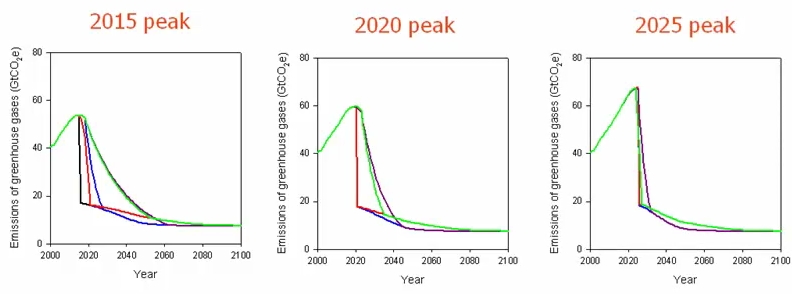
However, a clear understanding of how national emissions reductions commitments affect global climate change impacts requires an understanding of complex relationships between atmospheric ghg concentrations, likely global temperature changes in response to ghg atmospheric concentrations, rates of ghg emissions reductions over time and all of this requires making assumptions about how much CO2 from emissions will remain in the atmosphere, how sensitive the global climate change is to atmospheric ghg concentrations, and when the international community begins to get on a serious emissions reduction pathway guided by equity considerations. The problem in understanding these variables  is a challenge  that no static graph can capture.

A new website should be of great value to policy-makers to view  and understand the relationship between their national emissions reduction strategies and the global climate change problem, issues that must be considered in setting national ghg targets as a matter of ethics.  This tool is the Carbon Budget Accounting Tool (CBAT) which is available at http://www.gci.org.uk/cbat-domains/Domains.swf

Some features of CBAT are still under development, yet the site is already practically useful to policy-makers.

The CBAT has been developed by the Global Commons Institute founded in the United Kingdom in 1990 by Aubrey Meyer as an organization to find to a fair way to tackle climate change.

ContractionAndConvergence


The CBAT tool allows visualization of  any  national response for reducing national ghg emissions commitments based upon the idea of contraction and convergence, one of several equity frameworks under discussion in international climate negotiations,  but is also of value for visualizing the policy significance of other equity frameworks that are under discussion internationally.

CBAT allows those interested in developing a global solution to visualize the otherwise complex interactions of international carbon budgets, atmospheric greenhouse gas concentrations, ghg emissions reductions commitments, the effect of a nation taking its ethical obligations seriously, resulting temperature, ocean acidification, and seal level rise,

The CBAT model should be very useful for all who hope to understand future climate change policy options and the scale of the global challenge facing the world. This writer has been engaged in climate change policy options since the 1992 Earth Summit at which the United Nations Framework Convention was opened for signature and have attended most of the Conference of Parties under the UNFCCC since then. Yet even though I have significant experience and knowledge about future climate change policy challenges, the CBAT model helps me visualize the significance of certain policy options facing the world.

Because ethics requires policy-makers to understand the policy implications of their policies, understanding the complex interactions of the variables displayed on the CBAT is indispensable for national climate change policy-makers as a matter of ethics.

By:

new book description for website-1_01

Donald A. Brown

Scholar In Residence and Professor

Widener University School of Law

Visiting Professor, Nagoya University School of Law

Nagoya Japan

dabrown57@gmail.com

“What Is Wrong Climate Politics And How to Fix It” A Review of a New Book By Paul Harris


9922_whats_wrong_with_climate_politics_paul_g_harris

Given the strength of the scientific evidence that the world is rapidly heading to a climate catastrophe, it is vitally important to ask what has gone so terribly wrong with the world’s political response to climate change.  Understanding the cause of the utterly irresponsible and tragic political inaction on climate change provides some hope for changing course.

A a new well-written book by Paul Harris, What is Wrong with Climate Politics and How to Fix It, examines the failure of the global community to reduce the civilization challenging threat of human-induced warming. This book is an excellent, easily understood review of the sorry status of international cooperation to find a global solution to climate change. The book is valuable for its contribution to the growing literature on climate change policy particularly in regard to its clear description of the sorry history of international climate negotiations.

The main thesis of the book is that the  international focus in these negotiations on the obligations of nation states, rather than on individual responsibility, is a major cause of  what has gone wrong.

The book makes a compelling case that the almost exclusive national focus of climate change negotiations is problematic for two reasons.

First, nations have historically always engaged in international problems from the standpoint of national interest rather than global obligations.

Second, from the initiation of the climate negotiations, the international community has assumed that national responsibility will be apportioned largely according to two broad categories, namely developed and developing countries.  This categorization is problematic because this classification into these two categories arguably made some limited sense when the United Nations Framework Convention on Climate Change was opened for ratification in 1992, but it doesn’t now given that some of the countries that were initially classified as developing countries, including India and China, are quickly emerging as the among the largest emitters of greenhouse gases (ghg).

In addition, in almost all developing countries there is a growing middle and affluent class of high consumers. If developing nations understand that they have no responsibility to curb high consumption of their affluent citizens in regard to ghg, there is absolutely no hope for reducing global emissions  to levels necessary to prevent catastrophic warming.

In addition, if high emitting consumers in developing nations assume that the duty to reduce ghg emissions is solely a national obligation, not a personal one, they will more likely continue to emit ghgs at high levels without being haunted by ethical or moral failure.

And so, Harris compellingly explains why a reliance on national responsibility alone in the global search for an adequate response to climate change will likely guarantee continuing international failure to reduce the enormous threat of climate change.

The book also reviews in some detail the mostly dysfunctional role that the United States and China have played in international negotiations for over two decades while at the same time describing the centrality of these two countries in maintaining hope for a global climate change solution.

Harris also provides strategies for changing the world’s response to climate change so that citizens around the world understand that they have individual responsibility.

The first recommendation is to expand the use of a “human-rights” approach to policies on climate change. Implicit in this strategy is the idea that if individuals understand that they are responsible for human rights violations, they may take their obligations to reduce their gig emissions more seriously.

There is little doubt that climate change is already preventing many people around the world from enjoying a host of human rights, a phenomenon that is sure to grow in the years ahead.  Furthermore there are several practical reasons why an increased emphasis on human rights has considerable potential utility for improving the international response to  climate change.

One is that a greater understanding of climate change as  a human rights problem should lead to more widespread rejection of many justifications for non-action on climate change. For instance, some of the excuses often used to justify non-action on climate change by nations and others, such as it is not in their economic interest to adopt climate policies, are widely understood to be irrelevant to affecting human rights obligations.

However, although turning up the volume on the human rights significance of climate change is something that should undoutably be encouraged, it is not clear why an increased focus on human rights is likely to achieve a greater acceptance of individual responsibility. In fact, human-rights obligations are currently understood to be the responsibility of nations, not individuals, under existing international law. Thus non-state actors, including businesses,  currently have no or very limited obligations under human rights regimes.

And so, although it is unquestionably true that a greater emphasis on human rights in climate change policy disputes has practical value, it is not clear how this will lead to the shift to a focus on individual responsibility appropriately called for by Harris.

Harris’s second strategy to achieve the needed shift to individual responsibility is a public movement to get individuals to understand that current unsustainable consumption patterns are disastrous.  According to Harris, it is the unquestioned assumed benefits of the economic growth model that dominates the world that is a major cause of  irresponsible consumption generating more and more ghg emissions.

On this issue, Harris is undoubtably correct that an economic growth model that is oblivious to the environmental destruction that it is causing is dominating international relations. What is not clear, however, is why a call for change in the growth model by itself will likely undermine the dominant discourse. A deeper understanding of the sociological forces that enable  the current dominant capitalist development model to dominate international affairs is likely necessary to develop an effective  strategy to dislodge this discourse.

In addition some explanation is necessary for why some developed nations (most of whom are in Northern Europe) have taken climate change more seriously than others if the problem is the international dominance of the economic growth model.

In this regard, Harris’s analysis leaves something of great importance off the table. Harris almost completely ignores the role that economically interested corporations and free-market fundamentalists foundations have had in undermining climate change policies in the United States for over two decades.

As we have written about many times, there has been a huge, well-organized, well-funded climate change disinformation campaign that is largely responsiblse for the failure of the United States to take climate change seriously. See, for instance: The Climate Change Disinformation Campaign: What Kind Of Crime Against Humanity, Tort, Human Rights Violation, Malfeasance, Transgression, Villainy, Or Wrongdoing Is It? Part Two: Is The Disinformation Campaign a Human Rights Violation Or A Special Kind of Malfeasance, Transgression, Villainy, Or Wrongdoing ? and The Climate Change Disinformation Campaign: What Kind Of Crime Against Humanity, Tort, Human Rights Violation, Malfeasance, Transgression, Villainy, Or Wrongdoing Is It? Part One: Is The Disinformation Campaign a Crime Against Humanity or A Civil Tort?

This campaign, through the use of sophisticated public-relations honed tactics, has successfully prevented political action on climate change in the United States for over two decades. It also has had some effect on the the United Kingdom and Australia but much less so in some  other developed countries.

Therefore, the two strategies recommended by Harris to shift  global understanding about who has duties to reduce ghg toward individual responsibility will likely not be successful without a direct, dramatic, and vigorous confrontation with the climate change disinformation campaign. In fact, as we have argued before in considerable detail, this climate change disinformation campaign should be understood as  some new kind of crime against humanity.

The other failure not discussed by  Harris worthy of considerable attention is the failure of the media in many parts of the world to report on several aspects of climate change that need to be understood to fully understand personal and national responsibility. They include, the nature of the scientific consensus position, the civilization challenge entailed by the quantity of emissions reduction necessary to stabilize ghg in the atmosphere at levels that will avoid dangerous climate change, the fact that one can not think about national or individual responsibility clearly without considering equity and justice  questions, and the utter ethical bankruptcy of the scientific and economic justifications for non-action on climate change that have been the dominant excuses for non-action on climate change for 35 years.  At least in the United States, the media has dramatically failed to help citizens understand these crucial features of climate change.

new book description for website-1_01There is no doubt that Harris’s call for a shift to individual responsibility and away from national obligations alone is worthy of serious and expanded  reflection.  Therefore the book is recommended for anyone engaged seriously in climate change policy issues. However, to think strategically about how to generate a greater awareness of individual ethical responsibility, Harris’s book  should be supplemented by additional strategic considerations.  We have attempted to explain some of these considerations  in the recent book: Climate Change Ethics: Navigating the Perfect Moral Storm.  


By:

Donald A. Brown

Scholar In Residence,

Sustainability Ethics and Law.

Widener University School of Law


Equity Remains At The Center of Bonn Climate Change Talks


equity and climate change


In a recent article in Ethicsandclimate.org, we explained why there is an urgent need of nations to respond to climate change be reducing their greenhouse gas emissions to levels required of them by “equity” to give the world any hope of  limiting warming to tolerable amounts. On the Extraordinary Urgency of Nations Responding To Climate Change on the Basis of Equity

This article was written to explain in simple terms why national responses on the basis of equity are an indispensable ingredient in any global solution to climate change.  This article was also written because the media in the United States and other parts of the world are utterly failing to explain the importance of equity in national responses to climate change. This failure makes it easier for economic interests who perceive that they will be harmed if a nation reduces  its carbon emissions to manipulate the public with such arguments as the United States should not reduce its emissions because China is the largest polluter in the world. Citizens around the world need to understand that all nations have a duty to reduce their emissions to levels required of them by equity regardless of what other nations do to retain any reasonable hope of finding a global solution to climate change.

Since posting this article, nations have met under the United Nations Framework Convention on Climate Change (UNFCCC) in Bonn in early May, 2013 and in the first two weeks of June. In these meetings, equity continued to be a major focus of concern because of increasing scientific awareness of the urgent need of nations to increase their ambition in their greenhouse gas (ghg) emissions reduction commitments to have any hope of preventing dangerous climate change.

Equity was not the only important issue under consideration at the Bonn  new book description for website-1_01meetings. Other significant issues under discussion were loss and damages, REDD (reducing emissions from deforestation and forest degradation), market mechanisms under the UNFCCC, NAMAs (nationally appropriate mitigation actions for developing countries), and technology transfer, and completion of the architecture for the second commitment period under the Kyoto Protocol.

However, perhaps the most important issues in discussion in Bonn were those relating to structuring a new global climate change treaty that the world has agreed to complete by 2015 in Paris under the Ad Hoc Working Group on the Durban Platform referred to by acronym ADP. These discussions focused on finding agreement on pre-2020 ambition national emissions reductions commitments and a framework for post-2020 agreement, carried out in two different work streams.

Parities working under the ADP are working to get a comprehensive deal by the 2015 deadline. The Bonn meeting marked the beginning of that “road to Paris” where 2015 COP-21 that is expected to finalize a new climate change agreement with legal significance that will come into force in 2020 .

equity and ambitionParties at the May Bonn meeting stressed the need for nations to align their commitments on the basis of  equity as required by the UNFCCC.  During the May Bonn meeting some developing countries argued in behalf of a proposal by Brazil that developed countries must take the lead on emissions reductions that took into account historical responsibility.

Other equitable frameworks were also discussed in May including frameworks known as “contraction and convergence,” “greenhouse development rights,” the “Indian Proposal,” and others.

There was also discussion on a new framework that is based upon the idea that all people everywhere should have the same right to use global atmospheric space.

A number of Parties spoke of the urgent need to close the ambition gap, as well as the quantification of the amount of adaptation that will be required in the light of the current scientific assessment of adaptation needs should current commitments not be met.

At the just concluded Bonn meeting in June, there was very little progress made in getting nations to increase their ambition based upon equity or on agreement about what equity requires. Although the June Bonn meeting saw some modest  progress on a few issues including REDD, little progress was made on the substantive content of future national commitments under the new treaty to be negotiated by 2015.  These issues will be taken up again in Warsaw at the next conference of the parties under the UNFCCC in mid-November.

By:

Donald A. Brown

Scholar in Residence

Sustainability Ethics and Law

Widener University School of Law

dabrown57@gmail.com


On the Extraordinary Urgency of Nations Responding To Climate Change on the Basis of Equity.

400ppm

This  article seeks to explain in understandable terms why nations must not only aggressively respond to climate change but respond at levels required of them by equity if the world is going to have any hope of avoiding dangerous climate change. And so, this article seeks to help citizens around the world understand why their nations must create climate change policies consistent with their equitable obligations and that if their nations fail to respond on the basis of equity, there is vey little hope of an adequate global solution emerging that has any potential of avoiding catastrophic climate change.

Once again there has been some renewed interest in responding to climate change this week in response to the announcement by the National Oceanic and Atmospheric Administration (NOAA) that carbon dioxide (CO2) atmospheric concentrations have reached 400 ppm (parts per million). This concentration of CO2 is not only higher than experienced in the last 3 million years of Earth’s history  (Kunzig, 2013), it is additional evidence that the world is rapidly running out of time to prevent dangerous climate change.  NOAA posted on its website Wednesday night, May 9, that the daily average for CO2 was 400.03 ppm. (Kunzig, 2013)   The last time the concentration of the CO2 reached this mark, horses and camels lived in the high Arctic and seas were at least 30 feet higher. (Kunzig, 2013) This sea level  rise would  inundate major cities around the world and cause harm to hundreds of millions around the world when temperatures finally responded to these elevated greenhouse gas (ghg) atmospheric concentrations.

Although this story made it to the front page of the New York Times, (see Schuetze 2013), the US press continues to fail to educate American citizens fully about the seriousness of the problem that the world is facing particularly in regard to the urgent need of nations to take immediate steps to reduce their emissions to their fair share of safe global ghg emissions.  Ethicsandclimate.org has previously examined the failure of the US press to communicate to American people the importance of the equity issue in formulating US policy. (See, The US Media’s Grave Failure To Communicate The Significance of Understanding Climate Change as A Civilization Challenging Ethical Issue.Yet, as we will explain, in light of the rapidly decreasing amount of time remaining for the world to prevent dangerous climate change, there is now more than ever a need to increase political support at the national level around the world for the adoption of policies on climate change that reflect each nation’s fair share of safe global emissions.

rich countriesWhen almost all nations around the world agreed to the 1992 United Nations Framework Convention on Climate Change (UNFCCC), they promised  to adopt policies and measures to limit warming based upon “equity” to prevent dangerous anthropogenic interference with the climate system. (UNFCCC, Art. 3) Up until very recently it was possible for nations to ignore that they had a responsibility to reduce their ghg emissions to levels based upon “equity.” And so many, if not most, nations have been entering international climate negotiations as if they need only look to their national economic interest to determine what ghg emissions reductions commitments they need to make under the UNFCCC. However, now that the world is running out of time to prevent dangerous climate change, the urgent need of nations to reduce their emissions to levels required of them on the basis of equity and basic fairness is now obvious and undeniable. This was not the case only a few years ago.  For instance, just three years ago it was possible for the United States to ignore what was required of it as a matter of basic fairness because nations were happy when the United States made any commitment to reduce its ghg emissions having refused to do so from the early 1990s through 2010. Any US commitment was viewed as a positive step. And so, when President Obama made a voluntary commitment in 2010 in Copenhagen to reduce US emissions by 17% below 2005 levels by 2020, it was widely celebrated throughout the international community even though most observers knew this commitment was far short of what justice required of the United States. Yet just two years later in Qatar, the same US commitment was almost universally condemned on justice grounds. (See: Qatar: Bumping Up Against Climate Change Limitations On Human Activities Makes Ethical and Justice Issues Unavoidable) 

The importance of each government entity’s responsibility to limit their emissions to their fair share of safe global emissions has become undeniably obvious to most observers of international climate negotiations now that it has become clear to all that there is precious little time for the global community to avoid dangerous climate change. The central importance of the need to get nations to respond to climate change on the basis of “equity” becomes very obvious once a number of scientific aspects of climate change are fully understood. However, too few people understand these scientific aspects of climate change and the press is failing to educate citizens about these issues.

Slide2


To fully understand the importance of national responses on the basis of “equity” it is necessary to understand some features of climate change that make it unlike any other environmental problem facing the world. The atmosphere is like a bathtub, it has limited volume. Nations have been filling up the atmospheric bathtub since the beginning of the industrial revolution in the late 1790s. Because CO2 is long-lived in the atmosphere, the bathtub continues to fill up with CO2 even if rates of CO2 emissions slow down somewhat unless all ghg emissions are reduced to the rate at which the Earth’s natural carbon cycle can remove CO2, an amount which is less than 20% of existing emissions levels. Decreasing ghg emissions does not prevent global atmospheric concentrations from increasing unless they are cut back globally by huge amounts. And so to prevent dangerous climate change nations have to do much more than cut back on the ghg emissions levels that they are entering the atmosphere, they have to cooperate to prevent the level in the bath tub from reaching levels that will cause dangerous climate change. As we shall see, this is a level that the world is fast approaching. Furthermore because CO2 is well mixed in the atmosphere it makes no difference where on Earth the ghgs come from, the atmospheric concentrations of ghg continue to rise without regard to location of the source of emissions.

What makes the current climate change threat so ominous is that the levels of CO2 that have been building up for over 200 years are quickly approaching levels that could trigger dangerous climate change as emissions are increasing in many parts of the world.

In our experience, most Americans don’t understand the scale of the climate change facing the world. In Copenhagen in 2010 the international community agreed to set as a goal warming limit of 2°C not withstanding there are some scientific evidence to believe that the warming limit should be lower at 1.5 °C. The 2°C warming limit was chosen because there is strong scientific evidence that warming above 2°C could trigger rapid nonlinear climate change thereby threatening hundreds of millions of people around the world and the ecological systems on which they depend. Even if 2°C warming doesn’t trigger nonlinear warming, this amount of warming will cause great harm around the world to people and places that have done little to cause climate change.

The following graph describes the staggering challenge facing the world if the international community desires to limit warming to 2°C.  The graph depicts three different emissions reductions pathways where the steepness of ghg emissions reductions needed to limit 2°C depend upon when global emissions levels peak, that is in 2015, 2020, or 2025. Despite over twenty years since the international community agreed in 1992 to adopt policies and measures based upon equity to prevent dangerous climate change, global ghg emissions levels continue to rise despite a global economic turn down in 2008. Global CO2 emissions grew 3 percent in 2011 and were estimated to rise 2.6 in 2012. (Morello, 2012).  Since the international community began to negotiate a climate change solution, rather then emissions levels diminishing they have  grown to 58 percent above the 1990 emissions level in 2012 (Morello, 2012). And so, the world is facing the urgent need to reduce ghg emissions at hard to imagine rates as seen in the following graph where the different colored lines on this chart represent different assumptions about climate sensitivity. This graph shows that if the world waits to act together to prevent ghg emissions from rising until 2020 or 2025, the world will need to reduce ghg emissions at staggering reduction levels after the peak years.

three reductions pathways


(Anderson, K.. 2012)

On the basis of the magnitude of the ghg emissions reductions challenge facing the world, mainstream scientists around the world are now emphatically trying to get the world’s attention about the urgency of the need to act dramatically to prevent dangerous climate change. Yet there has been little discussion in the media about the importance of equity in national responses to this global emergency coupled with the fact that one needs to understand other aspects of the climate change problem to fully understand the importance of requiring nations to reduce their emissions based upon “equity.”

Once one identifies an atmosphere ghg concentration level that will serve as a goal for preventing dangerous warming it is a relatively straightforward calculation to identify the remaining amounts of ghg emissions that can be emitted worldwide to prevent atmospheric ghg concentrations from exceeding the maximum concentration goal. This calculation is the basis for determining an emissions budget. Because there is some uncertainty about climate sensitivity, that is how much warming the Earth will experience at different atmospheric ghg concentrations, different atmospheric ghg concentration goals create different levels of probability of limiting warming to 2°C.  The following chart identifies the quantity of ghg emissions in gigatons of CO2 equivalent that the world may emit to achieve different levels of probability that the 2° C warming limit will not be exceeded. Therefore we see from this chart that if the entire world is assumed to be allowed to emit no more than 886 gigatons (Gt) of CO2 equivalent, this budgetary limit creates between a 8% and 37%, with a best estimate of 20%, probability that temperatures will exceed the warming limit of  2°C.   At the upper end of this chart, a 1437 Gt CO2 budgetary limit creates a probability of between 29 to 70 probability, with a best estimate of 50%, that the  2°C warming limit will be exceeded.

The chart also shows that if the world emits ghgs at levels projected at 56 Gt per year, then, assuming that the world chooses to live with a budget of 886 Gt CO2 which gives the world an 80% probability that future warming will be limited to 2°C, then after12 years there will be zero emissions left in the budget.  The chart also demonstrates that even if the world chooses to run the risk of accepting a 50% probability that the 2°C warming will be exceeded then world can only emit greenhouse gases at projected levels for 22 years.
budget

As gloomy as this picture in regard to the remaining global ghg emissions budget, we have not yet explained why getting nations to commit to reduce their emissions to levels required of them by equity is so important and indispensable for thinking clearly about how the world must respond to the threat of climate change. And so, now, for the first time, we can explain the importance of “equity” in guiding international responses to climate change.


Slide3


Returning to the use of a bathtub as a metaphor for the atmosphere, we note that there is already elevated levels of ghg (metaphorically water) in the bathtub that have risen to current levels from over 200 years of human activities. That is CO2 has increased in the atmosphere from 280 ppm to 400 ppm since the beginning of the industrial revolution. If we assume that atmospheric concentrations of CO2 equivalent should be limited to 450 ppm to give the world a 50% chance of keeping warming from exceeding the 2°C warming limit, atmospheric concentrations have increased already by120 ppm from pre-industrial levels and only 50 ppm of atmospheric space are  left to allocate to the entire world.  The 120 ppm increase in atmospheric CO2 concentrations that has already been put into the bathtub by human activities has overwhelmingly been caused by activities in some rich, developed countries much more than poor developing countries.  The following chart shows which countries have contributed the most elevated concentrations of CO2 in the atmosphere.
cummualative over time

(EPA, 2002)

And so some countries more than others have contributed far more than others to elevated ghg concentrations. Given that there’s only 50 ppm of atmospheric space left to allocate (assuming and atmospheric goal of 450ppm giving approximately a 50 % chance of exceeding  the 2°C) and some developing countries desperately need to use the remaining atmospheric space to escape grinding poverty, it is obviously unfair or inequitable to require all countries to reduce emissions by the same amount.

Percapita nationaFurthermore, the above chart demonstrates that some countries including the United States, Canada,  and Australia, for instance, far exceed others in per capita levels of emissions from their citizens compared to other countries such as India.

If it is determined that the entire world must reduce its emissions by 80% below 1990 levels to prevent dangerous climate change, high-emitting nations or governments around the world, including the US, Canada, and Australia, will need to reduce their emissions to even greater levels on the basis of equity and fairness. To require each nation or government to reduce emissions by the same percentage amount would freeze into place unjust emission levels for high-emitting governments and very low emissions rates for poor developing countries.  For this reason, almost all the nations of the world, including the United States in 1992 when it ratified the UNFCCC, agreed that each nation must reduce its emissions on the basis of “equity” to prevent dangerous climate change. (UNFCCC, 1992: Art 3, Para 1) If all nations need only reduce their emissions by equal percentage amounts, then a high-emitting nation like the United States that emits ghg at rate of 17.3 tons per capita would be allowed to emit at a level 10 times more per capita than a country like Vietnam that emits 1.7 tons of ghg per capita. (World Bank, 2012b) As a result, all nations have agreed that national targets must be based upon fairness or equity.

Given that the entire world has only 50 ppm of atmospheric space left to allocate to give the world a reasonable expectation of preventing dangerous climate change, the equitable and fairness dimensions of national ghg emissions reductions commitments become obvious and crucial to increasing the ambition of nations to reduce their ghg emissions. Yet most citizens seem completely unaware of the equity issues entailed by climate change and many high-emitting nations are ignoring their equitable responsibilities.

However, the ability of nations to ignore what equity requires of them will become more and more difficult as the world wakes up to the hard-to-imagine stringent carbon budget that the world must face to avoid catastrophe warming. In addition the longer nations wait to respond to climate change on the basis of equity, the more difficult it will be in the future to do so because the steepness of their emissions reductions pathways needed to comply with what equity requires increases the longer nations wait to respond appropriately.

References:

Anderson, Ken, (2012) , Climate Change Going Beyond Dangerous, Brutal Numbers, Tenous Hope,  http://whatnext.org/resources/Publications/Volume-III/Single-articles/wnv3_andersson_144.pdf

EPA, (2002), CO2 emissions by country (http://www.epa.gov/climatechange/emissions/)

Kunzig, Robert, (2013) National Geographic News,  Climate Milestone: CO2 Level Passes 400 ppm,  National Geographic, http://news.nationalgeographic.com/news/energy/2013/05/130510-earth-co2-milestone-400-ppm/

Morello, (2012), Global CO2 Emissions from Fossil-Fuel Burning Rise into High-Risk Zone, Scientific American, http://www.scientificamerican.com/article.cfm?id=global-co2-emissions-from

Open Source, (2013) http://ossfoundation.us/projects/environment/global-warming/what-we-dont-know

 World Bank, (2012), CO2 Emissions (Metric Tons Per Capita), http://data.worldbank.org/indicator/EN.ATM.CO2E.PC

United Nations Framework Convention on Climate Change  (UNFCCC), (1992), http://unfccc.int/essential_background/convention/background/items/1349.php


By:

Donald A. Brown

Scholar In Residence,

Sustainable Development Ethics and Law

Widener University School of Law

dabrown57@gmail. com

What You Need To Know to Understand the Scale of the Climate Change Problem and The Continuing US Press Failure to Report on the Urgency of this Civilization Challenging Threat


Climate Change Is  Real, Yet The US Press Is Not Reporting On The Urgency and Magnitude of the Problem


One can tell by how climate change policies are being debated around much of the world that few people, including many very educated people,  understand the scale and urgency of the problem now being articulated by the most prestigious scientific international institutions.  In this writer’s experience this is true not only of average citizens but also of most college students and academics that are not enrolled in climate science courses and by almost all press that periodically reports on this issue.

This entry describes what needs to be understood to evaluate the adequacy of the US response to climate change although the analysis contained here could be applied to almost any nation in the world. This is so because the adequacy of any national response to climate change must now be examined in light of the scale of the problem, yet few people understand the magnitude and urgency of this enormous threat.

In the wake of Hurricane Sandy and reports that 2012 was the warmest year in US history, climate change has been more visible in the US press recently.  Yet despite this increased attention, for the most part, the urgency and magnitude of the need to reduce greenhouse gas emissions entailed by the mainstream scientific understanding of this civilization challenging problem is not being covered by the US press.

In fact, some of the recent climate change reporting could be understood as actually misleading US citizens that the United States is making acceptable progress in reducing the threat of climate change. For instance, a Scientific American Report of October 2012 was titled: “U.S. May Come Close to 2020 Greenhouse Gas Emission Target“. This article said that the United States is likely to reduce its greenhouse gas emissions by 16.3 % from 2005 levels by 2020, falling just shy of the 17 % target pledged by President Obama at the 2009 climate talks in Copenhagen, Denmark.  Other projections of US emissions have found, however, that although the US emissions are dropping compared to 2005, it is not likely that the US will come close to achieving the 17% reduction goal without further legislative action because current reductions will lead a best to a 9% reduction by 2020. (See, for instance, WRI report)

For instance, the following graph from the World Resources Institute includes a projection of future US greenhouse emissions that predict US emissions will flatten out above the 17 % reduction goal by 2020.

(WRI, 2012)

Some media reporting on US emissions reductions leave the false impression that the United States is performing well in meeting its responsibilities to reduce greenhouse gas emissions because it is possible for the US to come close to meeting a US commitment made in Copenhagen in 2009 to reduce its emissions by 17% below 2005 emissions.  Missing from such reports is an analysis of projected US emissions reductions compared to the magnitude of global greenhouse gas emissions reductions needed to prevent catastrophic warming and the limited amount of time that the international community has to put global emissions on a reduction pathway that has some hope of avoiding rapid non-linear climate change.  That is, to evaluate the US performance in reducing its greenhouse emissions one must compare US emissions both at existing and future commitment levels with what is needed globally to avoid harsh impacts.

The following chart shows the emissions reduction commitments individual nations have made thus far including the United States and what emissions are projected if the United States meets its projected target (there are two numbers shown on this chart for each commitment to take into consideration certain contingencies).


(UNEP 2012)

This chart shows that the US commitment is among the lowest emissions reductions from 1990 levels compared to other developed nations.

The following chart compares total emissions from major national emitters  in regard to 1990, 2005, 2010, business as usual,  and projected emissions in 2020 and projected based upon emissions reduction commitments.

Although China will soon be emitting total emissions at levels twice as much as the United States, the following chart demonstrates that the US will still lead even China in per capita emissions.

To make sense of the performance on greenhouse gas emissions of any nation one must understand the magnitude of greenhouse gas emissions reductions necessary to prevent catastrophic warming.

The international community has agreed that future warming should be limited to 2 degrees C because greater warming is believed to create a risk of passing tipping points in the climate system that will trigger rapid increased warming with devastating consequences. Given this there is now a strong scientific consensus that the entire global community must limit its greenhouse gas emissions by as much as 25% to 40 % below 1990 emissions levels by 2020 to have any reasonable chance of avoiding dangerous climate change and that global emissions are still increasing between 2% and 3% per year, the challenge to the international community in regard to magnitude of emissions reductions needed is staggering. And so any national commitment to reduce greenhouse gas emissions must now be evaluated by examining whether the commitment is ambitious enough to prevent dangerous climate change given what is the nation’s fair share of safe global emissions.  A simple comparison of the US commitment with needed global emissions reductions clearly reveals that the US promise is woefully and utterly inadequate.  That is, the US commitment of 17%  below 2005 emissions is only a 4% reduction below 1990 emissions levels making it among the weakest of the developed nations’ promises to reduce emissions and far below of global emissions reductions needed to prevent rapid climate change.

Moreover, to stabilize atmospheric concentrations at levels that will avoid dangerous climate change the entire world will need to peak its emissions  in the next few years followed by emissions reductions at hard to imagine rates over the next 40 years. The following chart shows the emissions reduction pathways that are needed in this century to give the world any hope of limiting warming to 2 degrees Centigrade. The later the peaking of global total emissions, the steeper the reduction pathways that are needed. (The different colored lines represent different emissions scenarios in the years ahead)


(Anderson, K.  2011)


And so, the US projected emissions reductions fall far short of the 25 to 40 %  emissions reductions below 1990 levels by 2020 that are likely necessary to put the world on a pathway that gives any hope of limiting warming to the dangerous 2 degree C warming limit that has been agreed to. Furthermore there is some inconclusive evidence that to prevent dangerous climate change the warming limit should be 1.5 degrees C, a matter that will  be investigated under the UNFCCC in the next few years.

If a 1.5 degrees C warming limit should be the goal of the international community rather than 2 degree C, the international community will need to dramatically increase it emissions reductions ambitions to hard to imagine levels.  In fact, all of the commitments made by all nations under the UNFCCC fall far short of the emissions levels necessary to prevent the 2 degree C warming limit . The following chart describes the gap between the emissions reductions commitments that nations have been made under the UNFCCC.


According to a recent report by the United Nations Environment Program, to have any chance of limiting warming to 2 degree C total levels in 2020 must be no greater than 44 GtCO2e (with a range of: 41-47 GtCO2e). Afterwards, global emissions must steeply decline (a median of 2.5% per year, with a range of 2.0% to 3.0% per year) to 2050.

Because current global greenhouse gas emissions, based on 2010 data,  are estimated at 50.1 GtCO2e the world is emitting emissions 14% higher than the median estimate (44 GtCO2e) of the emission level in 2020 needed to have any hope of limiting warming to the 2 degree C target and global emissions are currently increasing at 2 to 3% per year, the world is running out time to prevent dangerous climate change.  (UNEP, 2011).

The following chart demonstrates the enormity of the challenge after 2020 to limit warming to 2 or 1.5 degrees Centigrade.

(CAN presentation)

Not only must global greenhouse gas emissions be reduced at difficult to imagine rates to avoid dangerous climate change, the United States must exceed these global reduction rates for two reasons according to any sense of basic fairness. First, US per capita emissions are among the highest in the world as we have seen above.  Second, the United States also exceeds all countries in the world in historical emissions. The following chart shows the proportion of global greenhouse gas emissions being emitted by the United States since the beginning of the industrial revolution.


Therefore the US will clearly need to reduce its emissions to even greater levels than those required of the entire world because its per capita emissions are higher than almost all nations and its historical emissions have disproportionally contributed to the elevated atmospheric greenhouse gas concentrations already causing some climate change harms. And so, the United States is challenged to make rapid reductions in greenhouse gas emissions greater than most any other country. This is not only an ethical obligation, it is foundational to any hope of avoiding harsh climate change.

The US media has utterly failed to report on the scale of this challenge. Educators around the world have also largely failed to educate civil society about the urgency of action on climate change. To minimize the threat of climate change, the world needs an “all-hands-on-deck” approach to climate change that is mindful of the scale of the challenge.


By:

Donald A. Brown

Scholar In Residence, Sustainability Ethics and Law

Widener University School of Law

dabrown57@gmail. com